
This week, I’ll be attending the annual Tallgrass Prairie Seminar in southeastern Nebraska. The meeting is organized by Kent Pfeiffer (Northern Prairies Land Trust) and other staff of the Tallgrass Prairie Partnership office in Beatrice. One of the best things about the seminar is that well over half of the 100 or more participants are private landowners (the remaining are mostly agency biologists). I always enjoy talking with landowners about their prairies because it helps remind me what’s important to them. I already know what I want to see happen in the prairies I manage, but every landowner has their own individual goals for their prairie. Many rely on their prairies for at least some income, and that plays a large role in determining their annual management strategies. However, almost all prairie landowners (that come to this seminar) are also very interested in the wide variety of species, from pheasants to bees, that live in their prairies.
As I was thinking about going to the seminar this year, I started thinking about how landowners measure success related to prairie management. When I wrote my recent book on prairie management, I felt like some of the most important portions of the book were the ones that dealt with setting objectives and evaluating whether or not management strategies were helping to meet those objectives. Unfortunately, those were also the hardest for me to write.
Measuring success is really difficult for professional biologists, let alone landowners with much less formal training in science and monitoring techniques. In my book, I tried to suggest some examples of fairly simple, but effective, methods of monitoring the biological diversity of prairies, the response of the prairie to management, and threats such as invasive species. While I think my suggestions were useful, they were also relatively vague. I’ve thought a lot about the subject since and feel like it’s worth revisiting.
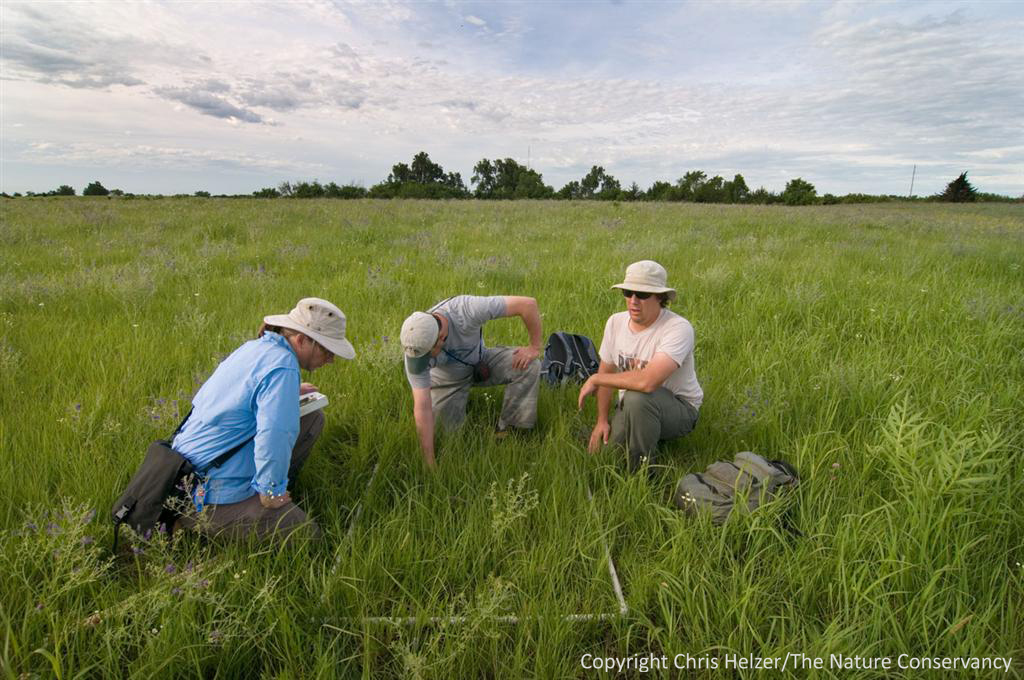
Biologists find it very difficult to evaluate prairies. It can be time consuming and expensive, and it is also difficult to design evaluation strategies that really measure the right things. (Biologists from the Illinois Natural History Survey collecting data on prairie plants)
What I’d really like to do is lay out some brief ideas in this blog post and get feedback from those of you who read it. I’m hoping that you’ll help me refine some of my thoughts, and that you’ll add to my short list. I’d really like to hear from landowners, as well as biologists. The overarching goal here is to come up with an array of measures that can help track how a prairie is doing. (Is the prairie maintaining or increasing its diversity of plants and insects? Are invasive species increasing or decreasing? etc.) The evaluation techniques need to be effective, but also accessible to biologists and non-biologists alike. They also need to be logistically feasible, and can’t take too much time or money. Should be easy, right?
Here are some ideas I have. I wouldn’t expect anyone to employ all of these, but rather pick and choose the ones that are most feasible for them, and the ones that best meet their individual objectives.
1. Measuring the number of plant species – at multiple scales. Counting plant species can be a challenge because of the relative difficulty of identifying plants (especially when they’re not blooming) and because the total number of species in a prairie can be very high. While it can be interesting to keep a comprehensive list of the plant species in a prairie, the primary value in doing that is probably to help the prairie owner learn plant identification. However, I think it can be more useful to count plant species at a much smaller scale – at the 1m2 or ½ m2 scale, for example. A landowner could walk around the prairie and stop in 10-20 random places and simply count the number of different plant species he/she sees within a plot frame laid on the ground. Identifying the species by name is not necessarily important – just counting the number of DIFFERENT species within the plot is the key. If grass species are too hard to separate, even just counting the number of broadleaved species would probably work. I’ve seen some interesting fluctuations in species numbers at this scale as a result of different management techniques, and I also think it can be a useful measure of long-term trends in plant community changes. Establishing permanent plots and counting the species in those each year would be even more valuable – but more difficult as well.
2. Tracking rare plant species. This can be very difficult to generalize because every rare plant species is so different. Prairie fringed orchids, for example, may bloom one year but not for the next several, and that may have almost no relationship to management. Some rare plants may occur in only a single patch each year, while others may be spread thinly across an entire prairie. I think it can be valuable, however, for a landowner to identify rare plants that are in their prairie, and find a way to track them – even if it’s as simple as walking the prairie during the time that plant blooms each year and estimating the number of individual or patches of plants. Keeping track of long-term (not short-term) changes in abundance can be important.
3. Tracking insect abundance/diversity. Because of the incredible diversity of insect species, their wild fluctuations in numbers from year to year, and the difficulty in identifying species, I’m having a hard time coming up with a reasonable method of tracking insect diversity over time. I like the idea of something simple – like putting out several types of sticky traps and counting the number of different-looking insects they find. I’m just not sure that would be very effective at detecting changes over time.
I wonder if it would be useful to select a couple of common wildflowers, one that blooms in the early summer and one in the early fall, and count the number of pollinators visiting them? A landowner could select 5 different plants and estimate the number of different species (and total number) of pollinators that visit each plant during a 10 minute interval.
Other ideas I have, but don’t really feel comfortable with, involve things like counting spider web numbers on dewy mornings, and the number of galls on goldenrod and other plant species. Bill Whitney, of Prairie Plains Resource Institute, has talked in the past about being able to hear the difference between a nice prairie and a CRP field because of the cacophony of insect sounds in a prairie, but I’m not sure I can translate that into an evaluation method! I could really use some help on this…
4. Counting Grassland Bird Species. Yes, I just wrote a blog post on how poorly grassland birds work as indicators of prairie quality. However, they CAN be useful when they’re only a part of a larger monitoring regime – and birds are relatively easy to identify. I think just counting the number of grassland bird species (those that actually nest in prairie vegetation) across a prairie can provide useful information about the functional size of a prairie and the types of available vegetation structure.

Red-winged blackbirds are one of the grassland breeding bird species least sensitive to prairie size.
An absence of grassland nesting birds can indicate that a prairie lacks the habitat size or distance from edges necessary to make them feel comfortable nesting there. Species such as dickcissels and red-winged blackbirds are some of the least sensitive to prairie size, and upland sandpipers, Henslow’s sparrows, and bobolinks are among the species generally considered to be more sensitive. Seeing only species that aren’t sensitive to prairie size could indicate that a prairie is too small or skinny for those species. It could also indicate that there are too many trees (or not enough area that is far away from trees) for those species to be present – and that might be something that management changes could fix.
However, birds also rely on habitat structure, so those needs have to be factored in when interpreting results of bird counts. For example, if a landowner only finds 3 species of grassland birds each year, and all three tend to nest in the same type of vegetation (short/sparse or tall/dense) the prairie is likely pretty homogeneous in terms of habitat structure. On the other hand, if there are about 3 species each year, but the species change from year to year, the prairie’s habitat structure type is probably changing from year to year as well. Ideally, it’d be nice to see more like 5-8 species of grassland breeding birds each summer, and to see them in different locations from year to year – indicating a shifting mosaic of habitat structure across the prairie, and adequate prairie size to attract those species. Yes, it’d be nice to know whether or not they’re successfully raising broods (looking for adults carrying food to young birds could help measure that) but measuring nesting success is generally well beyond the capacity of landowners, and most biologists as well.
5. Counting tracks in the snow. This obviously works better in northern prairies than southern prairies, but I like the idea of somehow incorporating tracks into evaluation. I don’t know that it has to be very rigorous to be useful. I’ve noticed here in Aurora that the small prairies right along the edge of town have very few tracks of mice and other small mammals on the snow compared to larger prairies further from town. My guess is that the lack of tracks in/near town is due to a combination of factors, including high predator pressure from cats, foxes, etc., frequent prescribed fires that burn all or nearly all of each prairie in the same year, and the lack of other nearby grassland habitat for mammals to recolonize from when/if the small populations in our small prairies disappear. It seems to me that seeing an abundance of tracks (of multiple species) during the winter is a positive sign that a prairie is providing habitat and relatively low threat levels for a number of species.

Can the tracks of small mammals in snow-covered prairies indicate how a prairie is doing?
6. Tracking Invasive Species. Just as with rare plants, appropriate methods of tracking invasive species (plants or otherwise) will vary widely by species. However, I do think it’s important to have some measure of whether high priority invasives are increasing or decreasing in abundance or impact. Some species, like trees, can be easy to track just by counting the total number or the number per acre. Others, like leafy spurge or crown vetch, may generally appear in relatively distinct patches, and can be tracked by counting and measuring the size of those patches in at least some portions of a prairie. Invasive grasses such as smooth brome, Kentucky bluegrass, or tall fescue can often be so ubiquitous that there is no point in trying to count stems or measure the extent of their occurrence (because they’re everywhere). With those species, the best measure of whether management is suppressing them or not may be to look at the species the invasives are impacting. In other words, if smooth brome is everywhere in a prairie, it’s unlikely that management will eliminate it from much of the prairie, but if plant diversity is increasing, that may mean that management is decreasing the dominance of brome in favor of other plants.
7. Journal of Observations/Photos. Finally, I strongly recommend that landowners – or any prairie manager – keep a journal of their observations each year. It’s hard to recollect exactly how abundant a species was 5 years ago, or how a particular management treatment affected habitat structure, without some notes (and preferably accompanying photos) to record that.
Journal notes don’t have to be extensive to be useful. If a landowner got a particularly good kill on Canada thistle last year, writing down what they did and why they think it worked can help them figure out why this year’s treatment didn’t work nearly as well. If there are an unusually high number of butterflies one year, jotting that down can help in future years when trying to figure out the impacts of management. Recording general weather patterns (“it was a hot and dry summer”) can help as well. Maybe the butterflies were abundant because of the spring weather, rather than management, for example.
Photography can be helpful as well. Photographs that accompany journal observations can help clarify memories of those observations later. Some people find that taking photos from the same place, and the same time, each year can help show patterns. I think that in some cases that can be useful, but it also takes discipline and time, so it may or may not be worthwhile for all landowners. In addition, photo points can help indicate whether or not trees are becoming more abundant, or the blooming abundance of certain flowers, but many other changes don’t show up well in photos.
.
Please help me revise and add to these. You can leave your ideas below under “comments” or “reply” so that others can respond to your ideas as well as mine. Thank you!


