
Snow and Light

We finally got our first measurable snowfall (4-5 inches?) of the year here in east central Nebraska.  I took my camera for a walk at our family prairie yesterday evening, enjoying the way a little snow really transforms a landscape.  I found and followed tracks of coyotes, mice, birds, and deer, and flushed flocks of meadowlarks and tree sparrows.  As the sun started to drop quickly toward the horizon, I wandered through one of the areas we grazed particularly hard last summer, enjoying the broad expanse of whiteness, punctuated by scattered plants poking up through the snow.
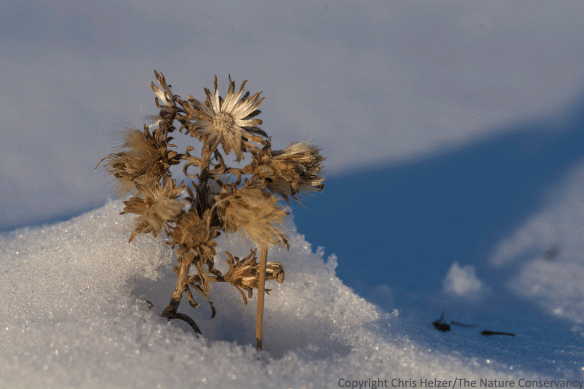
Heath aster (Aster ericoides) protrudes from a tiny mound of snow.

I spent the next half hour mainly lying prone on the snow, tripod legs splayed flat to the ground, photographing heath aster and sideoats grama plants, and having a great time.  As you look through these photos, you’ll be able to see how the quality and color of the light changed as the sun approached the horizon.  Shadows became much less stark and more blue in color, and the plants and snow both reflected increasingly golden-orange light from the setting sun.
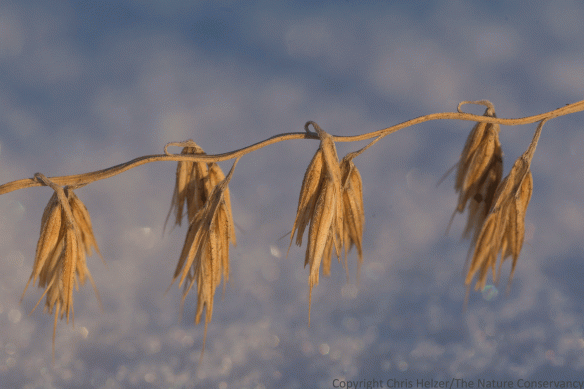
Sideoats grama (Bouteloua curtipendula)

More sideoats

More heath aster

Final sideoats photo, as the sun was right at the horizon.

The opportunity to watch sunrises and sunsets is a big perk of living on the Plains, where we get an unobstructed view of the sun from horizon to horizon, without pesky trees or mountains in the way.   On many nights, the combination of a low sun angle, expansive sky, and scattered clouds can provide spectacular views.  Other times, however, the best way to appreciate a setting sun is to turn and look in the opposite direction at the changing colors of light and shadows.

Merry Christmas everyone!

Photo of the Week – November 16, 2017

Most of us don’t think about ants very often unless they’re marching across our kitchen counter (or up our leg).  That anonymity isn’t their fault, it’s ours.  Ants play major roles in ecoystems, and their biomass in prairies can rival that of bison, so if we’re not paying them sufficient attention, that’s on us.

Ants on upright prairie coneflower (Ratibida columnifera) – The Nature Conservancy’s Niobrara Valley Preserve, Nebraska

I took the two ant photos in this post at the Niobrara Valley Preserve back in June of this year.  As is usually the case, I spotted the ants only because they happened to be crawling around on some flowers I was looking at.  Ants are often spotted on flowers, especially those that have easily accessible nectar that helps satisfies ants’ attraction to sweets.  While they don’t usually do much good as pollinators, ants might provide some protective services for plants by helping to keep herbivores away.

Ants spend most of their time underground, of course, where it’s easy for us to forget about them.  When they’re not in their tunnels, they still aren’t all that visible unless we’re looking for them.  Regardless, they are major predators in prairies, collaborating with each other to take down prey much larger than they are.  In addition, ants are scavengers, major forces in nutrient cycling, and important seed dispersal agents for some plant species.  Ants can also steal food and workers from each others’ colonies, “herd” aphids and harvest their honeydew and meat, and are themselves an important food source for other animals.  We should probably stop ignoring them.

Golden early morning light shown on this ant as it crawled down the stem of an upright prairie coneflower plant.

Most prairies probably have around 30 species of ants living in them, which is more local diversity than is found in grassland nesting birds, which we pay infinitely more attention to.  In addition, if we lost all our grassland birds tomorrow, it would be sad, but I’m pretty sure it would have much less impact on prairie ecosystems than if we lost our ants.

Let’s try to keep them both around, shall we?


Here are some previous posts I’ve written about ants if you feel like reading a little more about them:

The Density of Ants in Prairies

Ants in the Sun

Killer Thistles