A new study sheds (a little) light on a slice of grassland bird life we know very little about.
We know a lot about grassland birds. Sure, there’s a lot we don’t know too – but we certainly know a lot more about grassland birds than we do about leafhoppers, nematodes, or most other groups of grassland species. So how is it possible that we know almost nothing about what kinds of habitat grassland birds need during migration?

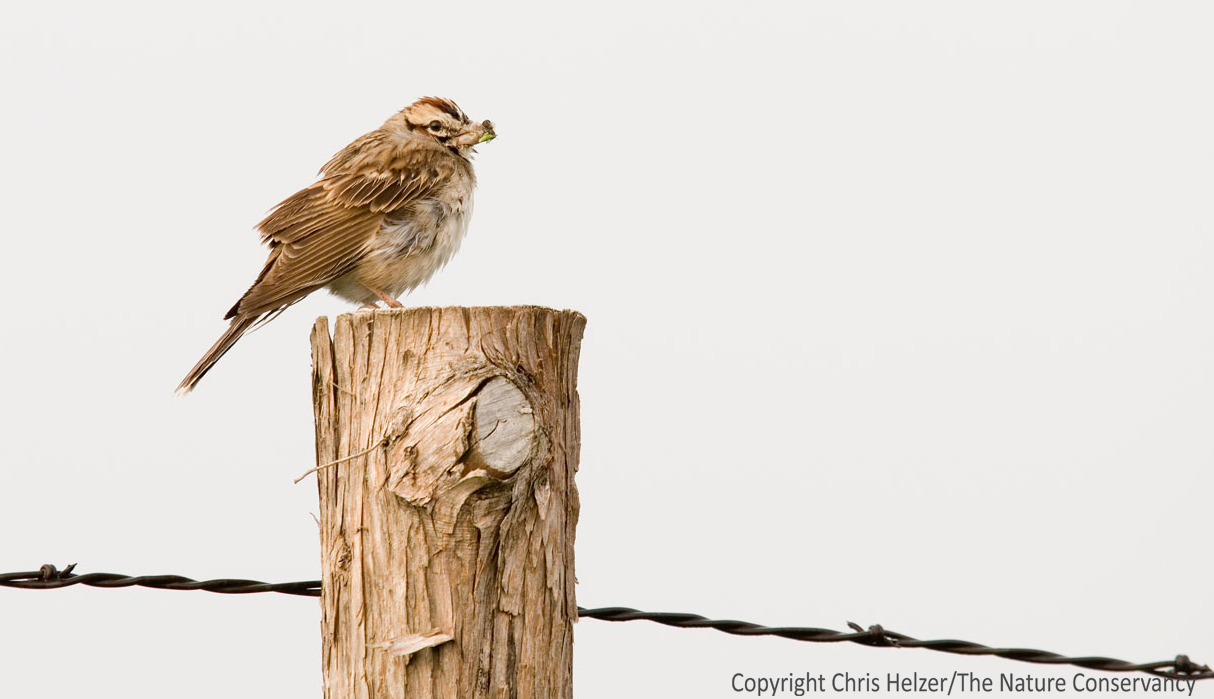
Do lark sparrows look for the same habitat during migration as they use for nesting? We really have no idea.
I’ve wondered about this for a long time – ever since I did my graduate work on grassland birds back in the 1990’s. At that time, I was one of a growing number of researchers investigating the importance of the size and shape of prairie habitats to grassland birds. We now know that prairie size and shape are very important, and more recent studies are even showing that the amount of grassland in the neighborhood around a particular prairie influences whether or not grassland birds will nest there or not. As we continue to refine our understanding of breeding habitat needs, however, we’ve made no significant progress at all on what grassland birds need for habitat during migration – even though we know that migration is an incredibly stressful part of a bird’s life cycle. It’s reasonable to wonder, in fact, if population declines in many grassland bird species could be more strongly tied to migratory and winter habitat than to breeding habitat.
For more than a decade, the only available published information on habitat use by grassland birds outside of their breeding areas has been a very nice study of winter habitat use in south Texas from 1999. That research found grassland birds using a much broader array of habitat types than expected, including brushy and even woodland habitats. The authors, however, were quick to point out that just because birds were using particular habitats doesn’t mean that those habitats were preferred, and there is no data on how well birds were doing in those habitats. Still, it’s intriguing to think that bird species that are so picky about finding big open grasslands for nesting might not hang around in the same habitat types at other times of the year.
Just last week, I talked to one of the authors (Patrick Doran, The Nature Conservancy – Michigan) of a new paper that gives us our first real peek into the migratory needs of grassland birds. Bruce Robertson, Doran, and others conducted a study of how grassland birds utilize grassland and biomass crops as migratory habitat as part of a larger project to assess biomass crops and their potential impact on birds in Michigan. Their data on bird use of switchgrass fields and prairies during migration showed that obligate grassland birds (species that rely solely on grasslands for breeding habitat) were positively tied to large grassland patches and tended to stay away from wooded areas. In addition to those two variables, obligate grassland birds also tended to use grasslands with patchy vegetation structure (a mixture of tall and short structure) more than uniformly tall/dense grass.
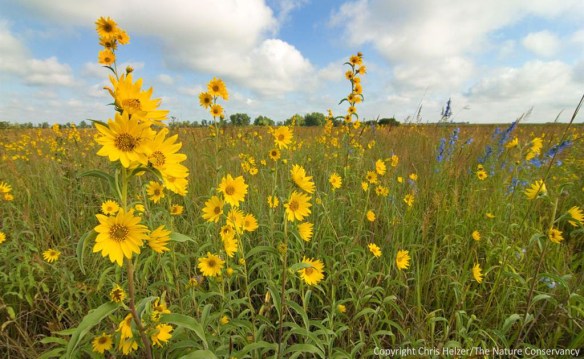
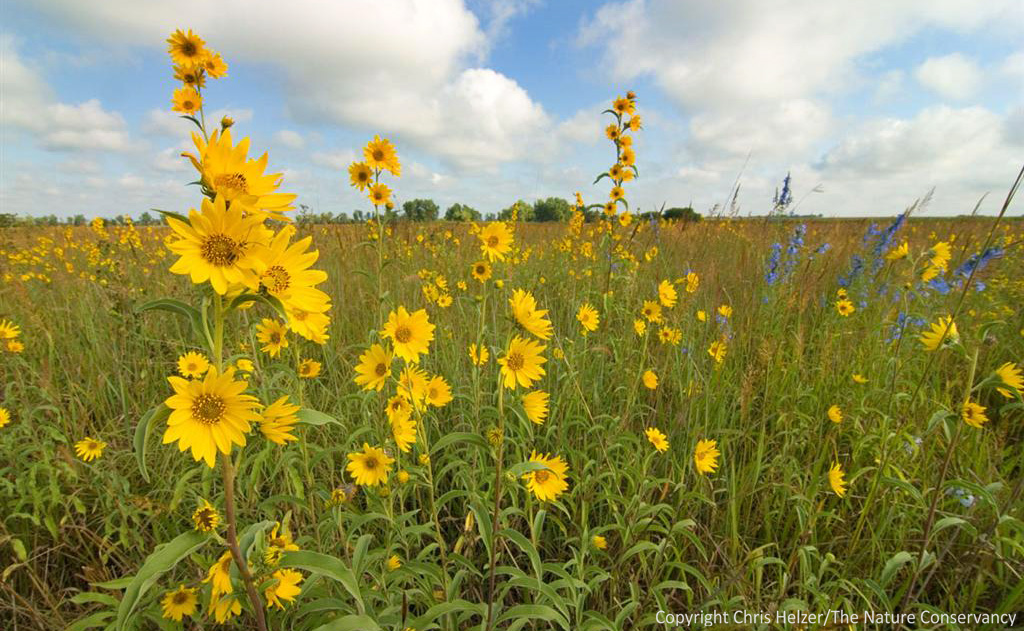
Large prairies with heterogeneous vegetation structure may be favored by migratory grassland birds. In August and September, as many grassland birds are moving south, both seeds and insects are abundant in many prairies. Is one food source more important than the other? Is either important? Or are birds simply looking for a safe place to rest before continuing south?
This project was a great first step, but like all good research projects, it left us with more questions than answers. What are those grassland birds using the habitat for? Are they feeding significantly while there or just resting? If they’re feeding, are they eating insects or seeds – or both? Do grassland birds look for the same habitat structure (e.g., tall/dense or short/sparse, etc.) when choosing migratory stopover habitat as they do when choosing breeding habitat? Knowing the answers to those questions would sure be helpful as we think about how to manage prairies. For example, assuming habitat structure is important to grassland migrants, decisions whether to burn a prairie in the fall, early spring, or late spring could have very big implications for migratory birds.
One of the most interesting findings in the study by Robertson and his colleagues is the suggestion that grassland patch size might be important for migratory grassland birds. Woodland migrants have been more extensively studied than grassland birds, and while the picture is not yet clear, it doesn’t appear that birds that require large woodlands for breeding habitat necessarily require the same for migratory stopover habitats. As an example, a study in eastern South Dakota found that neotropical migrants seemed to use small farmstead woodlots and large Missouri River woodlands interchangeably. Again, there are still lots of questions still to answer (e.g., are there differences in stress levels or weight loss between habitat types?) but that apparent ability for woodland birds to feed and roost in small woodland habitat during migration has important implications for conservation. If larger woodlands were required for migratory stopover sites, our challenge to provide appropriate habitat would be much more difficult – especially in landscapes like those in North America’s Great Plains. It looks like we might not get off so lightly in the case of grassland birds. If this recent study is representative, the future of grassland bird populations may hinge on our capacity to increase the number of large (how large is large enough??) grassland habitat patches in our most fragmented landscapes.
I’m hoping that the study by Robertson and his colleagues will spawn others like it. However, studying migratory grassland birds is difficult. How many of you are comfortable identifying little brown grassland birds when they don’t sing – and when your only look at them comes as they are darting away from you and diving back into the grass? Regardless of the difficulty, though, we really need the information, and that information doesn’t have to come soley from academic research. Any birdwatcher or prairie manager could add critical information to what we know by simply keeping track of the grassland bird species they see during spring and fall migration, and noting any habitat characteristics they can (e.g., prairie size, distance from trees, habitat structure – tall, short, dense, sparse). At worst, sharing field notes with each other might give us at least something to go on as we think about management, and at best could provide pilot data to help design more effective research projects than could be designed by starting from wild guesses.

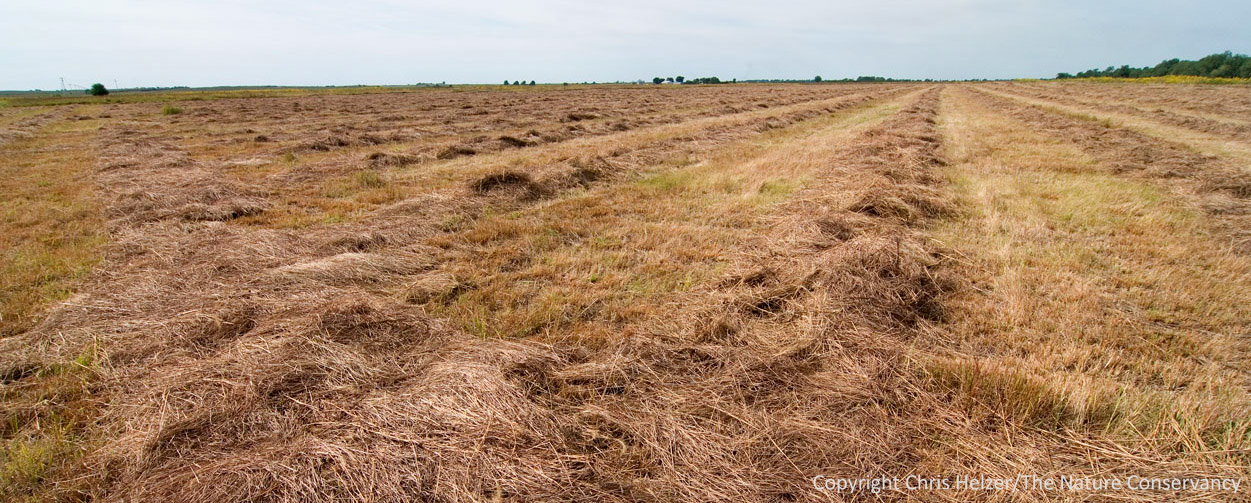
It seems reasonable to expect that late summer haying reduces the quality of prairies for migrating grassland birds. On the other hand, maybe not?
Our Platte River Prairies are located just to the south of an incredible grassland landscape – the 12 million acre Nebraska Sandhills. I sometimes wonder about the birds that nest there. They aren’t lacking for breeding habitat quantity or quality, as far as we know, but they’re only in those big sandhill prairies for a small proportion of their year. In order to survive to the next breeding season, those birds have to make their way south through some very fragmented landscapes, survive the winter in what can be perilous southern habitats, and then work back north through those fragmented landscapes again. Our Platte River Prairies are probably among their first stops heading south and their last stops heading north. Are there management practices that we’re doing that are contributing positively or negatively to the success of those migratory birds? We really have no idea. That makes me uncomfortable.
I imagine the birds are a little nervous too.


 The Prairie Ecologist