A guest post by Anne Stine, one of our Hubbard Fellows:
I had a pretty good foundation in forest ecology leaving graduate school, but I’ve really developed my forb and grass ID skills since starting work here in Wood River. Prairie ecology has grown on me. I was trying to explain it to a forest-loving friend: once you know the local plants, (that is, you see their uniqueness and their ecological and historical roles), you get a better feel for a place.
One of my favorite stewardship tasks is harvesting native seeds. The best assignments are for hard to find plants that require some knowledge of their life history to locate. I really enjoy the scavenger hunt and foraging aspects of searching for less widely distributed species. I also had one of my major botanical victories seed harvesting on the prairie.

Prairie seeds drying in our seed barn. Platte River Prairies, Nebraska. Photo by Eliza Perry, Hubbard Fellow.
I was driving around, looking for Canada milkvetch (Astragalus canadensis), when I spotted a familiar stalk sticking up in the pasture. I remembered it as a plant that had ridden shotgun in the truck with my field supervisor for a few weeks- clearly someone had harvested it. I just didn’t know what it was. Its flowers were now gone, only the long brown stalks and seed heads remained. The leaves looked like a cross between a strawberry and a prairie rose (Rosa arkansana). I collected the seeds and took the stalks home to identify. I was excited to discover that the plant in question, tall cinquefoil (Potentilla arguta), is indeed in the rose family! Ecologists find their thrills where they may…
As a natural history geek, I can’t help but delight in picking up random facts about prairie plants. For example, rocky mountain bee plant (Cleome serrulata) is a glorious nectar source for pollinators in mid-summer. Doves eat the seeds in the fall. Its leaves and seeds were also eaten by some Native Americans, “in spite of its strong smell” (“Grassland plants of South Dakota and the Northern Great Plains”, Johnson & Larson 1999). It takes all kinds, the authors seem to say. I didn’t find the odor especially displeasing, but evidently even botanists have personal opinions.
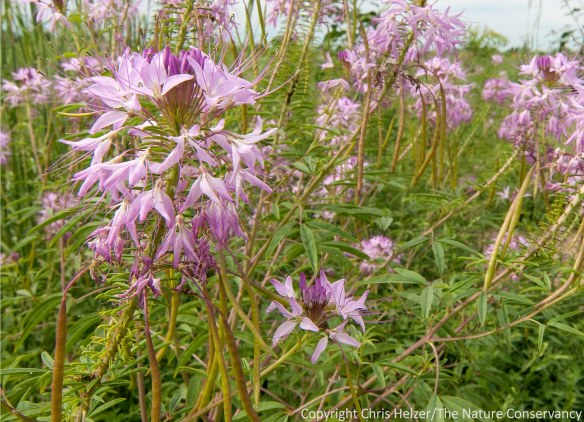
Rocky mountain bee plant. Platte River Prairies, Nebraska.
Foxglove penstemon (Penstemon digitalis) is one plant whose smell I do find distasteful, and its fragrance garnered no mention. This wildflower is not widespread, but neither is it difficult to find. You smell it before you see it. Interestingly, it’s the seed heads and red stalks that stink, not the flower. I left a bucket in the cab of the truck while I harvested other things, and when I came back the cab was filled with flies. They followed the bucket to the truck bed when I moved it.
Most of the seeds we collect this year will be used in over-seeding projects, intended to increase the diversity of prairies we manage. Over-seeding is one strategy we can use to boost a site’s forb population without tearing up the prairie and starting over. Building a native seed bank of local ecotypes is a useful technique to increase your chances of success in prairie restoration. It’s not bad work either, if you can get it.