
Hubbard Fellowship Blog – Hummingbird Moths

A guest post by Anne Stine, one our Hubbard Fellows.  All photos by Anne.

I adore hummingbirds, and I sometimes bemoan their rarity in my new home here on the Platte.  I grew up thinking they were better than fairies- they are cute, ferocious, and they migrate long distances despite their small size.  While hummingbirds themselves are scarce in this part of the country, “hummingbird moths” are abundant.  Hummingbird moths are so-named because they hover and fly like hummingbirds, sip nectar, and are approximately the same size as hummingbirds. I never noticed hummingbird moths growing up, so since moving here it is as if hummingbirds dropped out of the system and were replaced by enormous insect imposters.

Hummingbird moths, or sphinx moths, are large, furry, and active in the day.  Their caterpillars are called “hornworms” because they have what looks to be a long horn extending off their rumps.  Most of these larvae have multiple potential food sources.  Around here, likely food plants include four o’clocks, wild grapes, elms, and evening primroses1. While some species of hornworms eat crops like tobacco and tomatoes, they are infrequently a pest requiring treatment.  In fact, with their propensity to eat undesirables like Siberian elms and weedy species like four o’clocks and evening primrose, one could even characterize them as beneficial.

Hornworm

Hornworm larvae, possibly of white-lined sphinx moth?

There are two broods of sphinx moth annually, one emerging in spring and another in fall2.  Hornworms pupate in shallow excavations in loose soil1.  In the past few weeks I’ve encountered hornworms attempting to dig their burrows in our driveway at the crew house. Of the adults, I see the white-lined sphinx moth (Hyles lineata) most frequently.  Twice they have been attracted to my brightly colored clothing (pink shirt, orange shirt).  The moths hovered around investigating me for nectar reserves.  I’ve seen them feed on a variety of flowers, so they must not be too picky.

Hummingbird moths are an intriguing substitute for hummingbirds. Hummingbird moths are widely distributed across North America, so it would be interesting to learn if their role as pollinators takes on a greater importance in areas where hummingbirds are absent.
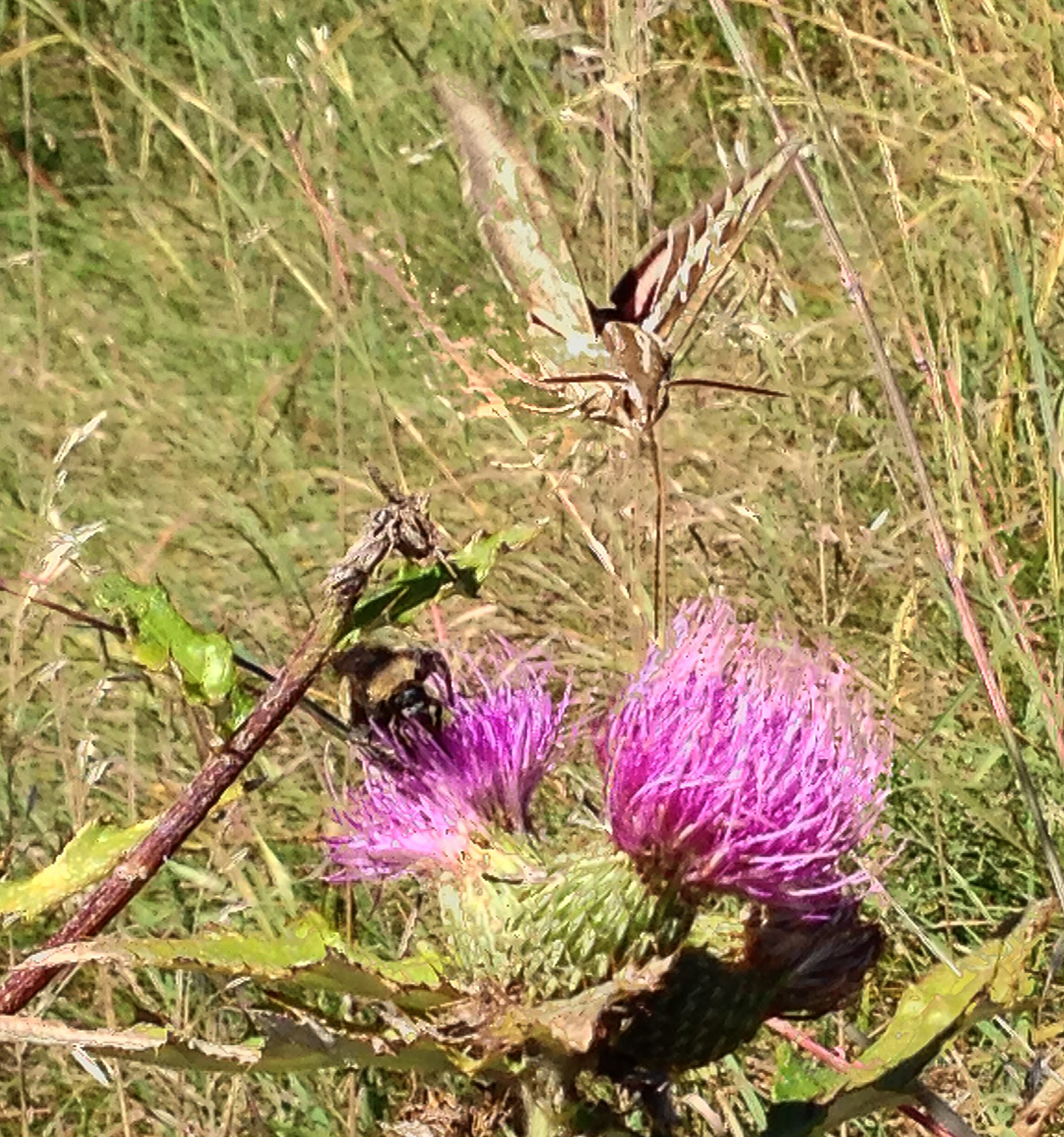
Front

White-lined sphinx moth, front view.

.
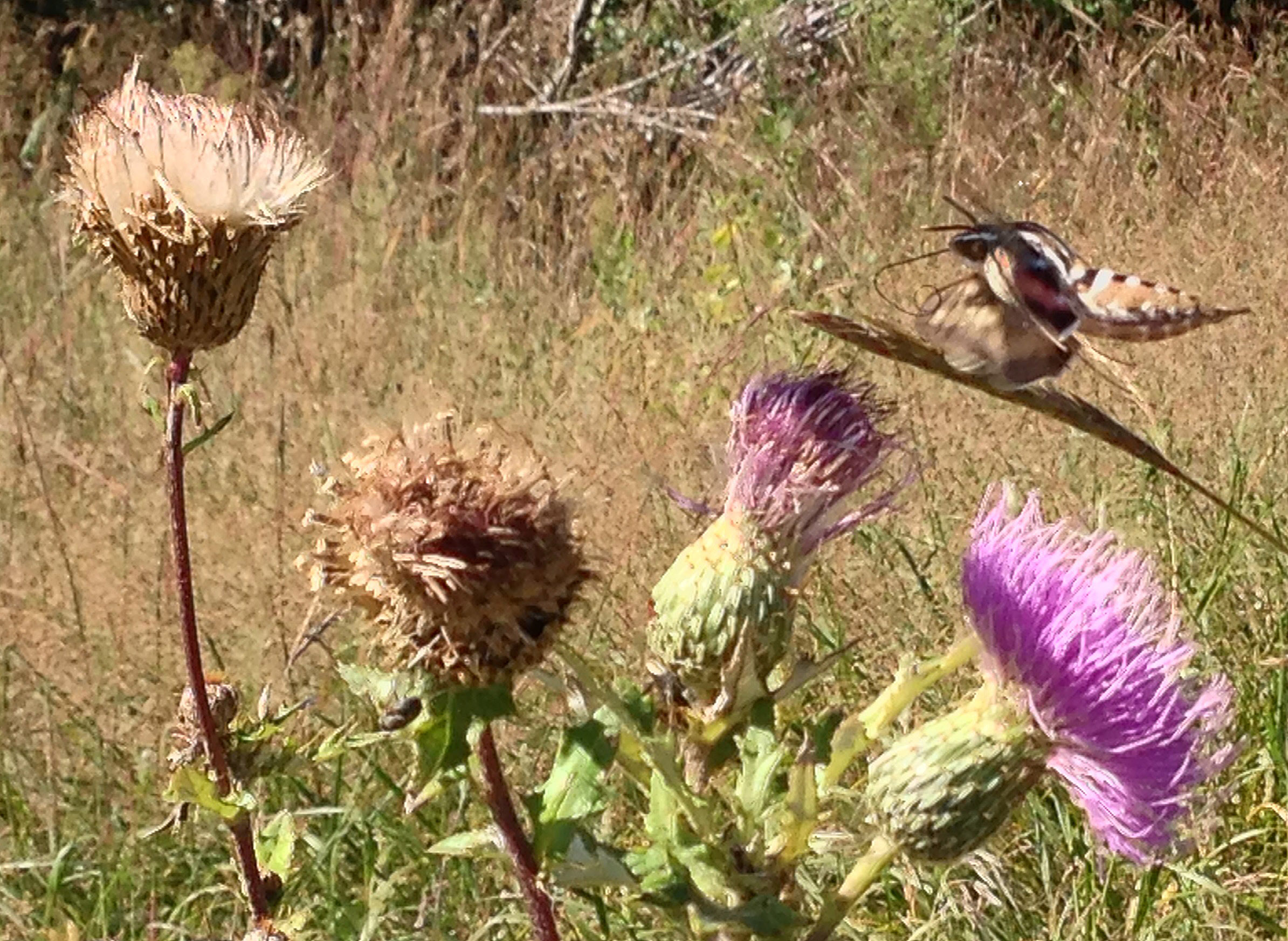
side

White-lined sphinx moth, side view, proboscis unrolling.

.
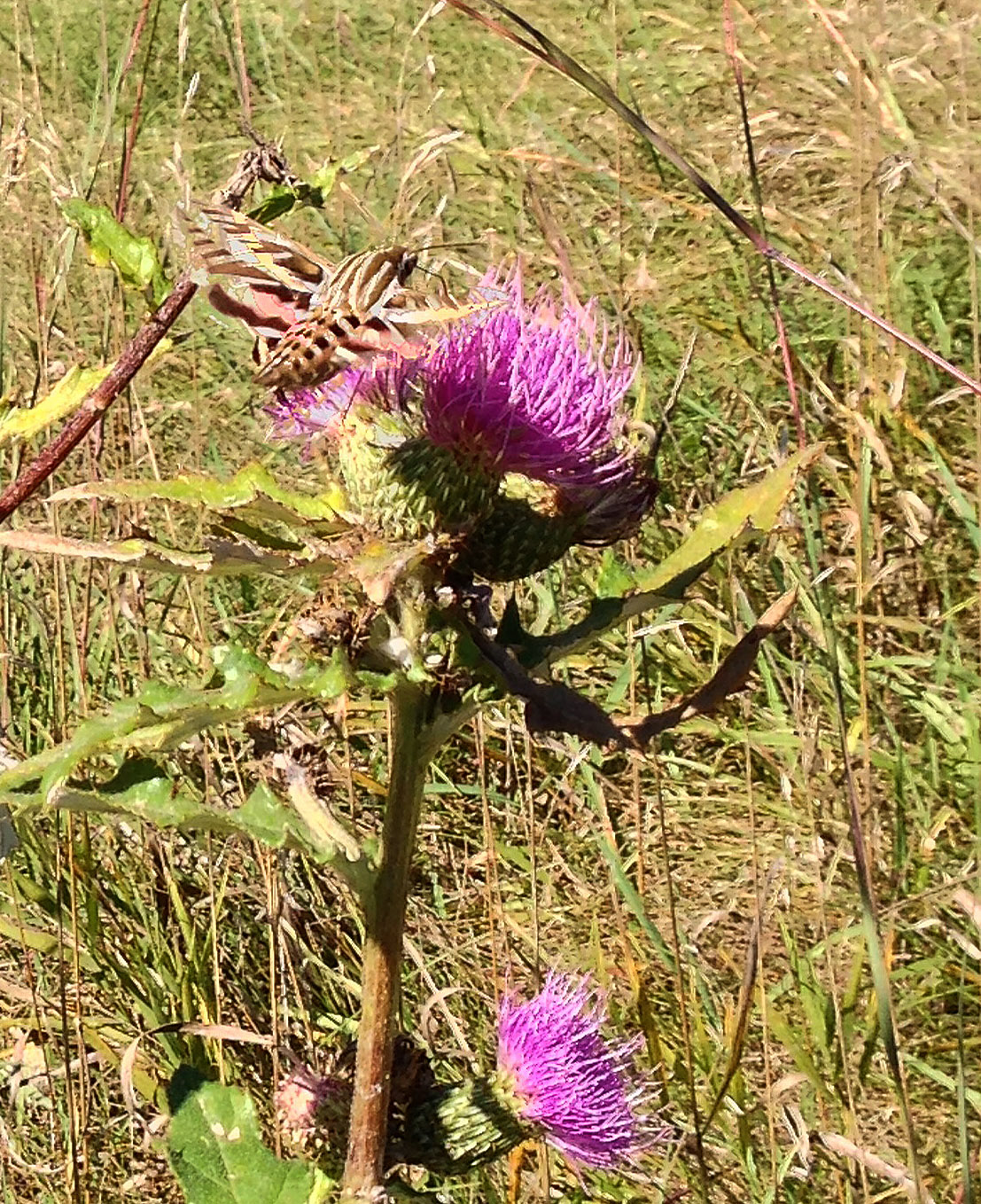
from back

White-lined sphinx moth, back.

1  http://www.butterfliesandmoths.org/species/Hyles-lineata

2 http://puyallup.wsu.edu/plantclinic/resources/pdf/pls48sphinxmoths.pdf

Isn’t it a little late to be nesting?

As you might remember, my Photo of the Week last week was an image of a fledgling meadowlark I’d found in mid-September.  At the time, I’d talked about how surprised I was to see such a young bird so late in the season.  Well, last Friday, Eliza Perry, one of our Hubbard Fellows, called me to say she’d just found a nest full of tiny birds – did I want to come take a look?  Of course I did.

American goldfinch chicks sit in a nest about three feet off the ground in a tall thistle (Cirsium altissimum) plant.  Platte River Prairies, Nebraska.

American goldfinch chicks sit in a nest about three feet off the ground in a tall thistle (Cirsium altissimum) plant. Platte River Prairies, Nebraska.

I’m pretty sure what Eliza found was an American goldfinch nest.  The bills and markings on the birds look right, and we spotted an adult goldfinch nearby.  However, the best supporting evidence was that the nest was located in a thistle plant (a native thistle species, by the way) and had thistle down in the nest cup.  There is a strong tie between American goldfinches and thistles.  Unlike most other bird species which feed their young on insects, goldfinches instead feed them regurgitated seeds – especially those of thistle plants.  In fact, they often delay their nesting until those thistle seeds have ripened.  Here is a link to photographer/naturalist Stan Tekiela’s post on this topic, if you’re interested in learning more about the topic.

These birds are even further behind the meadowlark in their development, and it’s already getting pretty cold overnight, so the nestlings’ chances for survival might seem slim.  Of course, the difference between the meadowlark and the goldfinches is that the goldfinches have adults around to help them.  Both have a challenging fall and winter ahead of them, but nothing others of their species haven’t dealt with countless times before, I guess.

A better view of the nest placement within the tall thistle plant.

A better view of the nest placement within the tall thistle plant.

Thanks to Anne Stine, our other Hubbard Fellow, who graciously helped hold equipment for me as we photographed the nest.  Because of the very bright early afternoon sun, I had Anne hold a diffuser near the nest to reduce the harshness of the sunlight while I held a small flash unit to better illuminate the birds.  We worked quickly and got out of the way so the parents could resume their feeding duties.