
Photo of the Week – July 20, 2017

Wow, this was a hot week.  About the time I stopped hiking hills and collecting data at the Niobrara Valley Preserve yesterday, my truck’s thermometer said it was 111 degrees Fahrenheit.  Sure, it was really hot, but I figured the truck was probably estimating a little high until Kim said she looked at the official weather report from Valentine (nearby town) and it said the high recorded temperature there was 112 degrees.  That’s pretty hot for northern Nebraska.

One of the reasons I was trudging through the hills in the heat was to look for lizards, but I’m pretty sure they were smarter than I was and were hanging out in cool shady places, because I didn’t see any after about 11 am.  The insects in the prairie seemed less affected by the heat, however, and I saw lots of them, including quite a few gorgeous red assassin bugs.

These assassin bugs didn’t seem to be affected by the extreme heat. I spotted them near where I parked my truck on a hill and they were still there over an hour later when I finished walking my transects.

Wasps also seemed to be particularly abundant this week, especially on the blossoms of sand milkweed and other wildflowers.  I enjoyed looking at the diversity of wasp species, but my enthusiasm diminished very suddenly when one of them (I’m pretty sure) stung me in the back.  I think it must have gotten itself wedged between my pack and my back.  It wasn’t MY fault it got stuck there, but I now have a large ugly welt anyway.  Man, that hurt!  A lot.

The day before I got stung, I spotted a wasp (probably not the same one) in a patch of bare sand, and thought about photographing it.  I glanced down at my bag just long enough to extract my camera, but when I looked back the wasp had moved a few feet and was now grappling with one of those red assassin bugs.

Just because the wasp is on top of the assassin bug doesn’t mean it was getting the upper hand, as you’ll soon see.

Actually, grappling is probably a misleading term because it looked like a pretty one-sided battle.  After a half minute or so, the assassin bug flipped the wasp over and it was clear who was winning.

Getting stung by a wasp on a super hot day wasn’t fun, but this wasp was having a worse day than I was having.  You can see the assassin bug’s proboscis inserted into the abdomen of the wasp, and the bug’s toxin is apparently pretty fast-acting because the wasp was done twitching by this point.

I photographed the scene quickly and then got up to leave.  I must have moved too suddenly for the assassin bug’s liking, though, because it took off and flew a few yards away, leaving the wasp behind.  Even after I kept moving away and left the area alone for a few minutes, the assassin bug didn’t return, so I came back and took one final photo of the dead wasp.  I’m hoping maybe the bug returned to finish its meal later.  I feel bad…

The dead wasp.

I think the wasp pictured above is a male, though I’m not confident of that.  I don’t see a stinger, anyway.  While I was driving home yesterday (with the air conditioner blasting pleasantly), I wondered to myself whether or not assassin bugs can tell male wasps from female wasps.  Apparently wasps can tell the difference, so it doesn’t seem completely crazy that other insects could as well.  It would sure be handy to know whether you’re about to attack a stinger-wielding female or an unarmed male…

Everyone thinks about this kind of thing while they drive, right?
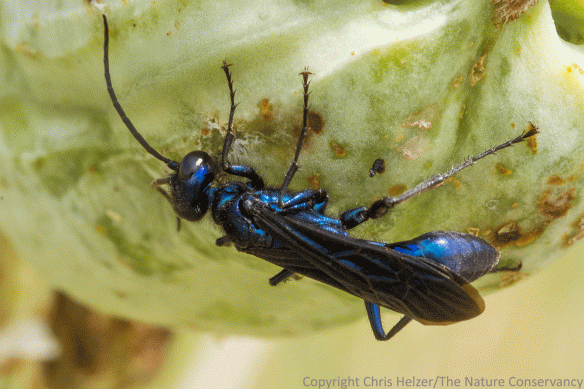
This wasp hung out on a yucca pod just long enough for me to photograph it.

I’m definitely a generalist, rather than a specialist, when it comes to ecology and natural history.  I know a little bit about a lot of species rather than a lot about a selected group.  If I had to narrow myself down, though, wasps would be a group of organisms I’d like to study.  I mean look how cool the blue one above is!  Or maybe I could study assassin bugs.  They’re pretty amazing too.  Or moths…  Or grasshoppers…  Or flea beetles?

Maybe I’d better stick to being a generalist.

Photo of the Week – May 26, 2017

Shell leaf penstemon (Penstemon grandiflorus) is one of the showier wildflowers in the Platte River Prairies during late May and early June.  It is most often found in dry soils and where the surrounding plants aren’t overly competitive.  We often see populations increase after droughts and grazing events and then decrease again as grasses recover their vigor in subsequent years.

Shell leaf penstemon has big showy flowers that are just the right size for bumblebees, but are used by other pollinators as well.

For years now, I’ve been periodically coming across patches of shell leaf penstemon plants that have been decapitated by a rabbit or something.  That wouldn’t be surprising except that the top of the plant is usually just lying next to the plant uneaten!  There is a single angular slice in the flowering stem, usually well below the bottom-most flower, and the entire flowering stem just (apparently) falls to the side.  I’m at a loss to explain this.  I don’t know if an animal is doing this to lick the juices out of the stem for some reason?  I honestly can’t think of any other good reason for what I’m finding – not that juice licking is a very good reason…  I’d love to hear from someone who knows the answer to this.

Yesterday, Nelson (our land manager) and I were touring a colleague from Wisconsin around one of our prairies and found a patch of decapitated penstemon.  As we were discussing the mystery, Nelson grabbed one of the stems and saw what he thought might be a black stem-boring insect.  As we peeled apart the stem to see it, it turned out to be a small black wasp or bee that Nelson had apparently squished when he picked up the stem.  Before I could get a very good look, the wind blew the deceased insect off the stem and down into the grass at our feet.  I didn’t worry too much about it, but as we continued to peel open the stem, I wished I’d tried to recover the insect.

Here is the detached flowering stem Nelson picked up.

The penstemon stem was stuffed full of flies.  Flies of all shapes and colors.  There were more than 20 of them, separated intermittently by wads of dried plant material.  Based on what we found, I guessed the insect we saw, and then lost, must have been a wasp and that it was laying eggs in the stem and provisioning them with flies.  I took the stem home to photograph it and then sent the photos to my friend Mike Arduser, who knows everything about bees, and an awful lot about wasps and other insects as well.

Here is a close-up photo showing the diversity and abundance of the flies jammed into the stem. I looked, but didn’t see the eggs that must have been there.

Mike said the insect was very likely a wasp in the genus Ectemnius that usually uses flies as the food source for its larvae.  They frequently excavate the pith out of twigs and other stems.  Based on the behavior of other wasps, I assume the flies were paralyzed, not dead, and that there was an egg laid with them, but I didn’t actually see any eggs.  According to Mike, Ectemnius wasps have a kind of “cuboidal” shaped head and the various species are between 6 and 14 mm in size.

I’m very certain the wasp wasn’t responsible for cutting the flowering stem off the penstemon, but it was pretty interesting to see something taking advantage of the destruction.  I didn’t see any other stems with similar nests in them, but I’ll sure keep an eye out for that in the future…

Now if I can just figure out who or what is decapitating our penstemon plants, I’ll be satisfied.  Until the next mystery comes along.

PLANT GAME RESULTS:

On the whole, you did pretty well on the plant game this week.  I tricked most of you on the first one, but the majority of you guessed correctly on the second and third questions.

On the first question, 161 people voted (as of this afternoon) and almost 50% chose Candy Lovegrass as the fake name, which is wrong – it’s a real plant.  Look it up if you like.  The actual fake name in that list was Clark’s Blisterpod, which came in 3rd at 22%.

More people (212) were bold enough to guess on the second question, and 50% of you were correct that Bully Pulpit was the fake plant.  However, about 1/3 of you guessed Beefsteak Plant, which sounds fake but is real – and invasive in at least some places/situations.

On the third question, 172 people voted, and 47% correctly identified Slipper Cherba as a fake plant name.  Autumnal Water Starwort and Beaked Ditchgrass were second and third in the voting with 25% and 21%, respectively.  I really thought more people would go for Beaked Ditchgrass, but what do I know?

Thanks for playing my goofy game.  The hardest part of putting it together is coming up with names that are weirder than the real ones…