Photo of the Week – April 13, 2017

Prairie dandelion, aka prairie false dandelion (Nothocalais cuspidata) is different from common dandelion (Taraxacum officianale), the one most people are familiar with in yards and weedy places.  Prairie dandelion is a native perennial wildflower, mainly restricted to dry unplowed prairies, while the other dandelion is a non-native species that seems able to pop up just about anywhere.  I’m actually a fan of both species, and don’t mind seeing common dandelion in our prairies, especially as an important early-season pollinator resource, but it’s always a treat to find populations of prairie dandelion.

Prairie dandelion at Gjerloff Prairie.

Prairie dandelion has a similar appearance to common dandelion, but there are some pretty strong differences as well.  The flowers are much larger, for example, and the leaves are long and don’t have the large serrations that common dandelion leaves have.  Prairie dandelion is considered to be a rare plant in many eastern prairie states, but is found across much of Nebraska – though it is certainly nowhere as abundant as common dandelion.

Close up of two prairie dandelion flowers.

While I was photographing prairie dandelion flowers this last weekend, I noticed a small grasshopper nymph feeding on the petals of one of the blossoms.  I took a few photos of it and moved on.  A few minutes later, I walked back past the flower and noticed the grasshopper had moved into a more visible location, so I took a few more photos of it.  When I got home and looked through the photos, my first instinct was that the second set of photos were better because I could see the whole grasshopper and it was better framed within the image.  Upon more reflection, however, I’m not sure.  Since some of you enjoy voting on this kind of thing, I decided to include both images, and you can tell me if you have a preference between them.  Just leave your vote in the comments section below.
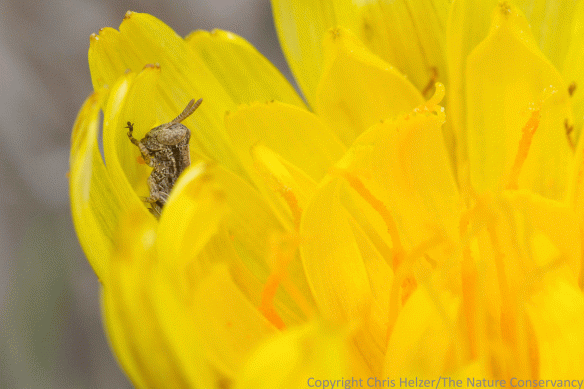
Grasshopper nymph #1

Grasshopper nymph #2

It was a pretty tough winter for prairie photography around here; not much snow, and not even a lot of ice to photograph – with the exception of one notable ice storm.  I’m really glad that flowers and insects are finally breaking up the monotony of drab brown prairie vegetation.  It should be a fun spring.

Spring Obsession

Man, I sure do love Carolina anemone (Anemone carolinianum).  It’s such a beautiful plant in such a compact package.  We have a few plants blooming in our prairie garden at home, but last weekend, I went looking for more of them at Gjerloff Prairie, owned and managed by Prairie Plains Resource Institute.  I don’t visit the prairie often enough to know for sure, but it sure seemed like there were many more patches of anemone than I’d seen in previous years.

There are both blueish-purple and pale lavender-white blossoms at Gjerloff, and sometimes the two were mixed within the same patch of flowers.  Interestingly, the white ones were easier to see at a distance then the blue ones, but both hide pretty well.  I often didn’t see them until I was within 5-10 yards.  They’re short, you see…

While it is a perennial plant, my limited experience tells me Carolina anemone flourishes when the surrounding vegetation is short.  Of course, that could be a function of visibility too, but I’m guessing it doesn’t bloom well when covered by thatch and tall skeletons of plants from the previous season.  (I’d be interested to hear from others about what kinds of response to management they’ve seen with this species.)  In our Platte River Prairies, I most often see them after a summer fire or after a year of intensive grazing.  The portion of Gjerloff prairie I found them in this year was burned and grazed pretty hard last year.  Other plant species seemed to be enjoying the abundant light in the grazed area as well, including numerous rosettes of ragwort (Packera plattensis) and quite a few individuals of prairie dandelion (Nothocalais cuspidata), which was just starting to bloom.  …More on prairie dandelion in an upcoming post…

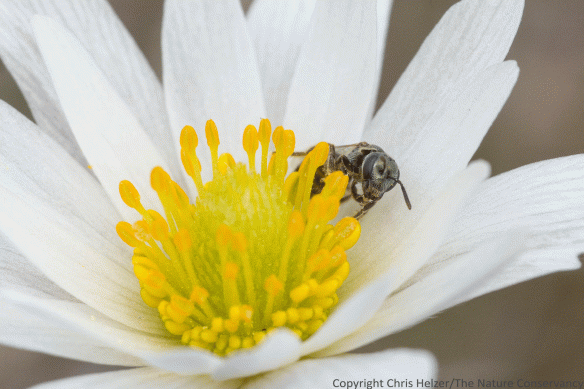
Several different small bee and fly species were feeding on the pollen of the anemone plants last weekend, including the gorgeous little Lasioglossum species shown above.  I’m guessing the anemone is a very welcome resource for those early-season pollinators.  Carolina anemone makes its pollen easy to access, and when you find one plant, there are usually quite a few more right next to it.  That’s pretty handy for a hungry bee or fly searching for something to eat across a still-mostly-brown prairie landscape.

There are lots of great spring wildflowers, but I have to say the little Carolina anemone is my favorite.  At least this week.  Although that prairie dandelion is sure cute too…  Oh, and how can you not like pussytoes?  And violets…  Hmm.