Photo of the Week – August 23, 2013

As we’ve been looking for bees lately, I’ve noticed the abundance of spotted cucumber beetles (Diabrotica undecimpunctata) in our prairies.  I’ve primarily noticed them because they are feeding on the pollen of flowers, and from a distance they look like a bee.  I can’t count the number of times I’ve crept up to a flower to see what kind of bee is on it, only to find that it’s just another cucumber beetle…
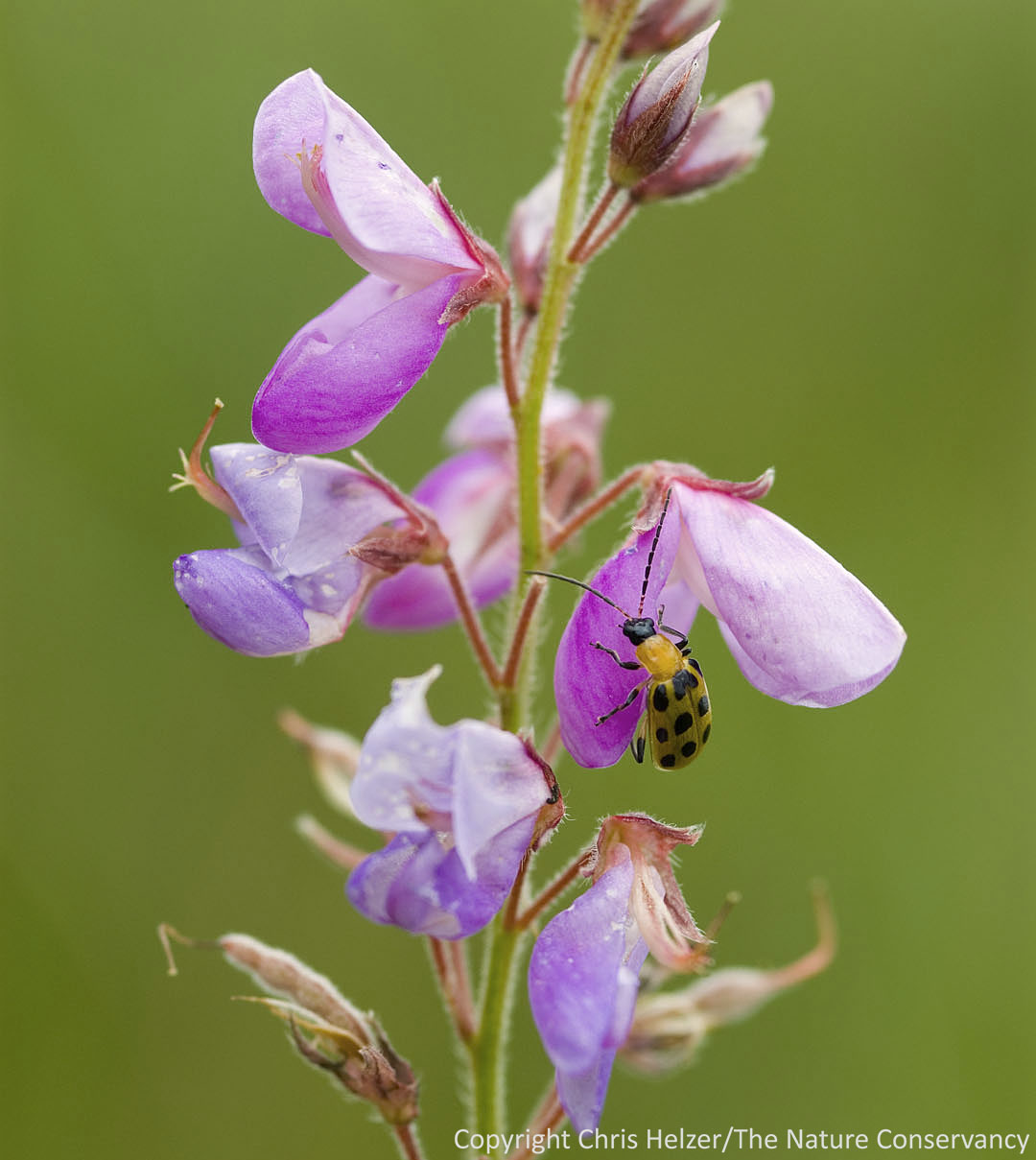
Spotted cucumber beetle on showy tick trefoil (Demodium canadensis)

Spotted cucumber beetle on showy tick trefoil (Demodium canadensis)

Spotted cucumber beetle has another name that will be very familiar to farmers – southern corn rootworm.  While it’s a native insect in North America, it has adapted very well to human agriculture and is now considered a pest in both crop fields (corn and other crops) and gardens (cucumbers and other cucurbits).  I’m hoping some of the readers of this blog can help me answer a couple questions I have about cucumber beetles.

1. Are spotted cucumber beetles more abundant in prairies now than historically because of the prevalence of nearby crop fields?

2. Do cucumber beetles have a significant impact on any particular prairie plant species or on the overall ecology of prairies?

As far as I know, cucumber beetles are just nicely adapting to human-dominated landscapes, and while I see a lot of them, their primary impact is that they keep fooling me into thinking they’re bees…
Hubbard Fellowship Blog – A Few of Anne’s Favorite Bees

Guest Post by Anne Stine, Hubbard Fellow:

I just finished a wonderful pollinator work shop with Mike Arduser here at the Platte River Prairies.  Much of this workshop involved catching bees, using a dichotomous key to identify them to genus, and then pinning the bees on-site.  I am pretty pleased with my collection, and I’ve decided to share a few of the fascinating factoids that are buzzing (I am so, so sorry) around my head.

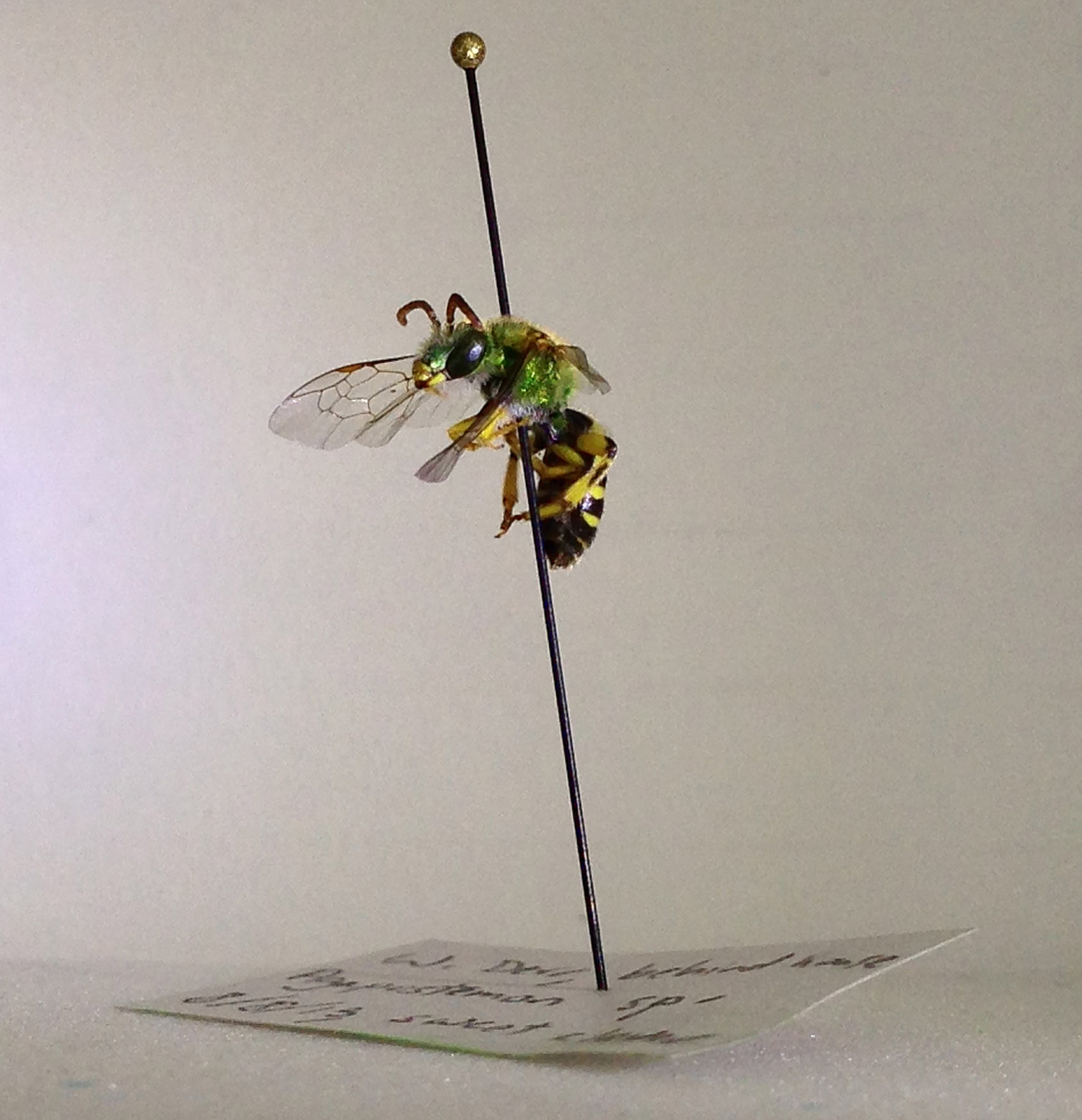
Agapostemon virescens is my new favorite bee.  They are eusocial, but not tyrannically so.  There is no queen, all females can reproduce; they just choose to share a nest (from “The Bee Genera of Eastern Canada”; Packer, Genaro, and Sheffield 2007).  I adore these utopian bees. They also happen to be gorgeous.  I’ve included a picture of the male below.  The female looks similar, but is all emerald without the striped abdomen.

h

Agapostemon virescens – Photo by Anne Stine

Svastra obliqua is my second favorite bee.  Their scopa (branched, pollen carrying hairs) are so exaggerated, they look like they are wearing giant fuzzy chaps.  Big and easy to spot, they hang around annual sunflowers and could be confused (if you were squinting and using your peripheral vision) with a small bumblebee.

Svastra

Svastra obliqua – Photo by Anne Stine

The Megachile family is another good group.  Instead of having scopa on their legs, they carry pollen on their abdomens.  This placement requires them to rub their bellies all over a flower when they forage.  It’s a pretty amusing mental picture.  Another reason to love the Megachile is that they can be field ID’d by ear.  After conferring with my fellow pollinator work shop participants, we decided that, if the bumblebee is a Harley (low pitched, rumbling “BZZZzz”, then the Megachile is the sportbike (they make a high pitched “eeeeee” sound when they forage).  Once you hear their whine, you won’t forget it.  Megachiles are leafcutters, and they excise circular patches from leaves to build their nests.  If you see a leaf that looks like a crazed administrator took a hole-punch to it, you should start listening for the Megachile whine.

Hymenoptera bonus: the cuckoo wasp.  She’s wearing a rhinestone suit of armor.

Cuckoo wasp

Cuckoo wasp – Photo by Anne Stine

There is so much more I wish to share!  I foresee future posts about buzz pollination, specialists vs. generalists, combative cleptoparasites, and the potential for the hymenopteran community as an indicator of restoration success.

Hymenopterans are beautiful, sometimes adorable, with unusual life histories that make their study easy to enjoy. I am so pleased I get to spend time with these creatures during my fellowship here on the Platte River Prairies.