It’s a great time of year to see snakes. As the weather cools in the fall, snakes are especially drawn to places where they can soak up warm sunlight during the middle part of the day. That makes it fairly likely to see snakes (alive and dead) along roads. In addition, many snake species overwinter together in communal winter dens – particularly in higher latitudes. As they move from their summer feeding areas to those winter dens, they often have to cross roads and other open areas. This puts snakes at risk from cars and predators but provides even more opportunities for interested people to see snakes that can be difficult to find during the rest of the year.
Yesterday, we spotted this beautiful young bull snake on a gravel road along the edge of one of our Platte River Prairies. It was only about 16 or so inches long, but it did a great job of making itself look menacing when we stopped to take a closer look.
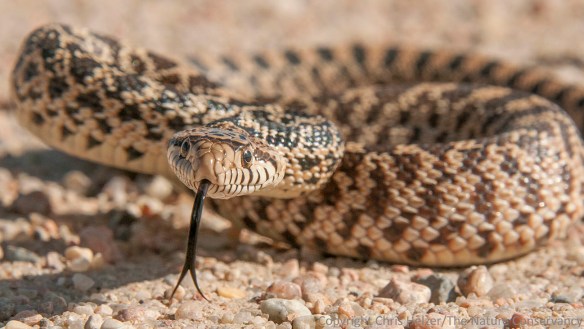
This little bull snake was doing its very best to scare me off, but it didn’t work. Instead it got its portrait taken. The Nature Conservancy’s Platte River Prairies, Nebraska.
As we approached it, the snake coiled up and flattened its head, making it look very much like a viper. It was also wiggling the tip of its tail back and forth very quickly – a move that would have made a sound like a rattlesnake rattle in dry leaves (a great scare tactic) but wasn’t incredibly effective on the gravel. As I moved in with my camera, the snake struck at me several times, but never came anywhere close to biting me. Being a biologist, my response to all this was to lie down on the gravel and photograph the snake. However, if I hadn’t known that bull snakes are basically harmless – unless you’re a small mammal or bird – I probably would have headed quickly in another direction. The snake probably would have preferred that…
I felt badly that the snake was putting on such a great show to no avail. Maybe I should have acted a little more frightened. Instead, I photographed the poor snake for a few minutes and then left it alone – hopefully before I completely destroyed its self esteem.


 The Prairie Ecologist