
Back in 2022, I wrote a post about the increasing competitiveness of woody plants – especially clonal shrubs like dogwood, sumac, and others – in prairies. There are lots of factors that have led to more shrubs moving into grasslands, but increased levels of carbon dioxide in the atmosphere probably play the biggest role. Regardless of the reasons, more and more prairies are becoming something different than we’ve been used to.

Since writing that post several years ago, I’ve engaged in a lot of conversation with land managers and other scientists on this topic. I’ve learned several crucial things about woody plants in Great Plains grasslands:
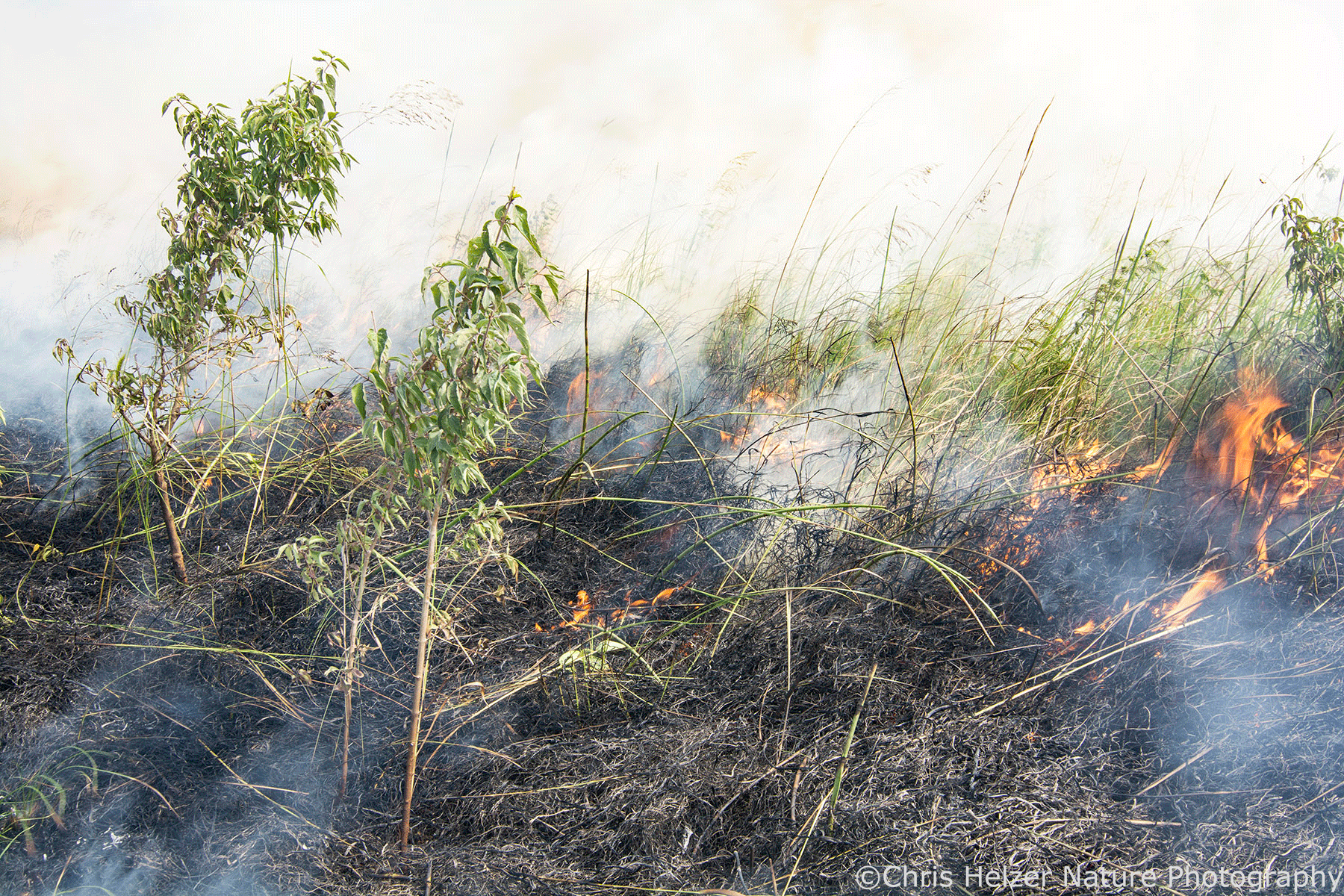
- Annual fire, and maybe biennial fire, may be able to prevent woody plants from moving into prairies here in the central United States. Anything less frequent than that is unlikely to be successful.
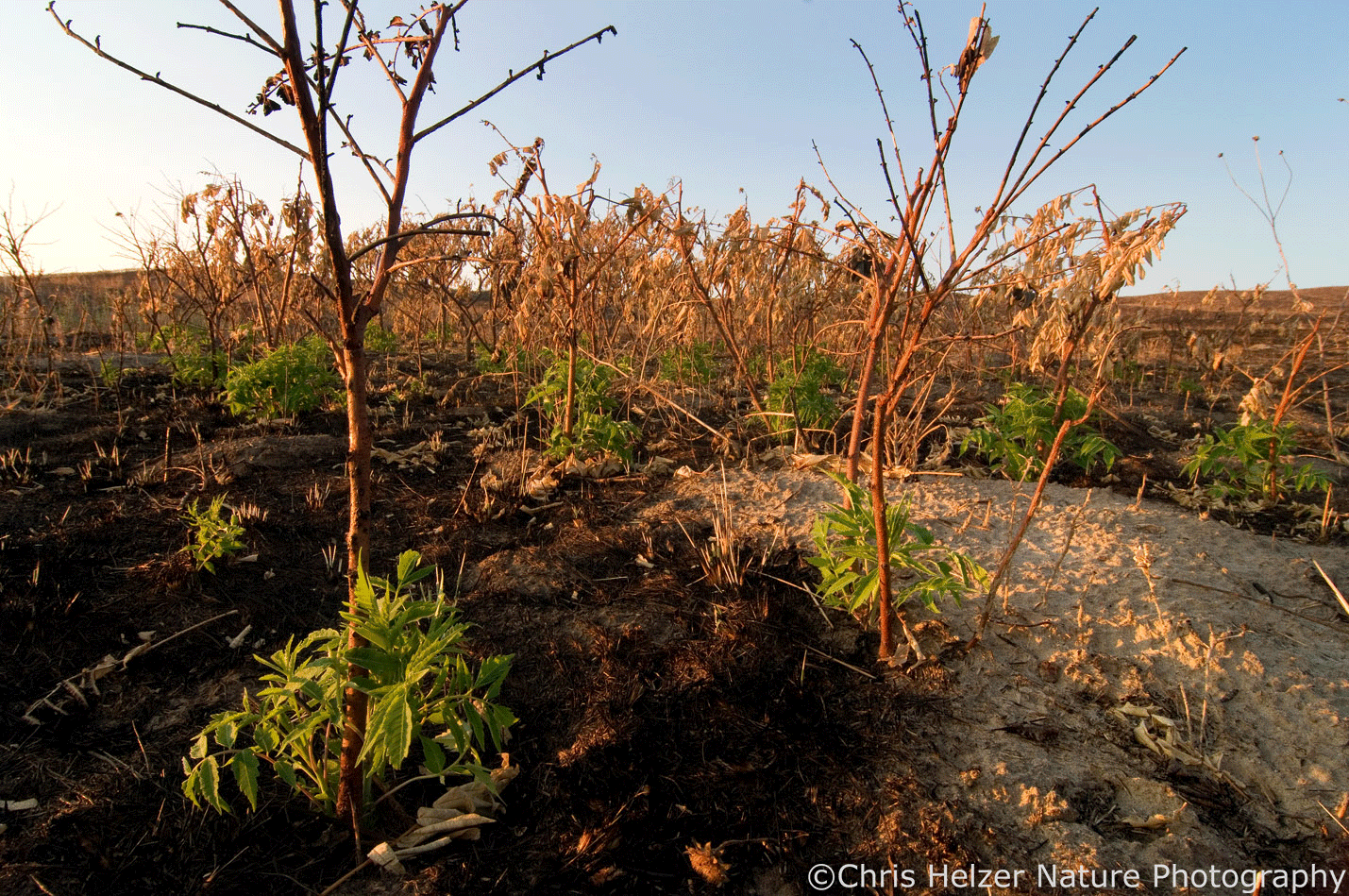
- At least in the northern Flint Hills of Kansas, once those woody plants have established, even decades of annual fire may not get rid of them. Researchers at the Konza Biological Station, for example, have seen that more than 20 years of annual fire has kept shrubs short, but hasn’t reduced stem density.
- The season of fire is probably important, but I’ve not found any evidence that burning in the growing season vs. dormant season changes the need to burn very frequently if that’s the only strategy being used to prevent woody plant encroachment. We’ve done a lot of summer burning here in Nebraska and see immediate resprouting of shrubs. Summer burning in droughts can sometimes look promising, initially, but the shrubs seem to roar back in subsequent years.
- Eastern redcedars don’t resprout after being burned (or cut), so at least we know what needs to be done to deal with them. Deciduous trees and shrubs do resprout unless they’re treated with herbicide. Cutting one down and treating the stump with herbicide works a treat. Unfortunately, that’s insufficient to deal with dense stands of trees or shrubs across tens, let alone hundreds or thousands of acres. Broadcast spraying of grasslands for shrub control can kill woody plants but is catastrophic for biodiversity. So what do we do?
- “Use goats!”, some of you are screaming. Sure, goats can be helpful, but once-a-year, short-term goat browsing seems to have the same impact as once-a-year burning or mowing, which is that the shrubs just resprout. Multiple treatments of mowing, browsing, burning, or combinations, can more drastically reduce the height and density of shrubs, which is definitely helpful, but – again – that can be difficult to scale up. Continuous, low-density goat grazing might be a decent option if we can figure out how to keep those goats contained (at a reasonable cost).
One of the most helpful things I’ve done is to convene a small group of smart people who have met repeatedly over the last couple years to discuss some big picture ideas. Those people, all PhD scientists and experienced grassland ecologists, include Sam Fuhlendorf of Oklahoma State University, Jesse Nippert and Zak Ratajczak of Kansas State University, Nic McMillan of the University of Nebraska-Lincoln, and Marissa Ahlering of The Nature Conservancy.
Conversations with those scientists have reinforced my thinking that prairie managers in this part of the world need to shift the way we think about woody plants in prairies. During most of my career, trees and shrubs have been the enemy – or, to put it better, they were important plants that could become problematic if I didn’t keep them at bay. Woody plants were ok in small patches, especially along the margins of grassland areas, but they could cause big problems if they started popping up out in the middle.
Well, the world has changed, dang it, and we need to change, too.
Just during my career as a prairie ecologist and land manager (30-some years, if I count my time studying prairies as a graduate student), I’ve seen changes in how deciduous shrubs respond to prairie management and spread across the landscape. There are still lots of grassland landscapes in Nebraska where woody plants are uncommon, and where it’s very feasible to keep them that way. However, there are more and more places where it’s not.
Especially in fragmented landscapes, where patches of prairies are relatively small and there are lots of woody plants nearby, trying to prevent shrubs and trees from moving into prairies can feel like poking a stick at a landslide.
Sure, annual burning may work, but there are a couple huge problems with that. In a fragmented landscape, burning an entire prairie each year risks eliminating populations of many animal species from that site. The isolation of that prairie from others means recolonization of those species is unlikely – especially if the closest other prairies are also being annually burned.
The other problem comes back to scale again. Here in Nebraska, we have 20 million acres of grassland. The idea that we could burn even half of those acres each year is ludicrous. Even if we had the will and capacity to do it (we don’t), the smoke from that many acres would be completely unacceptable. Mowing, of course, is also infeasible at that scale (not to mention limitations of topography in many places).
Currently, most of our deciduous tree and shrub encroachment is happening in the eastern third of the state, where many grasslands exist as patches within a crop land matrix. Even there, we’re still talking myriad scattered prairie parcels totalling millions of acres, so annual or biennial burning isn’t feasible at that scale.
Assuming we could somehow convince every eastern Nebraska landowner to burn their prairie every other year (there’s no chance of that), and we could figure out how to deal with all the smoke (we can’t), it still wouldn’t happen. We’d still have to deal with burn bans issued by local and state officials during drought years or whenever they feel sufficient public pressure.
I could go on and on, but the big point is this: excluding trees and shrubs from prairies is no longer possible in many places. It just isn’t. We can prioritize and dedicate resources to prevent encroachment in some select areas, but across much of the Central U.S., we are going to have shrubbier grasslands.
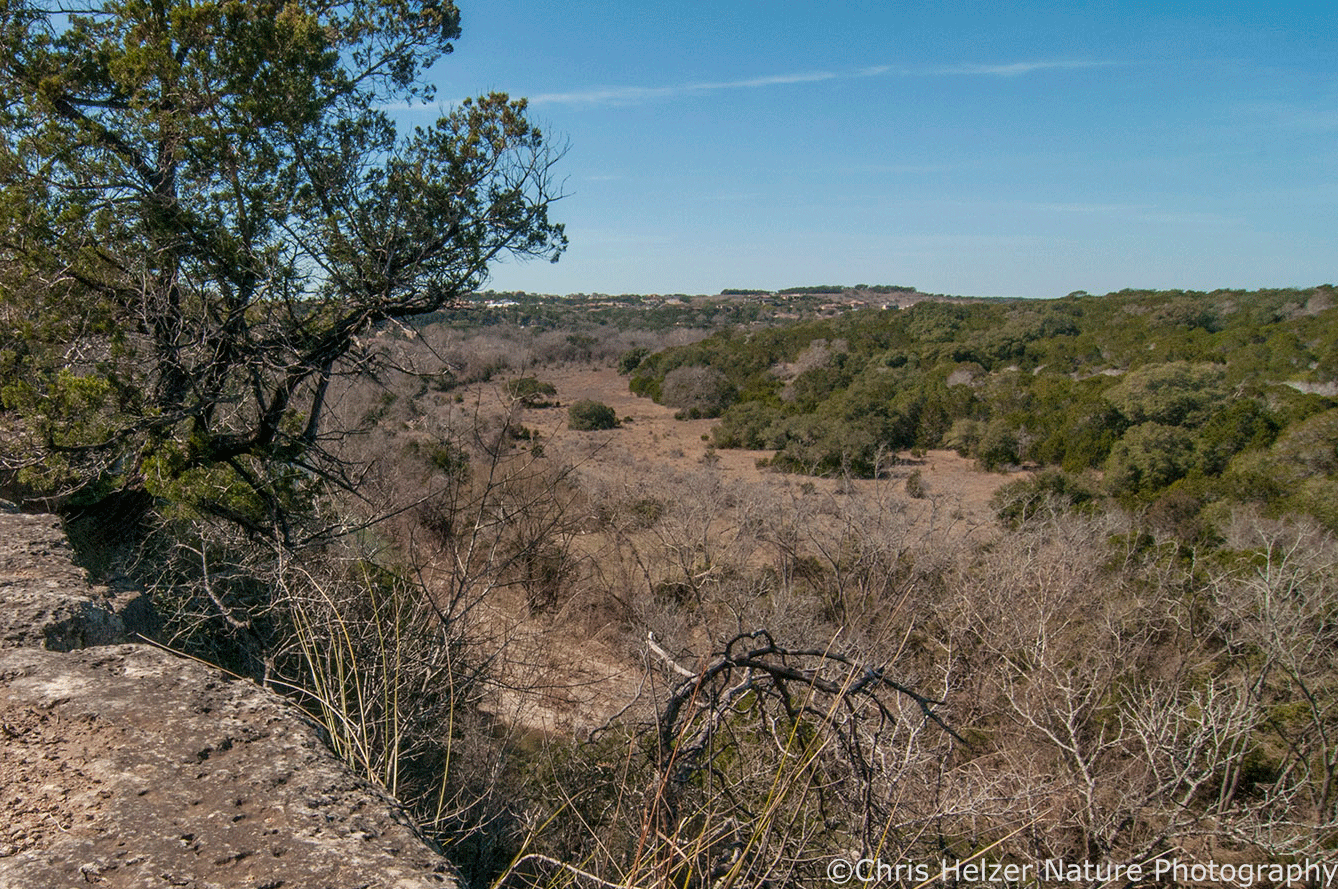
The transition from grasslands to shrubland has already happened in many parts of the Midwest and Great Plains. Ranches in parts of Texas and Oklahoma have had to shift from cattle grazing to deer hunting or other landuses. In parts of the Midwest, where many grasslands have persisted as small openings within a wooded landscape, lots of those openings have closed. Larger, drier grasslands in the western half of the Great Plains are transitioning much more slowly, but there are still examples of trees and shrubs – especially along creeks or wetlands – expanding their footprint beyond what we’ve been used to.
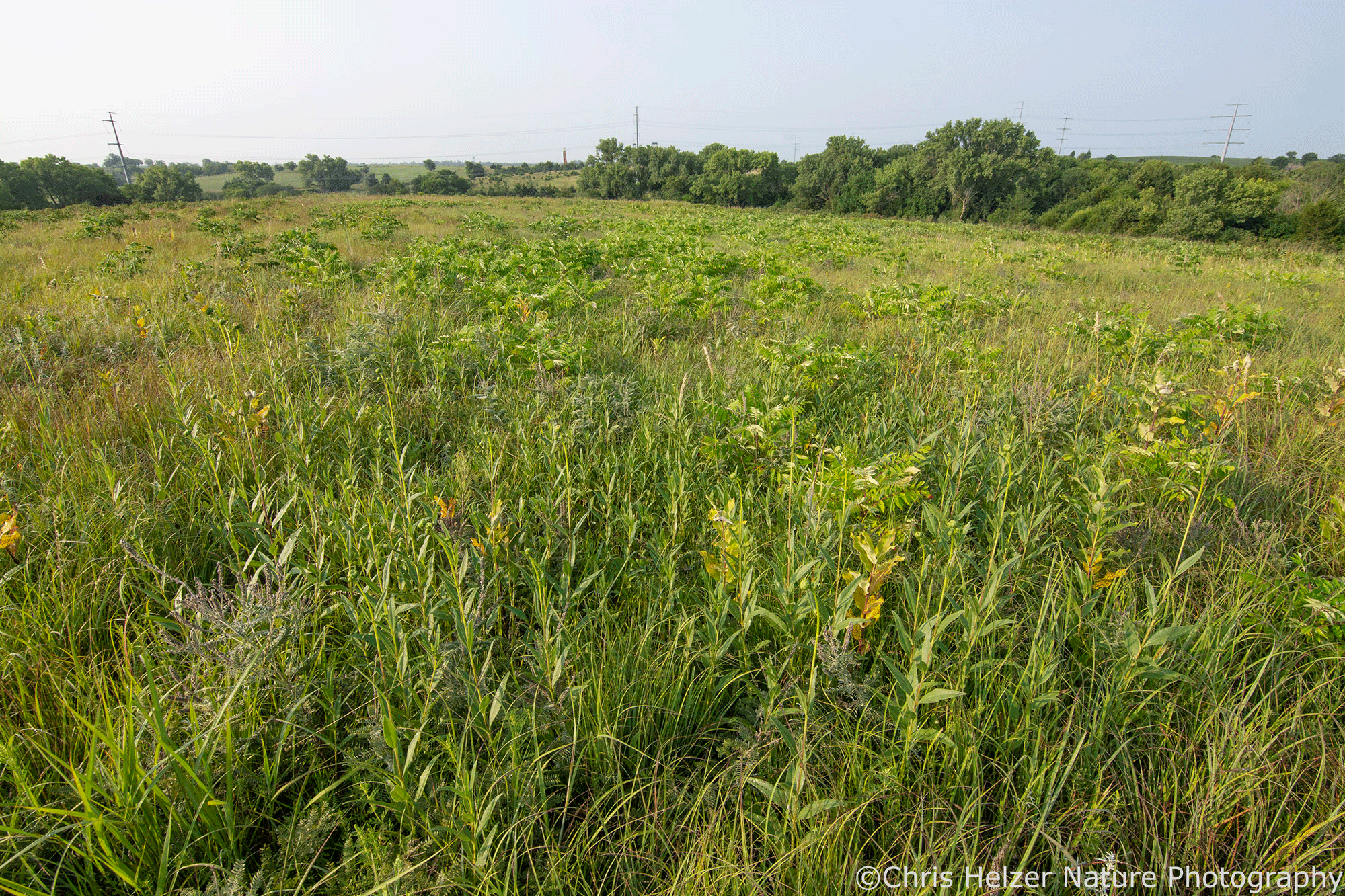
All of this means we need to think about how to manage woodier prairies for biological diversity and productivity – including agricultural productivity, since grazing and other agricultural uses is what has prevented many of them from being tilled or otherwise converted to something that’s no longer prairie.
This doesn’t have to be a catastrophe. In fact, there are many prairie species that benefit from the presence of more shrubby habitat. Others won’t, but we actually have a lot to learn about what kinds of shrub height and density will affect most prairie species, and how.
How much shade will various prairie wildflower species tolerate? What about the insects that pollinate them? How do grassland wildlife species respond to different heights and densities of woody plants? For animals and plants that can’t handle even a little tree or shrub cover, how big do open areas need to be to provide them with sufficient habitat to survive?
On the land management side, if we’re not trying to eradicate or prevent encroachment of shrubs and trees, what does prairie stewardship look like? In many places, our goal will probably be to manage the height and density of shrubs. That goal will be more defined as we learn how to answer the above questions (and many more), but few of us have focused on height and density management. We’ve been trying to kill shrubs, not compromise with them.
I’m planning to dedicate a big chunk of the next decade to this topic. We’ve already started some small experiments at Nebraska sites owned by The Nature Conservancy and are collaborating with a couple researchers to dig more deeply. I hope many others will also work on this. There are lots and lots of important questions to address.
Stay tuned for more. More importantly, if you’re a land manager or scientist, please consider how you might join in the effort to learn more about and experiment with “shrubby grassland stewardship” so we can all build off each other’s work.
If you’re interested, check out part 2 of this post, which shares preliminary results of two small experiments on how to manage height and density of clonal deciduous shrubs.
 The Prairie Ecologist
Pingback: Learning How to Live With Shrubbier Grasslands – Part 2: Experimentation | The Prairie Ecologist
Thank you!I’m originally from Europe, where conversations about rising atmospheric carbon dioxide—and, just as critically, reactive nitrogen—have been ongoing for some time. The natural response to a more fertilized world—driven by excess nitrogen from agriculture, fossil fuel combustion, and atmospheric deposition—is already unfolding in many ecosystems. We’re seeing faster plant growth and a more lush, green appearance. But beneath that surface lies a serious ecological cost: a dramatic loss of plant diversity.
Over time, this shift will probably lead to simplified plant communities with fewer species, which in turn supports fewer insects, birds, and other wildlife.
Bruermeister Prairie at Zornsky lake in Omaha is 100 percent dogwood and sumac. 30 acre of virgin prairie is risk of lost. I am suggesting to the city to mow in June and August.
Very interesting, partly for all the questions it raises. Is this one of the situations in which rewilding, rather restoration becomes an objective? Does restoration become limited to sites in which size, location, resources, etc., enable the kind of intensive management necessary to preserve the pre-existing ecosystem? In terms of shrubs species, are there sustainable management practices that discourage non-native invasives?
Hi John. It kind of depends on what definition of “rewilding” you use, I guess. I’m talking about working with the existing ecosystem but acknowledging and moving with the changes that are taking place. I’m certainly not talking about encouraging or enabling invasive species or trying to create novel ecosystems (again, depending upon how you define that term).
In terms of objectives, I’m pushing all of us to learn more about what objectives might be possible. Can we still manage for grassland nesting birds with shrubbier grasslands? If so, which species, and what are their habitat requirements? Similar questions for small mammals, grasshoppers, pollinators, and any other group of organisms.
There may be some tree and shrub species we will still try to prevent/eliminate, even if we allow our grasslands to be come woodier in general. If a particular species doesn’t play nice – pushes other species out of the way and decreases species diversity/ecological resilience, it still makes sense to treat that species like an invasive species and act accordingly. The strategy will depend upon a lot of things. On our sites, we manage smooth brome by keeping it from being dominant enough to reduce plant diversity. We manage purple loosestrife by trying to contain/eliminate it without doing undue damage the wet meadow plant community around it. Shrub management decisions will be similar, I expect.
In Missouri prairies, and Kansas by my experience, it has to do with fire seasonality. Sites in Missouri that are not burned after late February do not have weedy woody encroachment. These very often bordering sites that have had spring and other growing season fires. These sites have become weedy woody thickets. It has to do with nutrient flushes on seeds of these species in dormancy versus coming into the growing season. Prairie State Park Missouri which had/has a major problem over a few thousand acres is finding a substantial decline using low intensity fully dormant season fires. Given the many prairies of varying quality and history that don’t have this problem, and that they all share a dormant season burning history, I don’t see how the CO2 hypothesis can explain the problem satisfyingly.
Chris – I have been reading with great interest both your bookThe Ecology and Management of Prairies in the Central United States and your recent blogs on shrubbier grasslands.
As you may remember I used to live in Nebraska and was on the TNC board for a short time. I now live in Little Rock Arkansas in a community developed by a very nature oriented developer who went to great efforts to try to maintain the ecosystems he found on site before he developed the area. In particular he set aside about 5 acres of grazed land and even had TNC do a controlled burn on the site and seeded it with native grasses and other prairie species native to Arkansas. That developer, who still lives in the neighborhood and a few others including me are trying to develop a management plan to re-establish and maintain the prairie after years of regular mowing without regard to the prairie itself. I have found the Prairie Ecologist very inspiring and helpful and just wanted to let you know that you are appreciated, even in Arkansas.
Ann
Ann Bleed
ann.s.bleed@gmail.com
18 Cove Creek Pt Little Rock, AR 72211
402-419-1796 (cell)
Pingback: Letting nature take its course | The Prairie Ecologist