
Why I Care About Prairies and You Should Too

Lately, I’ve been trying to figure out why I think prairie conservation is so important.  I’m not questioning my conviction – I feel very strongly that prairies are worth my time and effort to conserve – but if I can figure out exactly what it is that makes me care so much, maybe I can be more effective at convincing others to feel the same way.

I can list off all kinds of logical and aesthetic reasons that prairies are important.  Prairies build soil, capture carbon, trap sediment, grow livestock, and support pollinators.  Depending upon our individual preferences, prairies also provide us with flowers to enjoy, birds and butterflies to watch, and/or wildlife to hunt.

The buckeye is one of the more striking-looking butterflies that can be found in prairies.

Those are all very practical reasons to think prairies are important, but I don’t care deeply about prairies because they make soil and grow pretty flowers.  More importantly, those reasons are not enough to make someone stop and reconsider a decision to plow up a prairie to plant corn or broadcast spray 2,4-D just to reduce ragweed abundance.  If prairie conservation is going to succeed, you and I both need to understand and articulate the deeper reasons that we feel prairies are worth saving.

Which brings me to Dr. Seuss.

As I was mulling over why I cared so much about prairies, the story of “Horton Hears a Who” popped into my head.  In case you’re not familiar with the story, Horton the elephant accidentally discovers an entire community (Whoville) living on a speck of dust.  After he finds and starts talking with the Whos, Horton agrees to help protect them from harm.  The other characters in the book don’t believe Horton when he tries to tell them about the Whos, and actually go out of their way to steal and destroy the speck of dust he’s trying to protect.  Only when the Whos are finally successful at making enough noise to be heard do those other characters recognize the existence of the Whos and agree to help protect them.

Dr. Seuss’s intended moral to the story (repeated many times) is “A person’s a person, no matter how small.”  It’s a fine moral, but isn’t what drew me to the story as a metaphor of prairie conservation.  Instead, I was thinking about WHY the other characters in the story finally changed their minds.   The sour kangaroo and the Wickersham brothers didn’t give up their threats to boil the speck of dust in Beezelnut oil because Horton finally came up with the right logical argument to explain why the Whos were worth saving.  They changed their minds because when they finally heard the Whos making noise they recognized and identified with the Whos as fellow living creatures.

Can you see where I’m going with this?  I think the biggest thing that drives me to devote my career (and a fair amount of my free time) to prairie conservation is that I have developed a personal connection to the species that live in grasslands.  Not only do I know those species exist, I can also identify with them and what they’re doing to survive.  By becoming familiar with them, I became fond of them.

When I was in graduate school, I studied grassland nesting birds.  I got to know those bird species well, including where they lived, how they survived there, and what motivated and threatened them.  I saw prairies through their eyes, and that made me want to help make those prairies as hospitable to birds as I could.  Eventually, I began learning about prairie plants and insects as well.  I was fascinated to find that their stories were equally or more interesting than those of birds.  Each species had their own unique set of life strategies that allowed them to survive and interact with the world around them.  As a photographer, I usually learn about new species by taking a photograph of some interesting plant or insect, and then identifying it and researching its life later.  I’ve yet to come upon a prairie species that doesn’t have an amazing life story, which means the process of discovery continues to be fulfilling for me.

Pitcher sage (Salvia azurea) is one of my favorite flowers to photograph because of it's unique color and shape. It also seems to be a favorite haunt of many insect species, judging by the number that always seem to be crawling around on or near the flowers.

As the number of species I’ve gotten to know has increased, so has my commitment to prairie conservation.  Maintaining the resilience and vigor of prairie communities has grown from something that seemed like a good idea into a personal mission.  Now I’m working to protect things I love, not just species I’d read about or knew about only in the abstract.

Be honest, would you be more likely to send money to help people recovering from a natural disaster in a neighboring town or in a town on another continent?  With rare exceptions, we’d all choose the nearby town.  Why is that?  I think it’s because we can more easily identify with the people who live there.  We can imagine ourselves in their places.  We can see the disaster and their plight through their eyes.  It’s not that we don’t care about people on other continents, but they’re naturally a little less real to us.

By the way, forming sympathetic bonds with species can be dangerous when managing prairies.  The more I know about the species living in my prairies, the more I understand the ways in which those species are affected (positively and negatively) by management activities.  Any management treatment has negative impacts on some species, and impacts from activities such as prescribed fire can be quite dramatic.  Caring about individual species to the point where I’m unwilling to do anything to hurt them would paralyze me.  Management is all about tradeoffs, and while my management objectives are to sustain all the species I can, I have to be willing to knock populations of some species down periodically so that others can flourish.  I think the key is to become attached to the species, but not the individuals.  Tricky…     

Why does all this matter?  It matters because we need to recruit as many people to the cause of prairie conservation as we can.  Excluding a tiny minority of prairie enthusiasts, when the general public thinks about nature and conservation they look right past prairies to the mountains, lakes, and forests beyond – even when prairies are in their own backyard.  After all, what’s to care about in prairies?  It’s just grass.

If we’re going to fix that, we’ll need to do more than describe how prairies can help sequester carbon, filter water run-off, or support pollinator populations.   We’ll need to introduce people to the camouflaged looper inchworm that disguises itself with pieces of the flowers it eats – and to the regal fritillary caterpillar which, after hatching from its egg in the fall, sets out on a hike that will end by either finding a violet to feed on or starving to death.  They’ll need to become acquainted with sensitive briar, the sprawling thorny plant with pink koosh ball flowers whose leaves fold up when you touch them.  And who wouldn’t love to meet the bobolink – a little bird that looks like a blackbird after a lobotomy and flies in circles sounding like R2D2 from Star Wars?
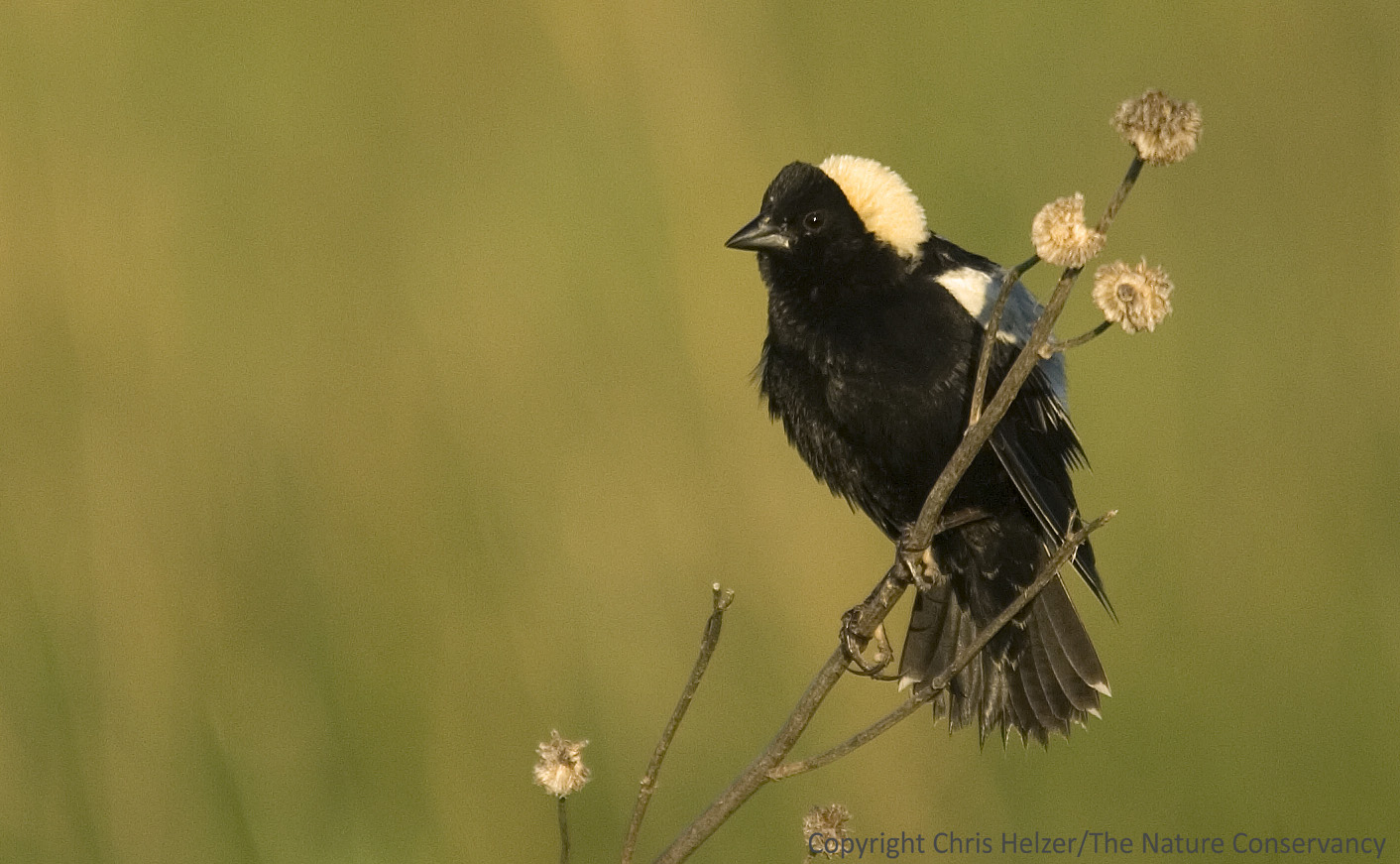
The charming and vociferous bobolink.

Through this blog, as well as through numerous presentations, articles, and tours, I spend much of my time sharing what I’ve learned about prairie species with anyone who will listen – hoping that those stories will spur people to explore prairies on their own and start to form their own individual relationships with the species and communities they find.  My photographs and narratives aren’t themselves sufficient to convert people to the cause, but maybe they can at least get some of them to put on their hiking boots and go for a walk.

What about you?  Have you met the citizens of the prairie?  If not, let me help introduce you.  If you have met them, what stories can you tell?  How will you spread your passion about prairies to others?

.

Here are some accounts I’ve written about prairie species I find fascinating.  If you find them interesting too, please share these links with others!

Camouflaged Looper – An inchworm that disguises itself with bits of the flowers it eats.

Yucca Moth – A terrific relationship between a plant and the single species of moth that has the capability to pollinate it.

Submarine Sora – Ever wonder why soras and other rails are so hard to find?

Sensitive Briar – A plant with a koosh ball flower, thorny stems, and leaves that fold up.

Pussytoes – One of the first spring-blooming flowers, and a surprisingly important resource for early season pollinators.

Of Mice and Clover – A great example of the complexity of interactions in prairies.

Crab Spiders – One of the great ambush predators of the world.

Flies – An unbelievably diverse group of insects with a wide range of ecological roles.

Grasshoppers – From their cute little faces to their complex communication strategies, it’s hard to beat grasshoppers.
Regal Fritillary Butterflies in the Platte River Prairies – 2011

We completed our second season of regal fritillary butterfly data collection this summer.  Funded by State Wildlife Grant funds from the Nebraska Game and Parks Commission, our surveys are designed to help us better understand how this butterfly species is responding to our prairie restoration and management work.  The species is doing very well in Nebraska, and the central Platte River valley has some of the highest concentrations of regals in the country, but the species is of conservation concern because of it’s extreme rarity elsewhere in its historic range.  In addition to informing our work, we hope that studying the species where it’s common can help inform conservation efforts in those places where it’s rare.

Some people may be surprised to hear that regal fritillary butterfly populations are thriving in the central Platte River valley – a landscape dominated mainly by rowcrop agriculture and degraded prairie plant communities.  The neighborhood around our Platte River Prairies is about 30% grassland – a higher percentage of prairie than many eastern tallgrass landscapes, but certainly not a large unbroken prairie landscape.  Moreover, Platte River grasslands tend to have long histories of chronic overgrazing and broadcast herbicide use which has left them with limited plant diversity.  Even most of our annually-hayed prairies are missing many wildflower species that would be expected to be dominant in those prairie types.  The fact that regal fritillaries are thriving in this landscape seems counter to some of what is published about the species’ reliance on “high quality prairie”, but they’re here nonetheless! 

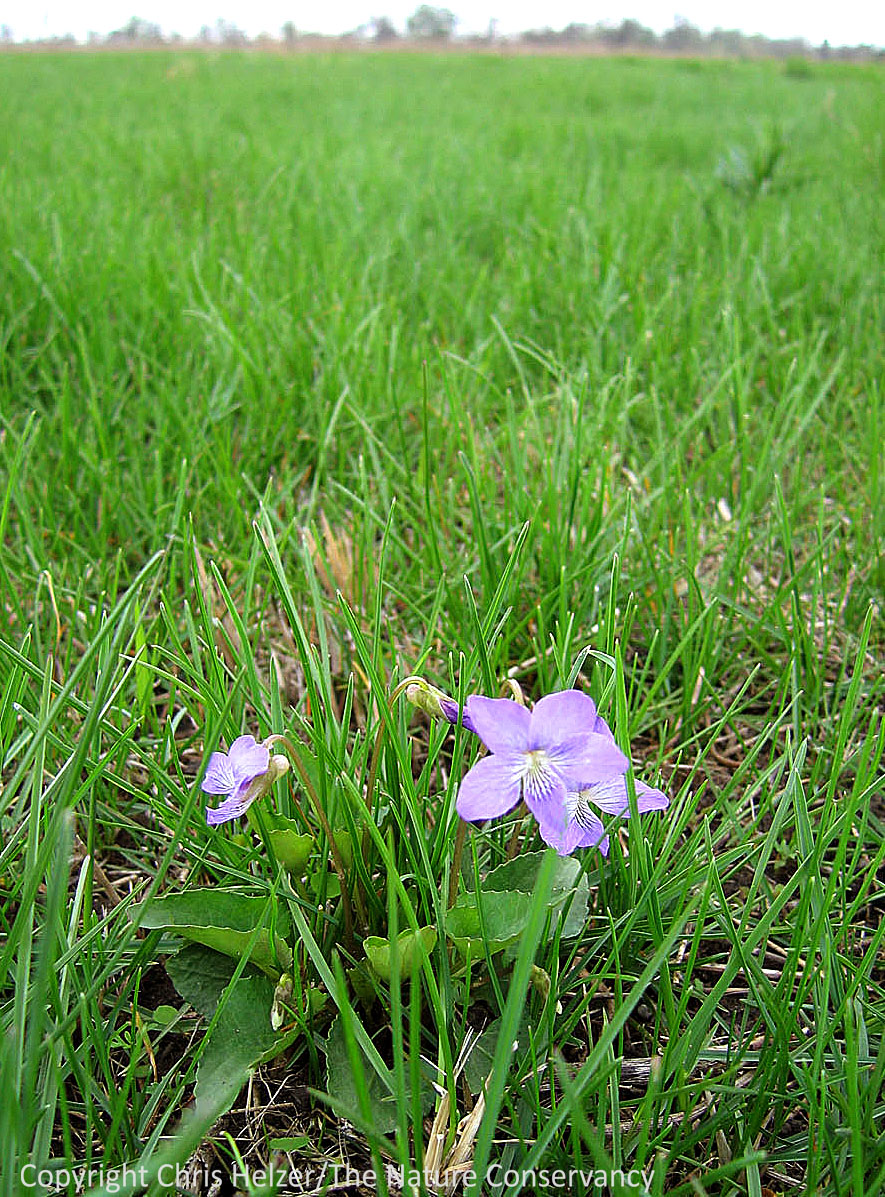
Regal fritillaries rely on violets as the sole food source for their larvae.  In our Platte River Prairies, the only perennial violet species we have is the common blue violet (Viola sororia).  In much of the eastern tallgrass prairie, prairie violets (V. pedatifida) or bird’s foot violets (V. pedata) are thought to be the preferred species, but we don’t get those species in our area.  Fortunately, the common blue violet thrives in pastures with long histories of annual intensive grazing, so the supply of larval food sources is not limited in our landscape.  It may be that the abundance of violets and the amount of grassland left in the valley are the two primary reasons for the regal fritillary’s continued success here.

Common blue violets (Viola sororia) are abundant in our degraded prairies - along with lots of Kentucky bluegrass. The species appears to support strong regal fritillary populations.

A brief report of our findings from 2011 can be found in this PDF, but I’ll lay out a few of the highlights here.  First, the seasonal patterns of butterfly abundance we’re seeing seems to match what we know of the life history of the species.  Males emerge first (late June), with highest numbers occurring in areas with relatively high amounts of thatch and lots of violets.  Those males tend to spend the next couple weeks flying around the same place they emerged from until the females also emerge and mating takes place.  That mating period is when we see the most fritillaries along our transects.  Following that, the number sightings drop as males begin to die off and females enter a period of “reproductive diapause”, during which they spend much of their time sitting around in the shade.  Finally, in late August, we see a little bump in our numbers again as females begin flying around and laying eggs.  (Those eggs then hatch, and the larvae – if they find enough violets to eat – will overwinter in the thatch.)

The effects of prescribed fire on regal fritillaries and other butterflies is a frequent topic of discussion among ecologists.  At our sites, we definitely see the highest numbers of regals emerging in June and July from prairies with high numbers of violets and with a build up of thatch.  Prairies that were burned in the spring have very few fritillaries during that peak period of emergence and mating – the larvae almost surely perish in spring fires.  However, during the summer of 2011, two of our top three sites for nectaring activity had been burned in the spring of that year.  It may be that in landscapes of relatively abundant habitat, a mixture of burned and unburned areas can complement each other by providing high quality larval habitat (unburned) and nectaring habitat (burned). 

In addition to prescribed fire, our other major management tool is cattle grazing – and the two are often combined within our various patch-burn grazing systems.  The burned areas mentioned above where nectaring activity was high were also being grazed.  Under our light stocking rates, cattle focus primarily on grasses, leaving most wildflowers to bloom – making them available to pollinators, including regal fritillaries.  Under higher stocking rates, fewer wildflowers escape grazing and regal fritillary are lower.  However, even areas that are burned and intensively grazed recover quickly, and within a year or two (as cattle focus on more recently burned areas) become hot spots for regal fritillaries again.  As stated earlier, it appears that a mixture of management treatments across a landscape with fairly abundant habitat is compatible with successful regal fritillary populations.

After our 2010 butterfly surveys, I posted a report on the nectar use by regal fritillaries and other butterfly species.  Those 2010 surveys included a slightly different mixture of prairies from our 2011 surveys, and included some transects where we counted all butterfly species.  Within that context, the clear favorite nectar plant was hoary vervain (Verbena stricta).  In 2011, vervain was still among the top nectar species for regal fritillaries – particularly in degraded remnants where it can be very abundant – but it was not quite as dominant as in last year’s surveys.  I think this was mainly because we included more restored prairies in our surveys this year, and the diversity of flowers was higher in those sites.  Even so, hoary vervain tied for first place in nectar species use with the combination of common and showy milkweeds (Asclepias syriaca and A. speciosa), followed closely by bee balm (Monarda fistulosa) and various thistle species (Carduus nutans and Cirsium spp).  It’s important to point out, however, that we only had 27 sightings of nectaring regal fritillary butterflies in 2011 (out of 352 total sightings), so our sample size was fairly limited.

Regal fritillaries in the central Platte River valley really like hoary vervain (Verbena stricta) as a nectar plant. Vervain survives intensive grazing very well, so it can be abundant in some of our more degraded pastures, as well as in our restored prairies.

Among those 27 sightings of regal fritillaries nectaring, all but four of them were in restored prairies (former crop fields).  At least based on the data we’ve collected so far, it appears that our regal fritillaries are tied to degraded remnants (lots of violets) for larval production but move into our restored prairies (lots of nectar plants) later in the season.  A quick and dirty correlation analysis showed that after the mating season was over, butterfly sightings were most likely to occur in portions of prairie with high abundances of their favorite nectar plants – but there was no such correlation prior to or during the mating season.  Again, a mixture of habitat types (this time, restored and remnant) appears to provide complementary resources for the butterflies in the Platte River Prairies. 

Clearly, regal fritillaries managed to survive just fine along the Platte River before our restored prairies were available, so it’s not that we’ve saved the species through our restoration work.  Intensively grazed pastures tend to have high numbers of hoary vervain flowers for nectaring, and some hayed prairies in the valley contain good numbers of milkweeds and other nectar species as well.  However, watching the behavior of fritillaries when areas of high nectar plant abundance (e.g., our restored prairies) become available may tell us about what their preferred habitat conditions are. 

Thistles, including this musk thistle, are among the favorite nectar plants for regal fritillaries - along with hoary vervain, bee balm, and common milkweed. At least for now, musk thistle is surviving just fine in the Platte Valley. (hooray?)

I feel pretty confident that regal fritillaries are managing to survive within the context of our current prairie restoration and management work.  However, we’re still not able to figure out where they’re laying their eggs.  According to the literature, regal fritillary females don’t lay their eggs on violets (why??) and no one is even sure if they select locations near violets.  I sure hope our regal fritillary females return to remnant prairies (where violets are abundant) to lay eggs, rather than laying them in our restored prairies.  If our restored prairies – with their abundant nectar plants – are luring those females away from prime egg-laying habitat, that’s not a good thing.  To date, we just can’t get enough sightings during that late summer egg-laying period to figure out what’s going on.  We even tried following females around to see if they were laying eggs but that turned out to be pretty difficult.  I guess since the population seems to be strong I’m not going to worry about it too much, but I’d still like to know what they’re doing. 

Because of the limited time we can devote to this project, it’s necessarily more of a pilot project than a full-blown research effort.  If there are scientists out there who would be interested in following up on our initial work, I’d be more than happy to work with you. 

In the meantime, you can see read the report from our 2011 surveys here, including lots of fun graphs and tables.