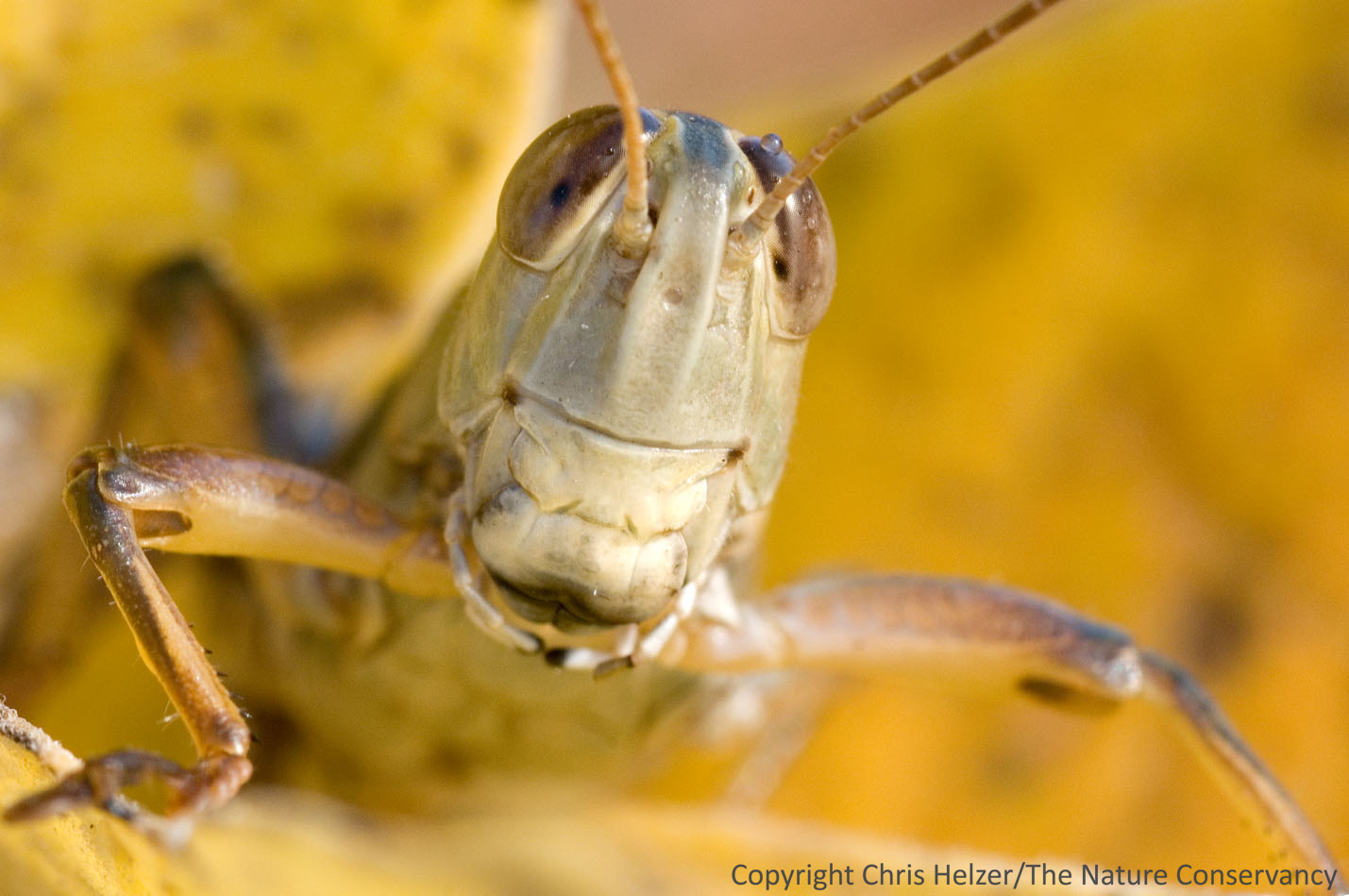
Last week, I spent two days working with local school kids at Griffith Prairie north of Aurora. On both days, my job was to get the kids excited about insects and spiders, teach them a few things, and let them catch and inspect as many things as they could. It was a great couple of days, with excellent weather and enthusiastic kids. Quite a few of the kids had never had any real positive exposure to insects or spiders, so it was rewarding to see them smiling as they held little creatures they would have stepped on or run from the day before. (By the way, my experience is that kids who say they won’t touch an insect or spider can be often be talked into holding an inchworm, or even a cute little jumping spider. Once they’ve done that, other species come pretty easily. In fact, you might say inchworms and jumping spiders are “gateway bugs”…)
Anyway, during lunch on one of the days, Jan Whitney from Prairie Plains Resource Institute found a gigantic wolf spider on the ground, and I scooped it up and put it in a ziplock bag to show the kids. It was the biggest spider I’ve ever seen in Nebraska, and the kids were duly impressed. At the end of the day, I took the spider home to get some photos of it before releasing it.

A face-to-face look at the big wolf spider found at Griffith Prairie, north of Aurora, Nebraska. Click on the photo for a bigger image.
This is the part of the blog post where I’m going to risk both ridicule and a fairly substantial loss of credibility by sharing a few of my secret techniques for getting fabulous photos of small creatures. I’m banking on the fact that most of you have been reading this blog long enough that you’ll put up with a few oddities and gimmicks and keep reading even after you’ve seen how the sausage is made, so to speak. At the same time, a few of you might actually decide to steal a few of my secrets, and that’s ok too. Now, before you get the wrong idea, the vast majority of my photos of insects and such are taken in the wild, and the subjects are photographed doing whatever they would have been doing even if I wasn’t peering through my camera at them. In some cases, however, it’s not possible to get a photo of a particular animal under those circumstances (have you ever tried chasing a wolf spider through tall grass??) and an alternative plan is needed.
So, my first step when I got home with my spider-in-a-bag was to find my wheelbarrow. Yes, that’s right – after extensive testing, I’ve determined that my old rusty wheelbarrow has all of the characteristics of a perfect backyard photo studio. Here’s how it works. First, I fill the bottom of the wheelbarrow with some appropriate looking habitat. In the case of the wolf spider, I put in some old leaves laying around near our compost pile. I patted them down into a nice natural-looking layer on the bottom of the wheelbarrow. Next, I push the wheelbarrow into a place in the yard where the bright sunlight is partially diffused by the leaves of my tall tree. Not complete shade, and not open sun, but something in-between, where the light is almost bright enough to make shadows. Once I’ve got my habitat and light arranged, I set up my camera and tripod, and I’m ready to introduce the photo subject.
The wheelbarrow photo studio works best with animals (or plants!) that are not incredibly quick, can’t fly or jump long distances, and that are small enough to fit comfortably into a wheelbarrow. Spiders, small turtles, lizards, and such work very well. Sandhill cranes? Not so much. In this case, the wolf spider was a good runner, but I was banking on the fact that it’d have to scrabble up and over the metal sides of my old wheelbarrow before escaping, and that my own cat-like reflexes would be sufficient to (gently) nudge it back inside the wheelbarrow before it got away completely.
This is probably a good time to say that while just about any wheelbarrow will probably work for a wildlife photo studio, there are a few specific design characteristics that are worth shopping around for. The most important of these is sides that are steep enough to slow down a quick spider, but not tall enough to create shadows across the habitat on the floor of the studio. It turns out that the 50-year-old barrow I inherited from my grandparents has the perfect mix of those characteristics. No, it’s not for sale.
Ok, anyway, I opened up the ziplock bag and let the big wolf spider run out into its new temporary habitat. Of course, it immediately shot off toward the edge and leaped out of the wheelbarrow into the yard. My cat-like reflexes notwithstanding, I managed to recapture it and try again. This time, I was able to keep it corralled and to turn it back every time it tried to get out, and after about 10 or 15 tries, it finally paused to assess the situation. This is known among wheelbarrow photographers as “The Moment of Opportunity”. I grabbed the camera, focused in on the spider, and squeezed off a couple shots before the spider caught its breath and shot off toward the side of the barrow again.
After a certain number (trade secret) of chasing/pausing/photographing sequences, I finally had enough photos that both the spider and I were satisfied with the shoot, and were ready to call it a day. During the amount of time (trade secret) it took to finish the shoot, however, I gladly took advantage of one of the other great attributes of a wheelbarrow studio, namely its mobility. Often, when the spider would pause, it would be facing away from the best light direction. In that case, I just moved the wheelbarrow around so that spider was lit more photographically. In addition, I had to move the wheelbarrow’s location several times to keep up with the pattern of dappled light that was shifting across my yard as the sun kept moving. (Yes, I know it’s the earth that’s actually moving, but that just confuses the story, doesn’t it?)
For those who are thinking about trying this at home, here’s a good tip for successfully photographing wildlife in a wheelbarrow… It’s often good to get the camera down to the same level as the creature you’re photographing, so you can look the subject right in the eyes when you take its picture. My wife will read this and snort (attractively) because she frequently has to remind me to do the same thing when I’m photographing our kids. (My only excuse is that it’s hard enough to keep the kids in the wheelbarrow that I sometimes forget to think about camera angles.) Anyway, the fact that the wheelbarrow studio is off the ground a couple feet makes it even easier to arrange the tripod in such a way that you can get good face-to-face photographs of spiders, turtles, or other cute little creatures. That up-close-and-personal perspective usually creates a more interesting photograph than a more “aerial view”.

Moving both the wheelbarrow and my tripod helped me find camera and light angles that made interesting photographs of the spider.
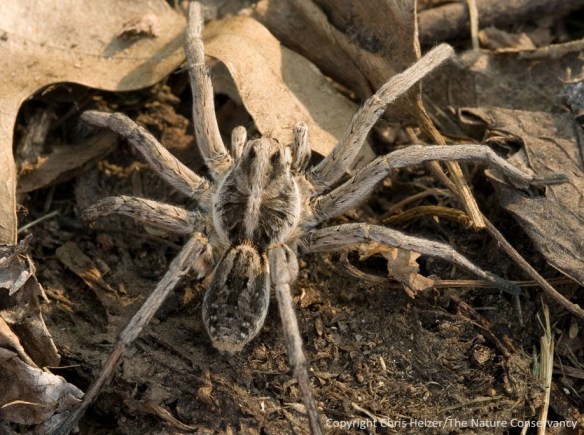
I took this "aerial view" to help identify the spider later by documenting color patterns on its carapace and abdomen. A big thank you to Professor Bill Beachly at Hastings College, who identified it as a big female Rabidosa rabida.
.
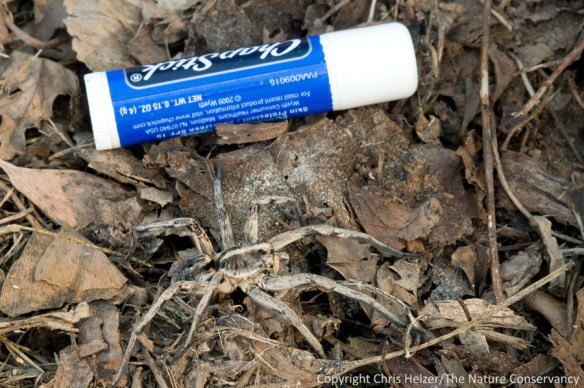
The use of this universal scale tool helped to document the actual size of the spider.
Well, there you go. I hope this has given you a peek behind the curtain and that you’re not too unsettled by what you’ve learned. I also hope the local hardware stores (or antique stores) will be able to handle the run on wheelbarrows over the next week or so as all of you rush out to build your own portable wildlife photography studios!
No spiders or humans were injured during the shooting for this blog post. Both the spider and human involved experienced some degree of temporary exasperation, but appeared to recover. The spider was released unharmed.