How important is plant diversity? Most ecologists think it’s a critical component of resilient ecosystems. Last week I collected some data that lends support to that view. In some experimental prairie plantings we’ve established in our Platte River Prairies, plant diversity appears to be suppressing the invasion of poison hemlock (Conium maculatum).
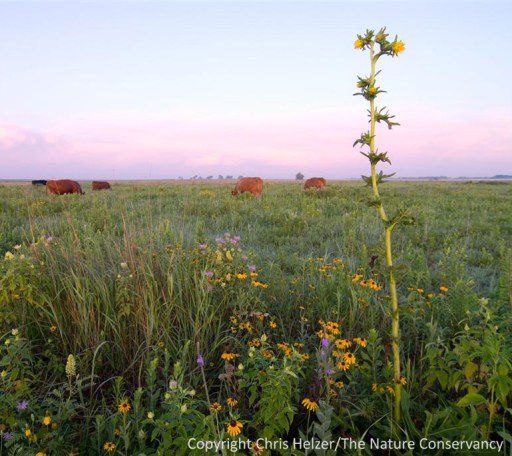
A floristically rich restored prairie, in which prescribed fire and grazing are being used to maintain high plant diversity. The Nature Conservancy’s Platte River Prairies, Nebraska.
Back in 2006, I established some research plots in our Platte River Prairies so we could take a more experimental approach to our work to understant how plant diversity affects prairie ecosystems. Those research plots consist of 24 squares, each of which is 3/4 acre in size. Half of those plots were planted with a high diversity seed mixture of about 100 plant species. The other half was planted with a lower diversity mixture of 8 grass and 7 wildflower species. Since then, several university researchers have helped us collect data on the differences between those high and low diversity plantings. We’ve looked at a number of variables, including soils, drought response, insect populations, insect herbivory rates, and resistance to invasive species.
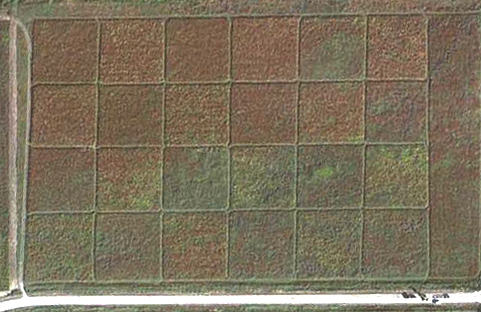
An aerial photo of our 2006 diversity research plots. Each plot is 3/4 ac (1/3 ha) in size and is planted with either a high diverisity (100 species) or low diversity (15 species) seed mixture.
Kristine Nemec, a recent PhD from the University of Nebraska-Lincoln, has done the bulk of the data collection and analysis from those experimental plots. A soon-to-be-published research paper from that work will report that plant diversity appears to be suppressing the spread of two invasive species: bull thistle (Cirsium vulgare) and smooth brome (Bromus inermis). Poison hemlock wasn’t included in that project because the methods we chose for measuring vegetation weren’t well suited to capture its presence and abundance. However, from a purely observational standpoint, it’s always appeared that a lot less hemlock grows in the high diversity plots than in the low diversity plots. Last week, I decided to test that observation by collecting some data.

Poison hemlock (Conium maculatum) has invaded portions of our research plots, sometimes forming large colonies that are near monocultures.
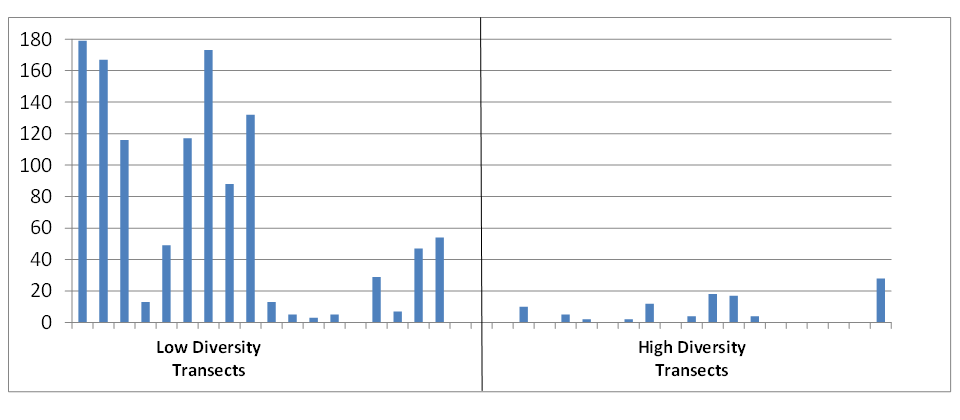
Since hemlock is abundant mainly in the southern half of our 24 plots, I only collected data from those 12 plots for this pilot effort. Half of those 12 plots had been seeded with a high diversity mixture and the other half with a low diversity mixture. I walked three transects across each of those plots, and counted the number of last season’s hemlock stems that were within a meter of me on either side. I only counted stems that still had seed heads to help ensure that I wasn’t counting stems from multiple years’ production. You can see the results of my counts in the graph below.

The number of poison hemlock flowering stems found by transect in low diversity and high diversity plots. Platte River Prairies – Diversity Research Plots. April 2013
Although I haven’t yet run any statistics on these data, there is a striking difference in the number of poison hemlock plants between the two treatments. Hemlock was rare in the high-diversity plots, but was found in large numbers in many of the transects through the low-diversity plots. This was just a quick and dirty pilot effort to see if there was enough difference to warrant a full-fledged research project, but I feel pretty comfortable that plant diversity is having an impact on hemlock abundance.
I plan to collect some more comprehensive data on poison hemlock this summer. I’d also like to collect the same kind of data from an adjacent set of plots we established in 2010. Those newer plots are the same size as those from 2006, but include three different seed mixtures: high diversity, low diversity, and a monoculture of big bluestem. If I see a similar pattern of hemlock abundance there, that will go a long way to confirm what I think I’m seeing in the 2006 plots.
I’ve never considered poison hemlock to be a particularly dangerous invasive species in our Platte River Prairies. It seems to be most abundant in old woodlots, and doesn’t often show up in our native or restored prairies. On the other hand, the plant’s toxicity can cause big problems, especially from an agricultural perspective. In fact, we’d considered haying our research plots last summer but couldn’t find anyone to harvest them because hay containing poison hemlock can’t be fed to livestock. If prairie plantings with a high diversity of plant species resist invasion from hemlock, that could have important ramifications for farmers who want to establish new grasslands for hay or grazing production.
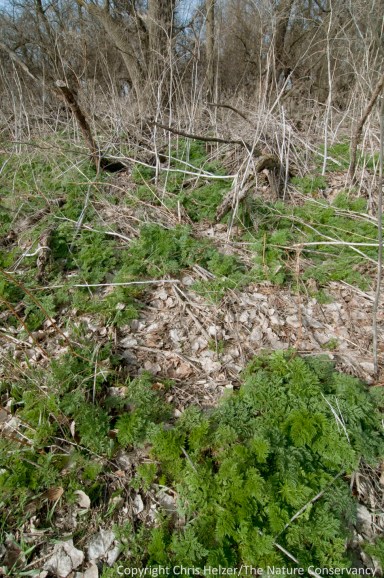
Poison hemlock is most often found in old woodlots along the Platte River. We don’t usually see it in our diverse prairies.
My little pilot study is a small addition to a growing list of other research projects demonstrating the value(s) of plant diversity. Unfortunately, high diversity prairie plantings are more expensive than lower diversity plantings, so it’s important for landowners and conservation organizations to know exactly what they get for that higher cost. High plant diversity provides nectar and pollen resources for pollinators, improves total vegetative production, and has other benefits, including quality wildlife habitat. However, one of the most intriguing aspects of plant diversity is its potential to help suppress invasive species. If we continue to find that more diverse plantings help repel species such as bull thistle and poison hemlock, that will have important implications for both agricultural producers and wildlife/prairie managers.
Stay tuned as we keep learning…