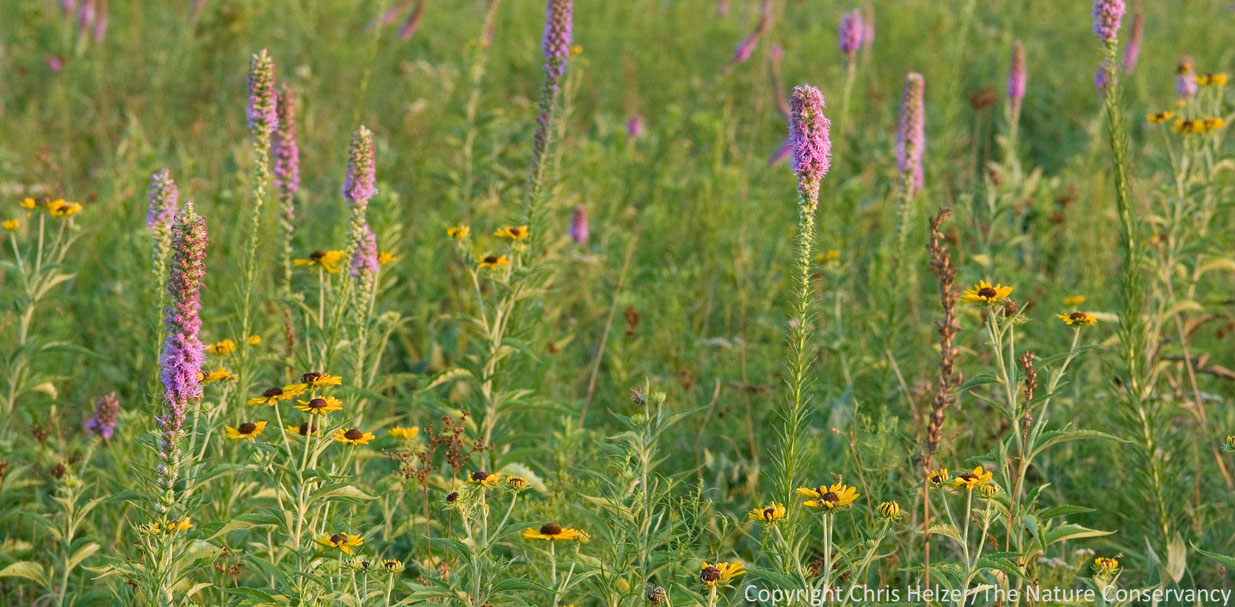
HOW OFTEN SHOULD PRAIRIES BE BURNED?
It’s a question prairie ecologists and managers have been wrestling with for many years. Unfortunately, research on the impacts of fire management is somewhat limited and often contradictory. Much of the best research has come from Konza Prairie in the flint hills of eastern Kansas, but many have rightly pointed out that translating flint hills research to other prairies – especially eastern tallgrass prairies – can be tricky.
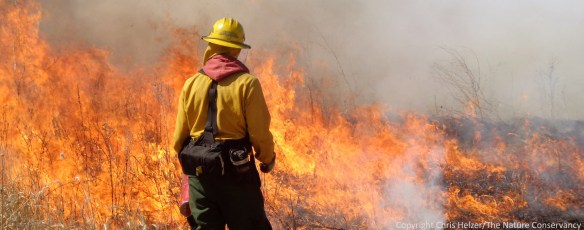
Prescribed is an important tool for prairie management, but how often should it be employed?
At Konza and other western tallgrass prairie sites, frequent application of fire (in the absence of grazing) tends to increase the dominance of grasses, and decrease the abundance and diversity of wildflowers. However, prairie ecologists and managers working in eastern tallgrass prairies (particularly in Wisconsin and Illinois) point to numerous prairies that have been frequently burned for decades with no apparent loss of plant diversity. Those experts make strong arguments against applying western experience with frequent fire to eastern prairies. Unfortunately, the discussion has suffered from a scarcity of published long-term data from eastern prairies to help evaluate impacts of fire management there.
Just last month, an excellent research paper by Marlin Bowles and Michael Jones helped fill that void. In 2001, Bowles inventoried the plant communities of 34 prairies around Chicago, Illinois – ranging from dry to wet-mesic sites – and compared those data to similar inventories conducted twenty five years earlier. The similarity in sampling methods between the two efforts allowed Bowles and Jones to look at how fire frequency affected changes in plant species composition over a significant period of time. In short, they found that a high fire frequency had a positive correlation with plant diversity.
Using data from a series of 0.25m2 plots, Bowles and Jones analyzed changes in the average number of plant species (species richness) between the 1976 and 2001 data sets. Frequent burning increased species richness overall, but had a particularly positive impact on summer wildflower richness. Spring wildflowers, warm-season grasses, and legumes didn’t necessarily increase in species richness with higher fire frequency, but strongly decreased in richness within prairies that were not burned very often. The authors speculated that the greatest impact of burning on plant species richness was likely the removal of detritus (previous years’ vegetation), which can greatly reduce the amount of light available to growing plants and also change microclimatic conditions and nutrient availability. Because eastern tallgrass prairies receive more rainfall than do western prairies, they produce more plant biomass each year. Bowles and Jones pointed to that increased biomass production as a probable reason that frequent fires have such a strong positive impact on plant diversity in eastern prairies.
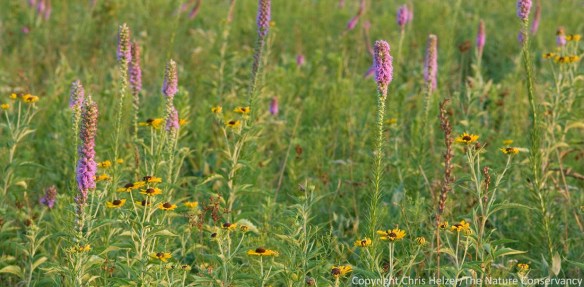
In the eastern tallgrass prairies studied by Bowles and Jones, summer wildflower diversity increased under frequent burning. (Photo from Taberville Prairie – Missouri)
The contrast in response to frequent fire between western and eastern tallgrass prairies is intriguing, and it’s great to have published long-term data to help quantify it. It may be that increased vegetative growth due to higher rainfall in the east is largely responsible for the difference, but surely the story is more complicated than that. It will probably take quite a bit more research across the entire east-west continuum of tallgrass prairies before we really understand what’s going on.
In the meantime, it’s important to recognize differences in the way eastern and western tallgrass prairies respond to fire management, but it’s also important to not overly generalize those results. Every prairie will still respond individually to management (based on many factors, including soil type, presence/abundance of invasive species, etc.,) and it’s important not to implement any management regime without evaluating and adjusting over time. In addition, east vs. west is only one of many ways to characterize differences between prairies and their responses to management. Northern and southern prairies, for example, also respond very differently to management – due in part to a stronger cool-season grass component in northern prairies, including several invasive grasses which are really not a factor in the ecology of southern prairies. (Southern prairies have their own set of invasive species as well.)
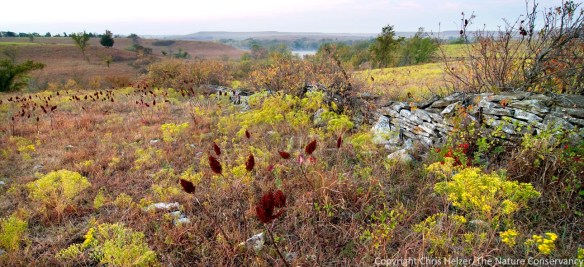
Prairies like this one in the flint hills of Kansas respond differently to fire and other management treatments than do prairies further east. However, other variables (latitude, soil type, topography, land use history, and more) all influence management responses as well.
.
BUT BE CAREFUL…
While I thought the paper by Bowles and Jones was very well done, two thoughts occurred to me as I read it. I will deal with each only briefly now, but will flesh them out more in future posts. I think both are important to consider before entering into a management regime dominated by frequent burning.
First, Bowles and Jones emphasized the importance of frequent fire as a “stabilizing force” in tallgrass prairie plant communities. In other words, they inferred that good management should result in a plant community that changes little from year to year. They called these stable plant communities “late-successional,” a term that I have a difficult time applying to prairies, which require frequent disturbances to keep from becoming woodlands. Regardless of terminology, however, the question of whether or not prairies should have stable plant communities is an interesting one. I’ve argued in the past that healthy prairie plant communities should look different each year (see, for example, my post on “Calendar Prairies”.) However, most of my experience comes from more western prairies, so I have an admitted bias. Still, it worries me to have a management regime that always favors the same species year after year, because other species are – by default – being perennially managed against. Reducing the overall pool of species in a prairie seems potentially risky, but I don’t know how serious that risk might be.

These black-eyed susans are blooming in profusion the year after a Platte River Prairie was grazed. An abundance of short-lived opportunistic species such as this one might lead to a prairie being characterized by som as “mid-successional”. Whether or not that characterization is apt or useful is an interesting question, and may depend upon where a prairie is located (or may just depend upon the background of the ecologist thinking about it!)
Second (but related to the first), arguments for frequent fire tend to focus primarily on plant diversity rather than the overall diversity of the prairie community, including both vertebrate and invertebrate animals – not to mention fungi, bacteria, and other organisms. Fire can have serious negative implications for some of those other residents, especially when small isolated prairies are burned in their entirety, leaving no unburned refuges for vulnerable species. Insects that overwinter in the stems of plants, for example, are particularly vulnerable to spring fires. The dramatic change to habitat structure wrought by fire can also have big impacts on vertebrates (as well as invertebrates) that require thatchy cover for survival. As I mentioned above, reducing the pool of species in a prairie (plant, animal, or otherwise) may have serious implications for the overall health of the prairie – especially in fragmented landscapes where species are unlikely to recolonize areas from which they are eliminated.
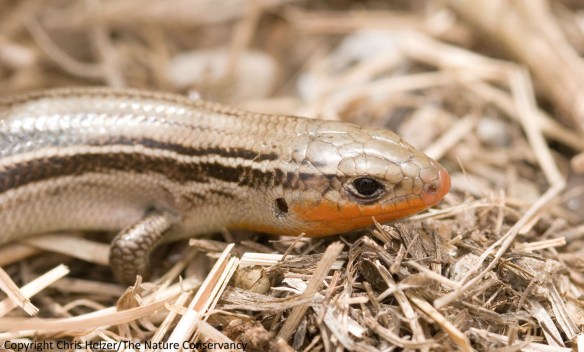
I generally find prairie skinks such as this one in prairies with a certain amount of thatch. I’m not sure how this or other thatch-dependent species would do in frequently burned prairies.
I tend to favor prairie management that provides multiple habitat types and growing conditions each year, and shifts the locations of those around the prairie from year to year. That kind of mixed and dynamic management should help ensure that animal species can always find a place to live within a prairie, and that every plant species will have positive growing conditions at least every few years. However, I’m making some big assumptions about the importance of that philosophy, and I’m certainly not advocating that every prairie should be managed that way – especially very small prairies for which subdivision of management may not even be feasible.
UPSHOT
Saying that prairies are incredibly complex and difficult to understand is an understatement. I think our prairie management should account for that complexity. Good managers carefully evaluate the responses of their prairies to management, and adjust accordingly. The Bowles and Jones study helps us better understand the way prairies respond to management, but also highlights the danger of simply applying what works in some prairies to others. Their paper focuses on differences between east and west, but regardless of geographic location, soil type, size, or degree of isolation, every prairie needs (and deserves!) management that is custom tailored.