Photo of the Week – August 1, 2013

I first noticed the dead ants about a year ago, when James Trager was visiting our Platte River Prairies to help us see our grassland through the eyes of ants.  As we poked around the prairie together we kept seeing ants that were stuck and dying on the flowers of two native thistle species (Flodman’s thistle – Cirsium flodmanii and Wavyleaf thistle – Cirsium undulatum).

This ant got stuck on the lower portion of this Flodman's thistle flower and eventually died there.  Helzer family prairie - south of Aurora, Nebraska.

This ant got stuck on the lower portion of this Flodman’s thistle flower and eventually died there. Helzer family prairie – south of Aurora, Nebraska.

The ants didn’t appear to be getting stuck on the numerous spines on the flowers.  Instead, they were getting caught by the flypaper-like stickiness of the lower portion of the flower as they tried to crawl up toward the nectar and pollen at the top.  While ants are definitely the most common victim of these flower traps, I’ve also seen bees, flies, and a few crab spiders get caught as well.

A small bee is among the victims on this particular flower.  The red ant on the left was still alive when I photographed it.  Flodman's thistle at the Helzer family prairie.

A small bee is among the victims on this particular flower. The red ant on the left was still alive when I photographed it. Flodman’s thistle at the Helzer family prairie.

It’s interesting to speculate whether or not ant trapping is a strategic adaptation the flowers have developed over time or just an unlucky accident for the ants.  Ants are not particularly effective pollinators, so it would make sense for thistles to evolve a strategy that helps prevent ants from “stealing” their pollen and nectar.  Since more effective pollinators such as bees and flies come to the flowers by air, stickiness of the lower portions of flowers wouldn’t affect them much (the above photo notwithstanding).  Ants have to get to the flowers by crawling, so a sticky zone between the ground and the pollen might be a very effective strategy for ant prevention.

This thistle "caught" three ants.

This thistle “caught” three ants.

The stickiness of thistle flowers is an interesting counterpoint to the extrafloral nectar produced by plant species such as sunflowers.  Sunflowers seem to produce that substance to ATTRACT ants – presumably to help ward off potential herbivores.  Thistles may be producing a substance to keep ants AWAY.  Very interesting.

Or it could just be a complete accident – which is not a very good story, and sort of sad.

(I vote for the defense barrier theory.)

Photo of the Week – March 21, 2013

Last week, I found ant species #23.

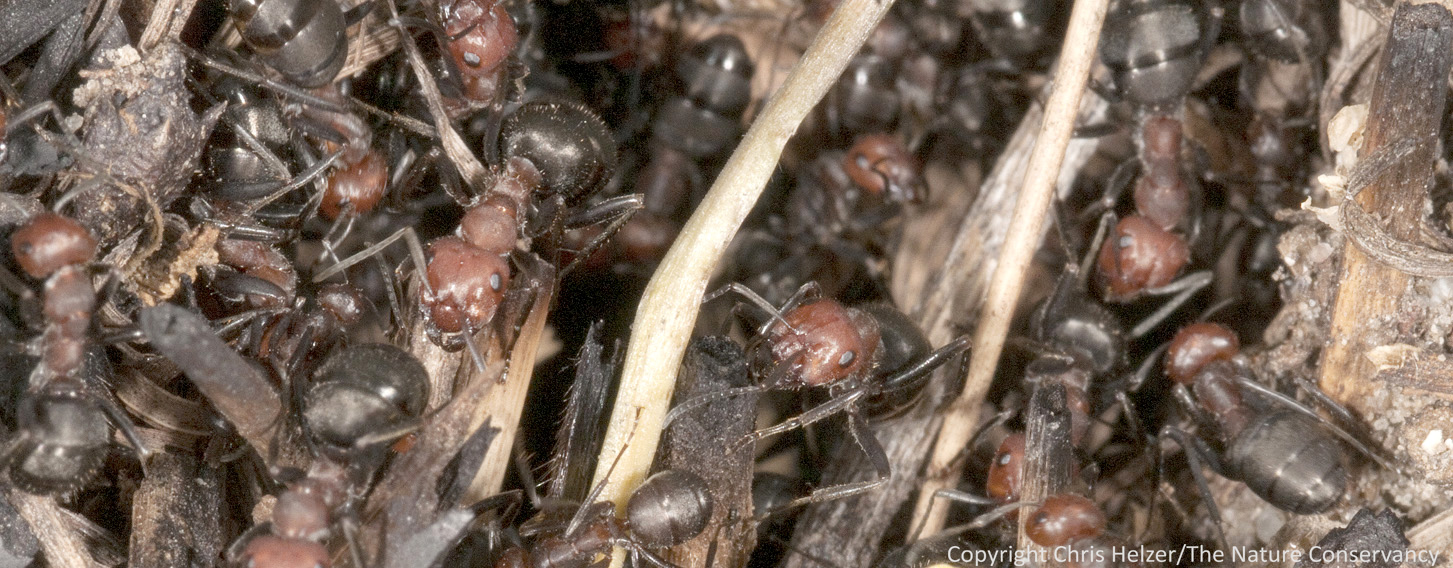
Formica obscuriventris - aka ant species #23.  It's a mound-building ant of prairies and savannas.

Formica obscuriventris – aka ant species #23. It’s a mound-building ant of prairies and savannas.

If you’ve followed this blog for a while, you know that we’re trying to inventory the ant and bee species (and others) in our Platte River Prairies.  Our main purpose is to see whether or not our restored prairies are providing habitat for the insect species living in our remnant prairies.  If they are, it’s likely that we’re succeeding in our attempt to use restoration to enlarge and reconnect fragmented prairies.  Last fall, I posted the results of the brief survey James Trager helped us with in the summer of 2012.  At that point, we’d found 22 species.

During a prescribed fire last week, we found a big ant mound.  The ants were understandably agitated by the fire…  I noted the location of the mound and went back the next day with my camera (and my new flash kit!) to get some photos.  I emailed James the photos to see if he could identify the ant species, and of course he could – Formica obscuriventris.  More importantly, it wasn’t a species we’d found last summer, so I could add it to our list!

The ant mound had multiple entrance holes.  There was a lot of activity around this particular one.

The ant mound had multiple entrance holes. There was a lot of activity around this particular one.

The mound was in a restored prairie, which was good to see.  Of the 23 species we’ve found so far now, 4 of them are tree-dwellers and 19 are prairie ants.  Of the 19 prairie ant species, we have found 14 in restored prairie.  I’m hoping we just haven’t looked hard enough to find the other 5 in restored prairie (very possible, given our limited sampling effort so far).  If that turns out to be true, it would be a great indication that our restored prairies are acting as new habitat for those ants, and enlarging/reconnecting formerly fragmented prairies.

Formica obscuriventris

Ants carrying the carcass of one of their compatriots.

I’m sure many of you could have identified this ant species without James’ help, but I couldn’t and am grateful to him.  He pointed out that it’s the boxy cross-section of the clypeus that separates this species from a couple other possibilities.  …But you probably already knew that…

Here's the mound, with a 72mm lens cap for scale.

Here’s the mound, with a 72mm lens cap for scale.

For those of you interested in the photography side of this, I photographed the ants with a 105mm Nikon macro lens on a Nikon D300s camera.  The images above are variously cropped to show the ants better. 

It was a partly cloudy day, and the light kept switching from dark cloudy to bright sunny – neither of which was great for photography.  To mitigate that, I used a diffuser (thin white cloth on a big collapsable plastic circle about 2 ft in diameter) to reduce the light when the sun popped out and then used flash to fill in the rest of the light needed to use a fast shutter speed.  My flash kit is a Nikon R1 Close-up Speedlight system, which has two small flashes – mounted on either side of the lens. 

…I might start to like this whole flash photography thing.