
Changing Our Focus

Last Friday night, I had the honor to be part of an event called the Conservation Jam, hosted by The Center for Great Plains Studies and The Nature Conservancy, and attended by about 300 people.  I was one of 15 conservationists asked to present a “big idea” to help conserve the Great Plains.  There was just one catch – each of us had to give our presentation in three minutes.

Three minutes is not very long.

I thought I’d share my presentation with you.  Partly because I spent a lot of time putting it together and only got to spend three minutes presenting it.  (But mostly because I’m too lazy to come up with another idea for a blog post this week.)  The topic of my presentation was not a new idea; if you’ve followed this blog, you’ve seen more extensive posts on similar subjects twice before, in January 2011 and February 2012.  The change of focus I advocate for isn’t, by itself, going to save the Great Plains, but I do think it’s a very important part of our approach going forward.

For what it’s worth, here’s my three minute presentation:

In grasslands, the vast majority of species are plants and invertebrates.  Birds and other vertebrates make up a very small proportion of those species.

In grasslands, the vast majority of species are plants and invertebrates. Birds and other vertebrates make up a very small proportion of those species.

.

Between them, plants and invertebrates drive the ecological function of prairies (including pollination and soil productivity, and they are the food sources for most creatures).   In other words, they’re what make grasslands tick.

Between them, plants and invertebrates drive the ecological function of prairies (including pollination and soil productivity; and they are the food sources for most creatures). In other words, they’re what make grasslands tick.

.

The diversity of plants influences the diversity of invertebrates, and vice versa.  That complexity is the foundation of the resilience and overall stability of the ecosystem.  It’s critically important to maintain plant and invertebrate diversity because without it, the ecosystem breaks down.

The diversity of plants influences the diversity of invertebrates, and vice versa. That complexity is the foundation of the resilience and overall stability of the ecosystem. It’s critically important to maintain plant and invertebrate diversity because without it, the ecosystem breaks down.

.
So clearly, as grassland managers and advocates for prairie conservation, we spend the vast majority of our time studying and managing for plants and invertebrates.  ...Right?

So clearly, as grassland managers and advocates for prairie conservation, we spend the vast majority of our time focusing on plants and invertebrates. …Right?

.

Wrong.  We actually  focus mostly on birds.  Birds we shoot and birds we watch.  I really like birds, but they’re not good indicators of how plant and invertebrate communities are doing, so they don’t tell us much about prairie function.  Birds are an important part of conservation, but they’re only a small piece – we need to be sure our focus on them doesn’t distract us from the broader ecosystems they live in.

Wrong. We actually focus mostly on birds. Birds we shoot and birds we watch. I really like birds, but they’re not good indicators of how plant and invertebrate communities are doing, so they don’t tell us much about prairie function. Birds are an important part of conservation, but they’re only a small piece – we need to be sure our focus on them doesn’t distract us from the broader ecosystems they live in.

.

A couple years ago, we brought these Illinois botanists to Nebraska to help us with a research project.  We had to, because there aren’t many people in Nebraska who can identify the majority of plants in a prairie.  That’s embarrassing.  More importantly, how can we manage prairies or evaluate our conservation progress if we can’t identify the species we’re trying to conserve??

A couple years ago, we brought these Illinois botanists to Nebraska to help us with a research project. We had to, because there aren’t many people in Nebraska who can identify the majority of plants in a prairie. That’s embarrassing. More importantly, how can we manage prairies or evaluate our conservation progress if we can’t identify the species we’re trying to conserve??

.

We know even less about insects and other invertebrates.  Of the few entomologists we have in Nebraska, most focus on crop pests.  As a result, we really don’t know what species of pollinators or other insects we have, let alone how they’re doing.  This is Mike Arduser, who came up from Missouri last year to help us learn about bees on the Platte River.

We know even less about insects and other invertebrates. Of the few entomologists we have in Nebraska, most focus on crop pests. As a result, we really don’t know what species of pollinators or other insects we have, let alone how they’re doing. This is Mike Arduser, who came up from Missouri last year to help us learn about bees on the Platte River.

.
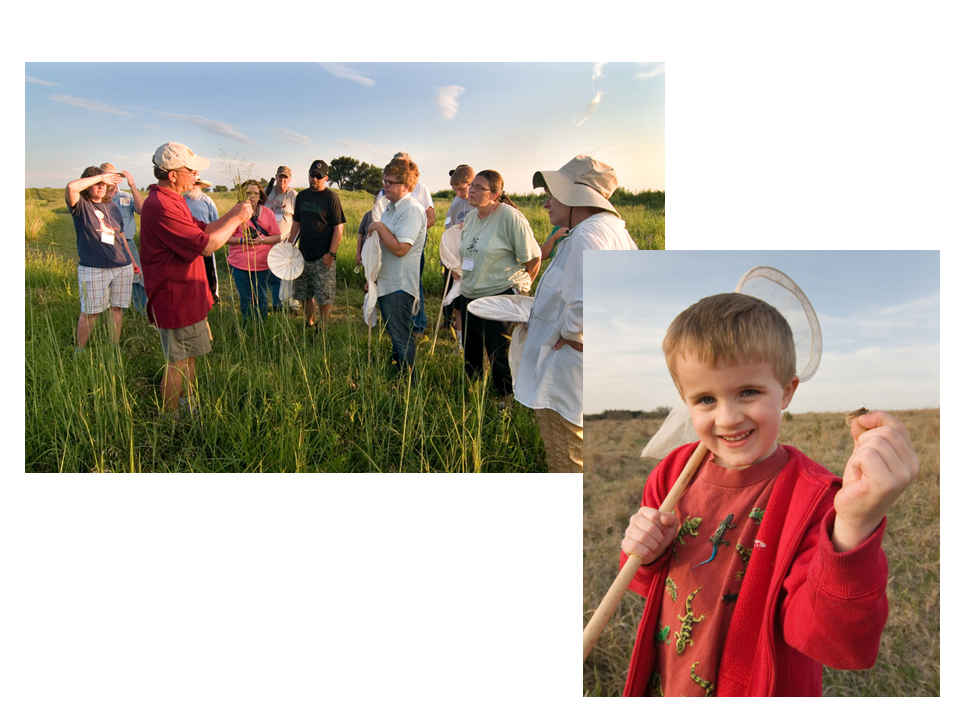
Look, we have GOT to make some changes.  We desperately need naturalists with broad bases of experience who can help us study and assess plants and invertebrates.  We need to know what we have so we can see if we’re winning.  It’s up to all of us to broaden our own focus, but also to encourage others to do the same.

Look, we have GOT to make some changes. We desperately need naturalists with broad bases of experience who can help us study and assess plants and invertebrates. We need to know what we have so we can see if we’re winning. It’s up to all of us to broaden our own focus, but also to encourage others to do the same.

.

9.Birds are beautiful, they’re worthy of conservation, and they’re great at attracting people to nature...

Birds are beautiful, they’re worthy of conservation, and they’re great at attracting people to nature…

.

...but THIS is the face of conservation.

…but THIS is the face of conservation.

.

We need to create more opportunities to learn both insects and plants.  More importantly, we need to convince people that plants and invertebrates are interesting enough to care about. There are resources like bugguide that can help amateurs like us identify insects, but they only work if we use them.

We need to create more opportunities to learn both insects and plants. More importantly, we need to convince people that plants and invertebrates are interesting enough to care about. There are resources like bugguide that can help amateurs like us identify insects, but they only work if we use them.

.
Lessons From a Project to Improve Prairie Quality – Part 1: Patch-Burn Grazing, Plant Diversity, and Butterflies

We recently completed a large multi-year restoration and management project at our Platte River Prairies.  Our specific objectives were to improve habitat quality for various at-risk prairie species and evaluate the impacts of our management on at-risk butterflies – particularly regal fritillaries.  The project was supported by the Nebraska Game and Parks Commission, who funded our work with two State Wildlife Grants (U.S. Fish and Wildlife Service money).  Over five years, we conducted fire/grazing management in our prairies and enhanced plant diversity through overseeding and seedling plugs.  We measured the results of that work by measuring changes in prairie plant communities and by looking at the use of our prairies by regal fritillaries and other butterflies.

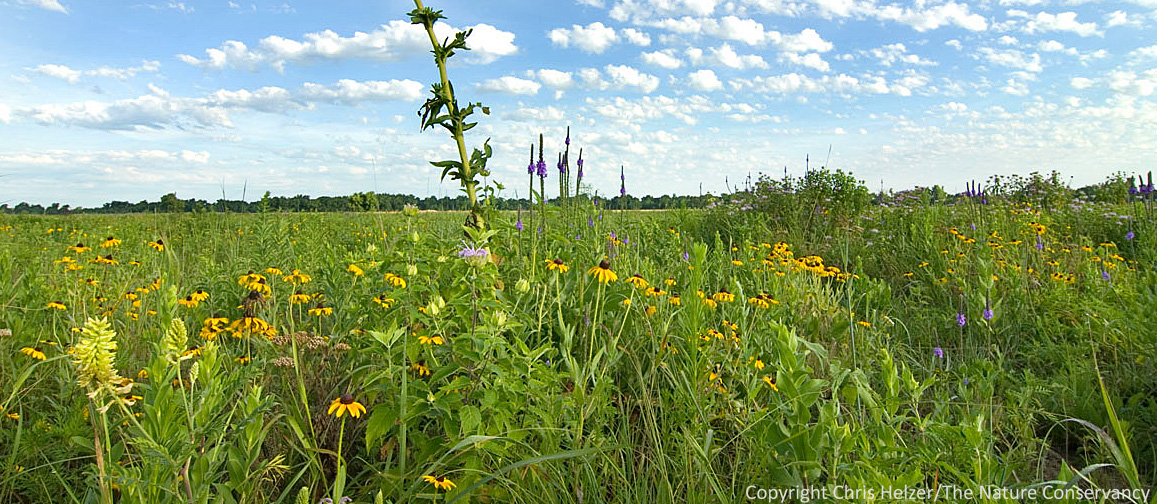
Plant diversity and buttterfly habitat were the objectives of our 5-year project.

We’ve worked hard to get plant diversity in our restored prairies, including this one.  We wanted to know whether or not our management was maintaining that diversity, and also how it was affecting butterflies.  The prairie shown here was being grazed at the time of the photo – July 2009.  The Nature Conservancy’s Platte River Prairies, Nebraska.

The following is a brief summary of the major lessons we’ve gleaned from the fire/grazing component of the project, including implications for future management and restoration work.  I will summarize the overseeding/seedling work in a separate upcoming post.  If you want more details, you can see our entire final report to the funding agencies here.  As a warning, the report is 14 pages long, with an additional 21 pages of Appendices, full of tables and graphs.

What We Did
Between 2008 and 2012, we treated over 1,500 acres of prairie with varying applications of patch-burn grazing management.  During that time, we altered the timing of burning and the intensity of grazing from year to year, and included years of complete rest from grazing in some prairies.  For the purposes of this project, we evaluated the results of our work in two main ways:

–          We measured changes in plant diversity and mean floristic quality.

–          We conducted three years of butterfly surveys to evaluate how regal fritillaries and other butterfly species responded to our restoration and management work.

Continue reading