Monarch Conservation Strategies

Last week, I attended a conference aimed at creating a statewide conservation plan for monarch butterflies.  The meeting was really informative and thought-provoking.  I learned a great deal about the ecology and conservation needs of monarchs from Chip Taylor of Monarch Watch and others, and was part of some good discussions about potential strategies to help the species recover.  I thought I’d share some of what I learned from those discussions because they helped me better understand the issues surrounding monarch conservation.  Any errors in the following are a result of my misunderstanding what smart and knowledgeable people told me, and I apologize in advance.

Monarchs

Monarch butterflies on a summer morning.  The Nature Conservancy’s Platte River Prairies, Nebraska

Monarch Migration

The monarch butterfly is a migratory species, but it takes multiple generations to make the migration from parts of North America to Mexico and back.  Here in Nebraska, we’re part of the Eastern Population of monarchs, which extends from roughly the east edge of the Rocky Mountains to the east coast.  The butterflies in this population leave their Mexico wintering grounds in late February each year and head north.  They lay eggs in the southern United States and the monarchs produced by those eggs then head north into the northern half of the U.S. and the southern edge of Canada during May and early June.

During the summer, there are a couple generations of monarchs that mature and lay eggs without migrating.  However, in mid-August and September, monarch adults get the urge to migrate and start heading south.  Those that survive the trip usually reach the Sierra Madre Mountains of Mexico by early November.
Migratory

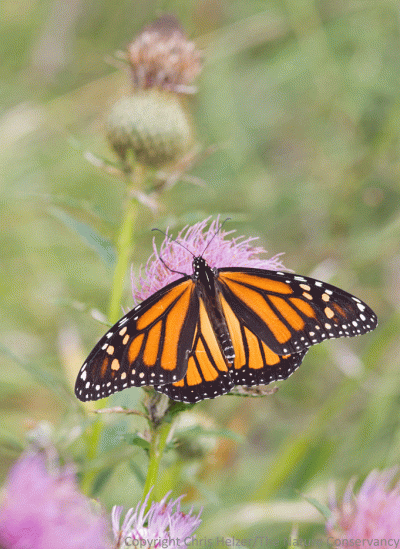
This migratory monarch is fueling up on a native thistle.  Thistles are among the top food sources for monarchs and other butterflies.  Allowing non-invasive thistles to persist in natural areas is an important part of pollinator conservation efforts.

Threats to Monarchs

There are two categories of threats to Monarchs: 1) Factors we can control, and 2) Factors we can’t.  The big factor we can’t control is weather and the way it interacts with migration timing and butterfly survival.  Weather can have a tremendous impact on butterflies, and many millions of butterflies are killed by hot weather, storms, or other events.  However, since we can’t control the weather, we have to focus on what we can control.

There is a long list of human-induced factors that affect monarch populations.  Those include the conversion of grasslands, roadsides, and field edges to row crops (largely facilitated by government policies) as well as farming practices that have nearly eliminated milkweed from farm fields.  Pesticide use is another factor, including pesticides used for farming and pesticides used for other purposes, including mosquito control.  Logging of forests in the wintering grounds of Mexico is another important issue.

I’d heard that the loss of milkweed from crop fields was a big deal for monarch butterflies, but hadn’t really understood why.  At the conference, we heard that research has shown that about four times as many eggs/plant are laid on milkweed plants in crop fields as on milkweed plants in other habitats.  (I’m not sure anyone understands why.)  In addition, while the eastern population is spread across a huge area of North America, about 50% of the butterflies that reach Mexico are born in the cornbelt of the U.S. – the intensively farmed Midwestern states.  Prior to the widespread use of glyphosate-resistant crops, milkweed was a pretty common inhabitant in crop fields throughout this prime breeding area for monarchs.  Now that farmers are so much more efficient at weed control, we’ve lost the most productive egg-laying habitat in the country’s most important breeding area for monarchs.

Conservation Strategies

Because monarchs can only be raised on milkweed, getting more milkweed plants in the landscape, especially within the cornbelt states, is a key part of increasing the monarch population.  It’s likely that more than a billion additional milkweed plants will be required to stabilize the monarch population.  Increasing milkweed populations to that extent will require a wide range of strategies.  In addition, protecting and restoring the wildflower-rich grasslands and other natural areas that provide food for adult monarchs, as well as for thousands of bee and other pollinator species, is also vitally important.
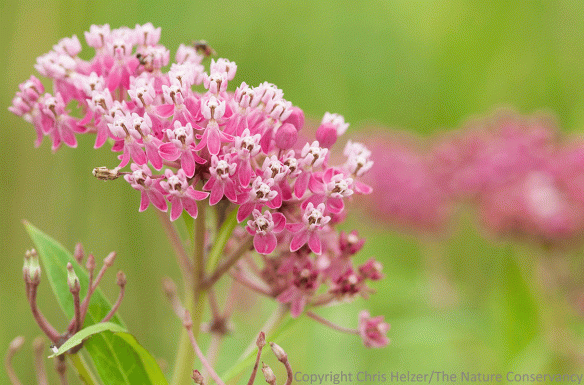
Swamp milkweed

It is critically important to increase the number of swamp milkweed (Asclepias incarnata) and other milkweed species available for monarch egg-laying.

One clear strategy is to plant more of monarchs’ favorite milkweed species in gardens, parks, roadsides, nature centers, and many other sites.  In the north-central U.S., milkweed species such as common (Asclepias syriaca), showy (A. speciosa), and swamp milkweed (A. incarnata), are known to be favorites, while green antelope horn (A. asperula) is important in more southern states.  You can find sources of seeds and plants at Monarch Watch or from the Xerces Society’s Project Milkweed website.  Sites like monarchgard.com can help with garden and landscape design ideas.

More milkweed in gardens and landscaping can make a big difference, but an even bigger part of monarch recovery needs to come from a change in the way milkweeds – and the weedy, edge habitats they thrive in – are perceived by the public.  Elimination of milkweed from roadsides, field edges, and odd corners and margins of our landscapes happens because we are uncomfortable with the “messiness” of those areas if they aren’t frequently mowed and/or sprayed with herbicides to make them look uniform in height and composition.  Allowing milkweed and other wildflowers to thrive in those odds-and-ends habitat areas can have a huge impact on monarchs and other pollinators, along with pheasants, song birds, and many other wildlife species.  Reducing mowing frequency and spot-spraying truly invasive plants – instead of broadcast spraying to kill anything that’s not grass – in these habitats saves both money and time as well.
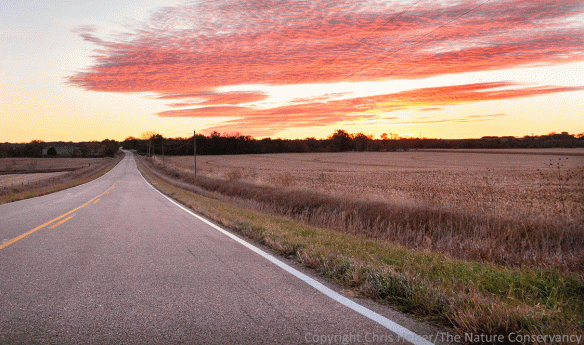
Roadsides

“Sanitized” monoculture roadsides like this offer no benefit to monarch butterflies or other pollinators.  We need to change our cultural aesthetic and acknowledge the value and beauty of roadsides that actually offer habitat values to monarch butterflies, pollinators, pheasants, and other wildlife and invertebrate species.

The Role of Prairies?

Last week’s meeting also encouraged me to focus even harder on an additional aspect conservation I’ve already been working on – improving the contributions of native prairies and rangeland to pollinators.  The experts at our meeting, along with other sources of information on monarchs, seem to be focused largely on milkweed and the kinds of farm fields, edge habitats and landscaping mentioned above.  While all those are very important, I can’t help but think about the value of native prairies – especially in places like Nebraska where we still have millions of acres of grassland.
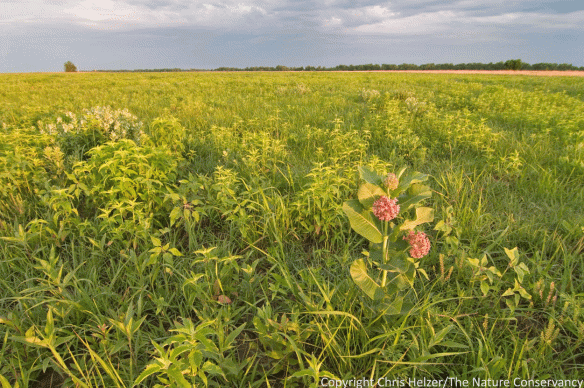
Milkweed in prairies

Many of our restored Platte River Prairies maintain milkweed populations for many years after establishment, even under fire and grazing management.  Figuring out what management strategies facilitate survival of milkweed may be a very important part of successful monarch conservation.

A healthy prairie with a diverse wildflower community is invaluable to bees and other pollinators, and also provides nectar resources needed by monarch butterfly adults.  If that prairie contains vibrant populations of milkweed species that provide egg-laying habitat to monarchs, that’s even better.  Many prairies don’t currently have strong milkweed populations.  Some milkweed species are not strong competitors in a tight-knit plant community, and certain grazing and other management practices tend to further discourage milkweeds.  Over the next several years, I am hoping to learn more about how to make prairies support stronger milkweed/monarch populations.  Hopefully, we and others can help make North American prairies even better contributors to the survival of monarch butterflies.


How big do prairies need to be?

There is an awful lot we still don’t understand about prairies (and the rest of the natural world, for that matter).  First and foremost, we haven’t even come close to discovering all the species that live in prairies.  We have probably identified all of the birds, and most of the other vertebrates, but there are still many prairie invertebrates no one has yet described.  The world of microorganisms is beginning to open up to us, but that is still, by far, the biggest pool of unknown species.  How can we manage a natural system when we don’t even know what’s there – especially when those inhabitants have a tremendous impact on ecosystem function?

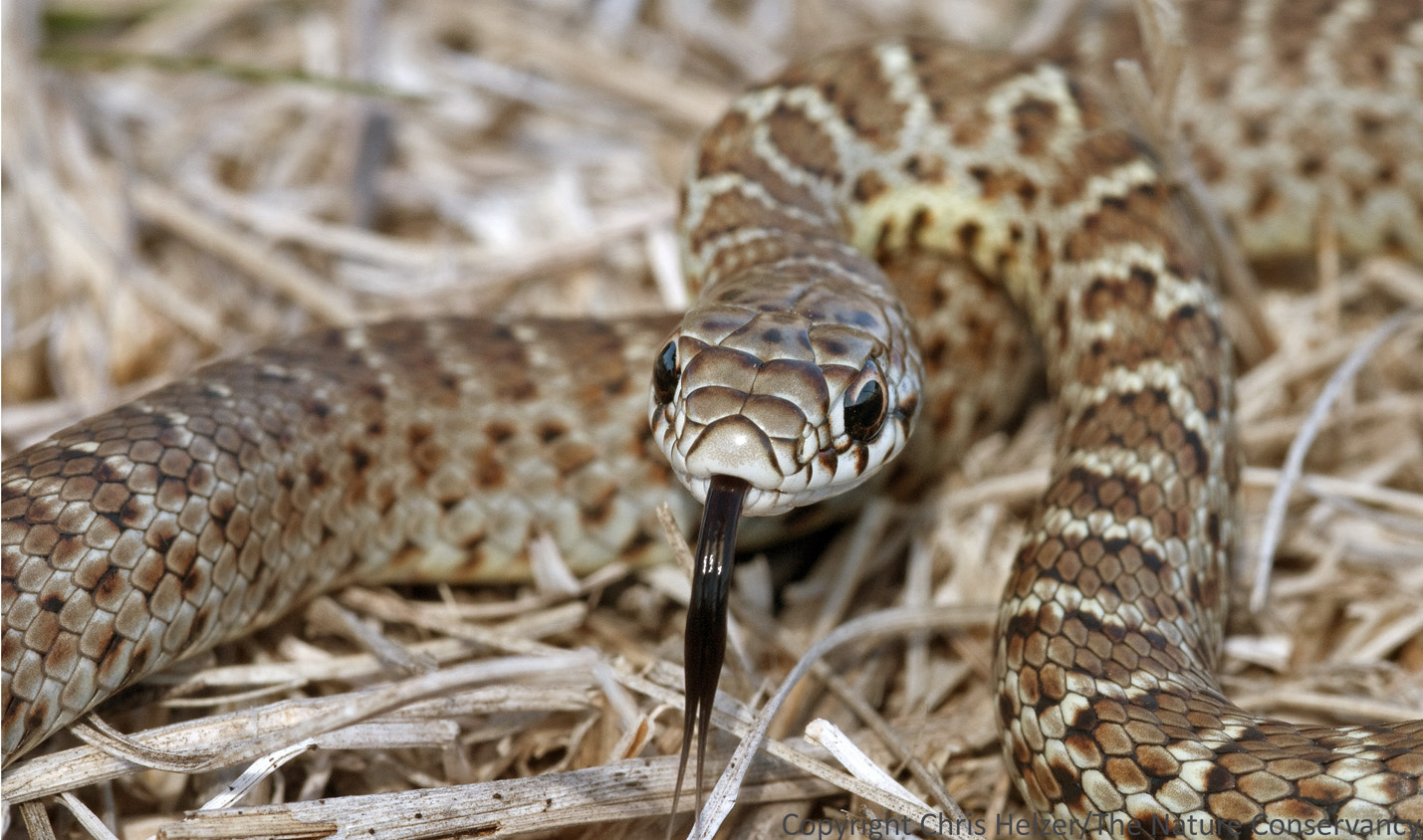
It's still possible that we'll find more snake species in North American prairies, but we've surely discovered nearly all of them. This one is a juvenile eastern racer (Coluber constrictor) in TNC's Platte River Prairies, Nebraska.

It’s possible that we’ll find more snake species in North American prairies, but we’ve surely discovered nearly all of them. This one is a juvenile eastern racer (Coluber constrictor) in TNC’s Platte River Prairies, Nebraska.

We need to discover more species and understand the basics of their life histories, but there are some other really big prairie questions out there that need attention as well.  I thought I’d share a few of the ones I think are most important.  I’m hoping you’ll find them thought-provoking and join me in trying to chip away at them.  We’re not going to answer any of them in the near future, but more people thinking about them and making careful observations will speed us more quickly along the path.  Because each question takes some explaining, I’ll just deal with one here and cover the others in future posts.

Big Question #1:  How big and connected does a prairie landscape need to be to support the majority of prairie species and essential natural processes?

This one has bothered me for a long time because not knowing the answer prevents us from setting reasonable goals for landscape-scale conservation efforts.  As prairie landscapes get carved up by rowcrop agriculture (e.g., the Dakotas), how do we know how much fragmentation will be catastrophic to the ecosystem?  On the flip side, in landscapes that were carved up long ago, what size prairie restoration projects should we aim for to truly restore sustainable prairie ecosystems?

We know that some prairie species require large patches of habitat.  Based on quite a bit of research on birds, we can make reasonable guesses about the size of prairie landscape needed to maintain populations of most bird species.  I’m not completely up to date on this research topic, but I think it’s fair to say that if you had a couple thousand acres of prairie and managed it for a diversity of habitat structure, you’d see most of the grassland bird species in your region show up to nest.  To ensure that those populations were large enough to survive tough years, it’d be nice to have more like 5,000 or 10,000 acres.  Depending upon where you live, that might sound like an impossibly big number or a very manageable one (Illinois doesn’t even have 10,000 acres of remnant prairie in the state, while 10,000 acres is pretty small for a ranch in the 12 million acre Nebraska Sandhills).

Uplan

Upland sandpipers are found most often in larger prairies, especially those with relatively short vegetation.

Assuming that 10,000 acres is a comfortably large prairie for grassland birds, you might think we could just use that as a benchmark for other species as well.  Unfortunately, there are a number of problems with that assumption, many of which I laid out in an earlier post.  One big problem is that bird habitat (quantified largely by factors like vegetation structure and insect abundance) is not necessarily quality habitat for pollinators, ants, or many other species that rely on high plant diversity.  Each of those other species has particular needs, both for habitat size and habitat quality.

A few species (bison? prairie dogs? others?) might need considerably more than 10,000 acres to support a viable population.  However, many other species probably need considerably fewer.   In fact, 10,000 acres might seem like an entire universe to many invertebrate species – although the more we learn about insect migrations, the more complicated that picture becomes.  Is 10,000 acres enough to provide for the vast majority of prairie species?  Maybe.  We really don’t know.

Green darners, and many other dragonfly species, migrate long distances. So do a number of moths and butterflies. Other invertebrates can also travel long distances. Does that make them more or less reliant on large prairie blocks?

Green darners, and many other dragonfly species, migrate long distances. So do a number of moths and butterflies. Other invertebrates can also travel long distances. Does that make them more or less reliant on large prairie blocks?

Regardless of whether or not it’s big enough to sustain populations, we know that restoring and/or preserving a single 10,000 acre block of prairie somewhere in the central United States would not be sufficient to conserve all prairie species.  In order to preserve genetic health and allow populations to recover from catastrophic events, species need multiple habitats in multiple locations.  They also need connectivity between those habitats so that individuals can move between populations.  So, we will need multiple examples of large prairie blocks in every region of the country, with smaller prairies around and between them.  (Questions about what constitutes connectivity and how much connectivity each species needs are also big important questions, but before we address those, we first need to know how large individual habitat blocks need to be.)

Why is this so important?  I’ll give you two real world examples.  First, think about a prairie landscape that has been relatively intact for thousands of years, but is now becoming fragmented by a rapid increase in new rowcrop agriculture.  This is a situation all too familiar to conservationists in the Dakotas, where millions of acres of prairie have been converted to rowcrops over the last couple of decades.  As those conservationists struggle to protect remaining prairie through conservation easements and other strategies, they are doing so with limited time and money.  Knowing what size a prairie block needs to be to sustain species and ecosystem processes would be tremendously helpful.

Let’s say an organization obtains a conservation easement that prevents 5,000 acres from being farmed.  Should they prioritize obtaining an additional easement next to it so that if everything else in the county gets farmed up, there will still be a 10,000 acre block of prairie remaining?  What if they have to pay double the price to obtain that second easement?  Is it worthwhile?  Or should they spend the same amount of money on two more 5,000 acre easements in other locations?  Not knowing the answer to what seems a pretty basic question makes it really difficult to know how to proceed.

My second example is at the other end of the spectrum.  There are a number of large scale prairie restoration efforts going on around North America, where thousands of acres of cropland are being restored to high-diversity prairie communities.  The best of those start with a number of unplowed prairie fragments and enlarge and reconnect those through restoration. The complexes of interconnected remnant and restored grassland they build are many thousands of acres in size.  The Nature Conservancy’s Glacial Ridge project in Minnesota, Nachusa Grasslands in Illinois, and Kankakee Sands project in Indiana are all great examples of this, as is the US Forest Service’s Midewin Tallgrass Prairie in Illinois.

We have proven that we can rebuild prairie landscapes of 10,000 acres and larger.  The sites look good, with beautiful plant communities and abundant wildlife, but are they big enough to sustain that biological diversity?  Should those sites be spending $15,000 per acre to buy high-priced cropland around their borders and increase the size of their restoration projects? Or should they invest those funds in invasive species control and other management needs to protect the investment they’ve already made?

Unfortunately, the answers to these fairly simple questions are not going to be simple to obtain.  We and others have taken a few baby steps by comparing the diversity and abundance of invertebrate species among prairie fragments of varying sizes and degrees of isolation, but we’re just getting started.  I think a better approach would be a large collaborative project that focuses on some of our largest, most intact prairie landscapes such as the Sandhills of Nebraska and the Flint Hills of Kansas and Oklahoma.  Studying how populations and ecosystem processes differ between core areas of those landscapes and the fragmented edges would be an excellent start.  We could learn which species might be most vulnerable to the negative impacts of fragmentation, and then focus on those species through additional research looking at how they are doing in prairies of varying sizes across their ranges.

We can learn a lot by studying how species do in the core versus the ragged edges of huge intact prairie landscapes like the Nebraska Sandhills.

We can learn a lot by studying how species do in the core versus the ragged edges of huge intact prairie landscapes like the Nebraska Sandhills.

I’ve planted this idea with quite a few people, but nothing has really taken off yet.  I’m not giving up.  This is too important.  Does anyone have a couple million dollars to spend answering one of the most pressing conservation questions of our time?

Here are a couple other examples of big research questions I think about.  I’ll address them in more detail in future posts.

1. How effective is prairie restoration (converting cropfield to high-diversity prairie plant communities) at defragmenting prairie landscapes?  Do populations of plants, insects, and wildlife in small prairie fragments grow larger and more interconnected when surrounding cropland is converted to prairie?  What are the key ecosystem components that need to be restored in order for that to happen?

2. How do prairie species respond to fire and grazing management patches, and how should that affect the scale and frequency of those management treatments?  What happens to a vole or other creature living in the unburned patch of a prairie when that patch burns?  Can it travel to other suitable habitat?  How does it know where to go?  What kinds of habitat can it cross and how far can it travel?

3. How does plant diversity influence the productivity and sustainability of grasslands, especially in ways that directly influence agricultural production?  Why should a rancher care about the plant diversity of his/her pasture?  Are there demonstrable increases in soil health, pollination services, forage productivity, forage selection, etc., and are those strong enough that a rancher would trade slightly lower annual income for them?