
Nebraska Wildflower Field Guide

About 20 years ago, Jon Farrar, one of Nebraska’s preeminent naturalists and photographers published a fantastic field guide to the wildflowers of Nebraska and the Great Plains.  Unfortunately, the book sold out within a year and a half and has been nearly impossible to find since then.  Finally, after all this time, it has been reprinted, and the new edition is even better than the first.

I was asked to write a review of the new edition for Prairie Fire Newspaper, and was more than happy to oblige (and not just because I got a free signed copy of the book!).  The review was published in the April 2012 issue of Prairie Fire, and you can read it here.

To see more of Prairie Fire Newspaper, please go to their website at www.prairiefirenewspaper.com.  You can also read more about Jon’s book at the University of Iowa Press website.
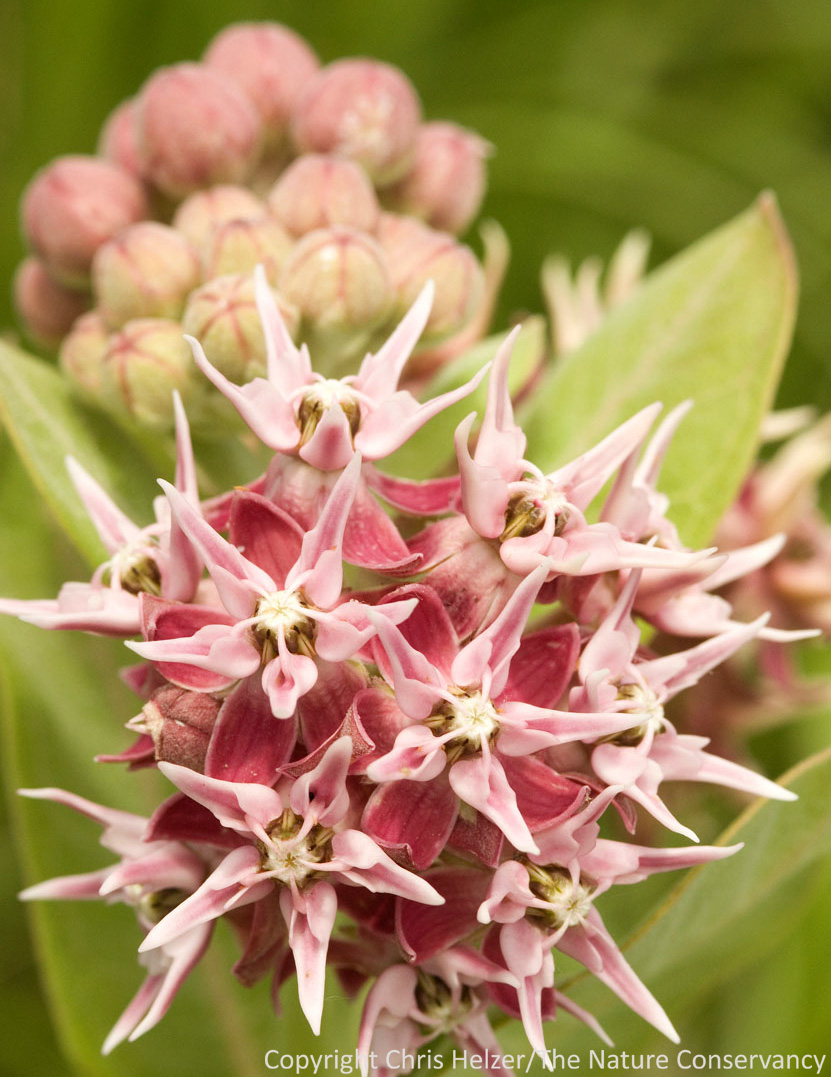
If you had Farrar's wildflower field guide, you'd know that this is showy milkweed - not common milkweed - because the flowers are more prominent and have longer "hoods". Not only does the book explain what hoods are, it has excellent photos of both species that make the differences very easy to see.

It’s Spring for Snakes

The temperature topped 80 degrees F today in the Platte River Prairies.  I heard a frog plop into the water as I walked along a wetland edge.  Red-winged blackbirds were defending territories. 

…and apparently red-sided garter snakes were feeling the spring too.

A small mating ball of red-sided garter snakes. Platte River Prairies, Nebraska. Click on the picture for a larger, sharper image - if you dare.

When I first came upon these garter snakes, there were four of them.  As I neared, the writhing mass of snakes separated, and they all started for me like they thought I was going to give them something to eat.  I have no idea what that was about, but it’s a good thing I’m not afraid of snakes!  As I got my camera out of the truck, the snakes scattered, and one went a different direction from the others.  The other three slithered about 10 feet away and then re-formed their mating ball.  I’m assuming the bigger of the three snakes was the female, but it can be hard to tell.

Apparently, even snakes can have a hard time telling males from females in this kind of mating frenzy.  As garter snakes emerge from their winter dens, males come out first and and lie in wait for females.  When a female arrives on the scene it’s mobbed by a group of waiting males and they writhe around together until a pair finally mates.  Just to make things interesting, though, sometimes males can pretend to be females, and can even exude a female pheromone.  It’s not clear why the “she-males” do this, but there are some theories.  Since newly emerging snakes are cold, and thus slow, it may be that she-males are trying to warm up by attracting a “snake blanket”.  Besides the warmth advantage, being in the middle of a big ball of snakes might be good protection from any nearby predator, who is likely to pick off the snakes from the outside of the ball, not the inside.  On the other hand, it seems like a ball of snakes might attract more predators than a single slow-moving cold snake!

It was a great spring day to be outside.  Apparently, the snakes thought so too!