Conservation Grazing in Iowa

I got the chance to spend a couple days in Iowa last week, talking about conservation grazing with staff of the Iowa Department of Natural Resources.  They invited me to join a two day workshop discussing various ways to use grazing for conservation objectives.  My main role was to kick off the meeting by providing various examples of objectives that can be addressed through grazing.  Beyond that, I was asked to participate in the remainder of the workshop and contribute thoughts and ideas as appropriate.  I am grateful to have had the opportunity to participate, and came away with a better appreciation for the challenges faced by Iowa prairie managers.

Staff of the Iowa Department of Natural Resources discuss conservation grazing at the Kellerton Wildlife Management Area in south-central Iowa.

Staff of the Iowa Department of Natural Resources discuss conservation grazing at the Kellerton Wildlife Management Area in south-central Iowa.

I thought I’d share some of what I covered in my presentation.  Essentially, I focused on two broad categories of prairie management objectives that can be addressed through cattle grazing.  Those are:

  1. Reducing grass dominance to increase plant diversity
  2. Increasing heterogeneity of habitat

Reducing Grass Dominance

Dominant grass species can sometimes suppress prairie plant diversity by monopolizing soil and light resources.  Two categories of prairies seem particularly vulnerable to this: 1) prairies that have been degraded by chronic overgrazing or broadcast herbicide use, and 2) restored (reconstructed) prairies.  In Nebraska and Iowa, dominant grasses can include non-native invasive species such as smooth brome (Bromus inermis), Kentucky bluegrass (Poa pratensis), tall fescue (Schedonorus arundinaceus), and reed canarygrass (Phalaris arundinacea), as well as native species such as big bluestem (Andropogon gerardii).

When attempting to reduce the dominance of these grasses, it’s important to be clear about what you’re trying to accomplish.  If the ultimate goal is to increase plant diversity, it’s not enough to just suppress the vigor of grasses.  In order to be successful, a variety of other plant species have to colonize territory abandoned by that weakened grass.  A late-spring prescribed fire can temporarily suppress the growth and vigor of smooth brome or Kentucky bluegrass, but often results in robust growth of big bluestem later that season.  Trading a dominant invasive grass for an aggressive native grass may not be success if wildflower diversity remains low.

Grazing can play an important role in increasing plant diversity by repeatedly defoliating  major grass species that limit plant diversity.  The timing, stocking rate, and frequency of grazing can all be adjusted based on the grass species and objectives at a particular site.  As an example, we sometimes combine an early spring prescribed fire with intensive grazing (through about June 1) to suppress cool-season invasive grasses such as smooth brome and Kentucky bluegrass.  If big bluestem is abundant in the same place, we’ll leave cattle in for much of the summer as well, but at a lower stocking rate.  The strategy is to suppress both the invasive cool-season grasses and the native warm-season big bluestem while allowing other plants to thrive and expand their footprint.

At low stocking rates, cattle tend to keep big bluestem closely cropped, but don’t target most wildflower species.  We usually see an abundance of new plants growing in and amongst the weakened brome, bluegrass, and bluestem during the year of grazing and the following year.  Those new plants include both short-lived “opportunistic” plants and longer-lived perennial plants.  The result is a bump in plant diversity.  If we repeat the same kind of treatment every few years, we can often maintain a richer plant community than we can with other management options such as fire or mowing alone.

The rattlesnake master plant (Eryngium yuccifolium) in the foreground of this photo was ungrazed, in  spite of being the burned patch of this patch-burn grazed prairie.  A light stocking rate meant that even this often-favored plant was being rarely grazed in this Iowa DNR prairie.  Staff were hoping to reduce the dominance of tall fescue and allow species such as rattlesnake master to increase in abundance.

The rattlesnake master plant (Eryngium yuccifolium) in the foreground of this photo was ungrazed, in spite of being the burned patch of this patch-burn grazed prairie at Kellerton WMA.  A light stocking rate meant that even this often-favored plant escaped grazing in this Iowa DNR prairie. Staff were hoping to reduce the dominance of tall fescue and allow species such as rattlesnake master to increase in abundance.

There are countless ways to employ cattle grazing to weaken dominant plants and stimulate higher plant diversity.  I’ve written about other examples previously.  You can find a couple of those here and here.

Increasing Habitat Heterogeneity

Cattle grazing can create habitat structure that other management options such as fire and mowing can’t.  As they work to meet their nutritional needs, cattle graze some plant species (mostly their favorite grasses) preferentially.  Stocking rate, or the intensity of grazing, correlates with grazing selectivity.  At low stocking rates, cattle are free to eat only what they really want, resulting in closely cropped patches of grass interspersed with taller clumps of less palatable grasses and wildflowers.  When stocking rates are higher, cattle are forced to eat a wider range of plant species, creating a more uniformly short vegetation structure.  Both the “lower-stocking-rate-patchy-habitat” and “higher-stocking-rate-uniformly-short-habitat” can be valuable to wildlife and invertebrate species.

The ideal situation is to provide the widest possible range of habitat types within a prairie, or within a series of adjacent or connected prairies.  That way, regardless of their habitat needs, most wildlife and invertebrate species will be able to find a place to live.  Changing the location of each of those various habitat types from year to year helps keep any species (plant or animal) from becoming so abundant that it impacts other species to the point of reducing diversity.

Because of the unique vegetation structure created by grazing, a wider range of habitat types can be created with grazing than with either fire or mowing.  However, it’s also very important to ensure that grazing doesn’t have a detrimental impact on plant diversity in the name of creating wildlife habitat.  Significant periods of rest from grazing and careful monitoring of grazing impacts and populations of sensitive plant species are important.  If conservation is the primary goal, grazing should be used only when there are specific objectives to meet, not as a default strategy.

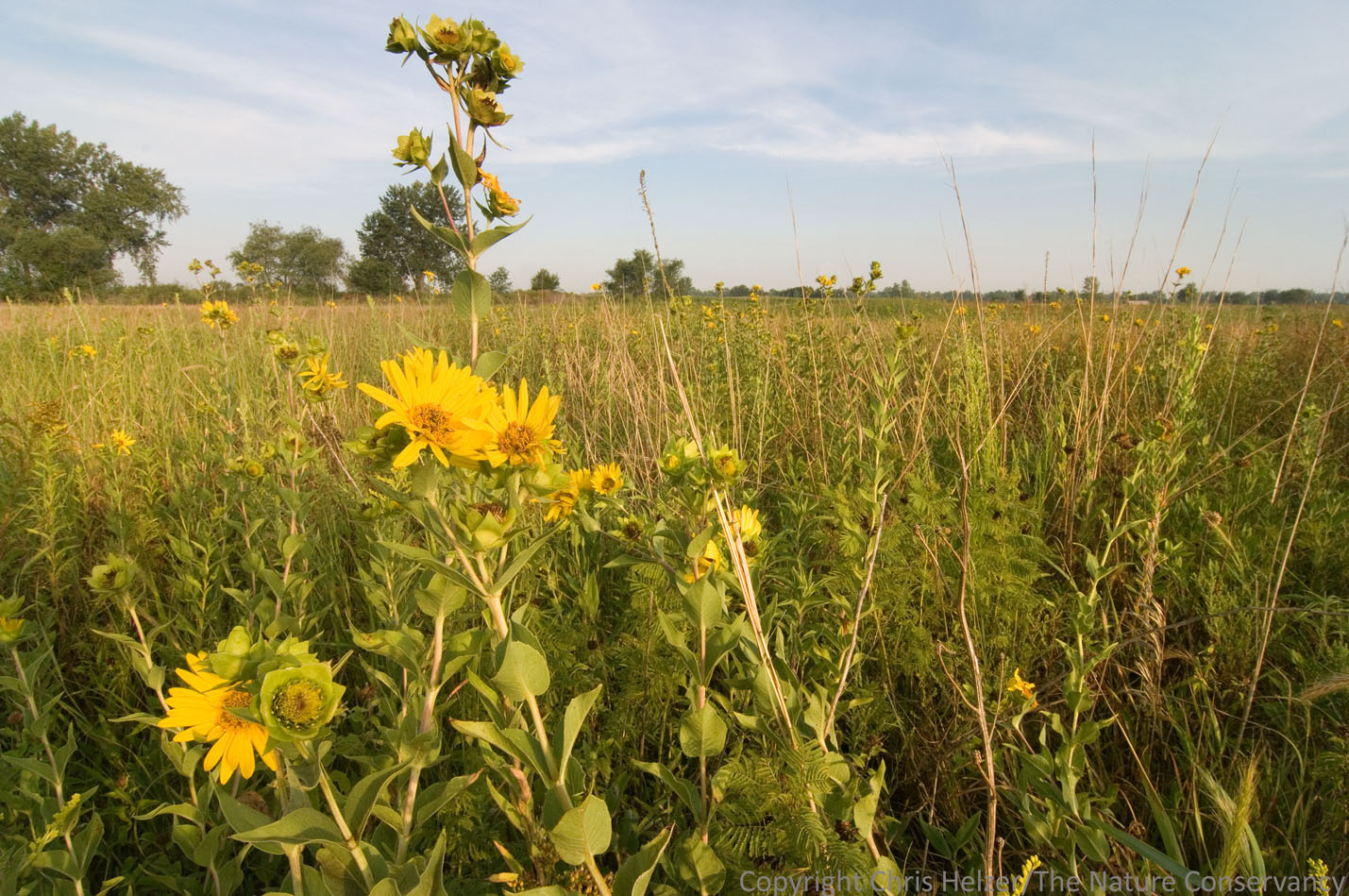
This seeded prairie has been part of a grazing system in every year since it was planted in 2003, and has maintained an excellent diversity of prairie plants.  Examples in the foreground include leadplant (Amorpha canescens).

This seeded prairie has been part of a grazing system in every year since it was planted in 2003, and has maintained an excellent diversity of prairie plants. Examples in the foreground include leadplant and Ohio spiderwort (blooming) but many others, including rare and conservative species, were abundant as well.

I’ve written much more on the topic of creating heterogeneous habitat with grazing in previous posts as well, and you can find a couple examples here and here.

Setting Useful Objectives – And Then Using Them

Regardless of the management tool(s) being employed, the biggest challenge for a prairie manager is to set clear objectives and then follow up on them.  Start by defining the outcome you want (different habitat structure, more plant diversity, etc.) and then describe precisely what success looks like.  Monitoring doesn’t have to mean spending hours on your knees with a plot frame, it just means measuring the outcome you desired.

For example, if you want more habitat diversity, you could start by listing the types of habitat structure you want (tall/dense, short sparse, patchy forbs with short grass, etc.) and how much of the prairie you’d like to be in each category.  Then, you could make a rough map of how the site looks before the treatment and estimate percentages of each habitat type.  After your grazing, fire, or mowing treatment, make another map and see if you reached your objective.

If plant diversity is important, decide how you will measure that.  This is where a plot frame and repeated sampling across a prairie can be helpful, but there are simpler ways as well.  You could pick out 3-5 small areas (less than 10 square meters) that you can find each year and then annually list the plant species you find in each area to see if that number changes over time.  You don’t have to identify all the species, just list how many there are.  If you are using grazing, it’s also important to figure out which plant species are favorites of the cattle and use that information to ensure that your management allows those plants enough rest from grazing that they can bloom and make seed every few years.

Most importantly, your objectives should drive the adjustments you make to management from day to day and season to season.  If you can define what you want, you can see if your management is moving you in the right direction.   It’s fine to change objectives as you learn, or as conditions change.  In fact, in our Platte River Prairies, while we have some broad objectives (plant and habitat diversity), we set new specific objectives and management strategies each year to respond to what we’re seeing on the ground.

Cattle grazing is just another tool that can be used for the conservation of prairies.  It’s not appropriate for all prairies or situations, but can help meet some objectives in ways that other tools (fire, mowing, herbicides) can’t.  Conservation grazing differs from ranching in that income doesn’t have to be a major part of the decision-making process each year.  On land where conservation is the primary objective, managers can decide when and how to employ grazing (or not) based purely on the conservation challenges they face.

Thanks again to the Iowa Department of Natural Resources for inviting me to their conservation grazing discussion last week.  I was impressed by the thoughtfulness and creativity of the staff I met, and I look forward to hearing more about their prairie management and restoration work down the road.


Photo of the Week – May 30, 2014

I made another trip up to Griffith Prairie last week.  It looked pretty much as it had the week before – still lots of ragwort blooming –  but the photographs I returned with were very different.  This time, I came home with a bunch of photos of dumb invertebrates.

(I don’t mean that invertebrates as a group or concept are dumb, rather that the particular individuals I photographed seemed not to be very smart or savvy.  I’ll explain in a minute.)

Since I’d spent quite a bit of time photographing landscapes on my previous visit, I decided to put my macro lens on the camera and look for insects this time.  It was immediately clear that the long winter had dulled my insect photography skills…

First, I had to get my brain refocused on the idea of finding small creatures.  That part actually came back fairly easily.  Second, however, I had to work on my approach once I spotted those small creatures (come in low and slow).  I started by tracking some damselflies that were flitting just ahead of me as I walked.  I’d wait for one to land, then creep slowly toward it.  Unfortunately, just as I’d set my tripod down and lean forward to focus, the damselfly would fly about 2 feet further away and I’d have to repeat the whole process.  That highlighted the third aspect of insect photography I had to recapture… patience.

This was not the first damselfly I tried to photograph...just the one that finally let me get close enough to get a picture of it.

This was not the first damselfly I tried to photograph…just the one that finally let me get close enough to get a picture of it.

I did finally manage to get a photo of a damselfly.  I think it was a matter of following several different ones until I found one that wasn’t as skittery.  Of course, that’s probably a bad sign for the potential survival of that individual damselfly, since skittery is a good tactic to avoid predation.  I often wonder whether the insects I photograph are the ones that are not long for the world…

This returns us to the “dumb insect” topic.  Do you suppose smart insects look different from dumb ones?  I’ll probably never know because the only invertebrates I can photograph are the ones that are too dumb to run, jump, or fly away!

Here is a selection of some of the invertebrates that hung around on ragwort flowers long enough for me to photograph them last week.  I wish them the best, of course, but I’m not optimistic about their long-term survival…

This tiny beetle was on several ragwort plants.  Most of the beetles turned away or jumped to safety when they saw me coming, but this one didn't.

This tiny beetle species was on several ragwort plants. All of the other similar-looking beetles turned away or jumped to safety when they saw me coming, but this one didn’t.  It appeared to be enjoying its pollen dinner too much to bother running away.  It’s probably inside a bird or spider by now.

.

Not a very smart little fly...

Not a very smart little fly…

.

I must have seen two dozen crab spiders before I got this photo.  All the rest of them crawled beneath the petals when I approached, or dropped to the ground if I kept coming.  This one just sat there.

I must have seen two dozen crab spiders before I got this photo. All the rest of them crawled beneath the petals when I approached, or dropped to the ground if I kept coming. This one just sat there.

.

I got several photos of various individuals of this bug species (a true bug - Hemiptera).  Maybe the whole species is not so smart?

I was able to photograph several individuals of this bug species (a true bug – Hemiptera). Maybe the whole species is not so smart?

It was pretty neat to see the diversity of insects and other invertebrates using this one species of wildflower.  There were quite a few more than I’m showing here because most of them didn’t stick around long enough to be photographed (the smart ones).  I’m grateful to those that did.

…and I bet there are some grateful predators out there too.