I was featured on a podcast episode that came out today. I’ve enjoyed being a guest on quite a few podcasts, but I think this one might have produced the best synthesis of many of my thoughts on prairie management. If you’re interested in listening to it, check out the Wild Ag Podcast on your favorite app or click here.
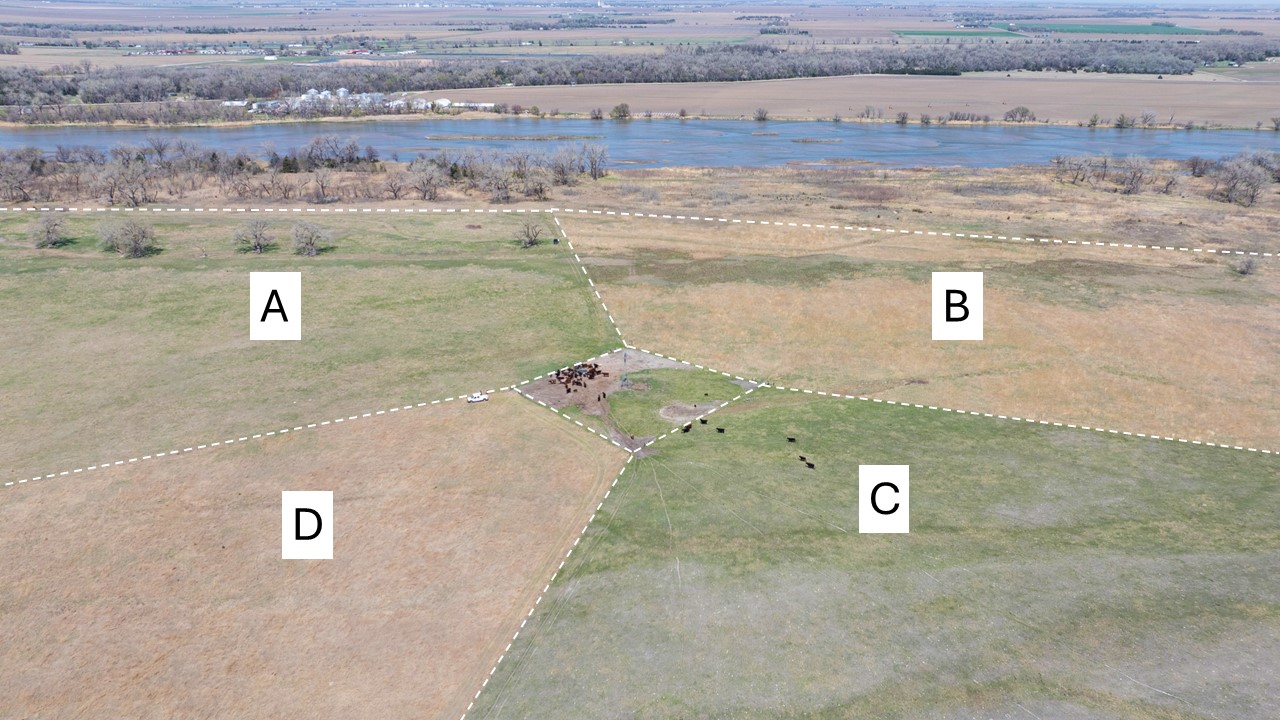
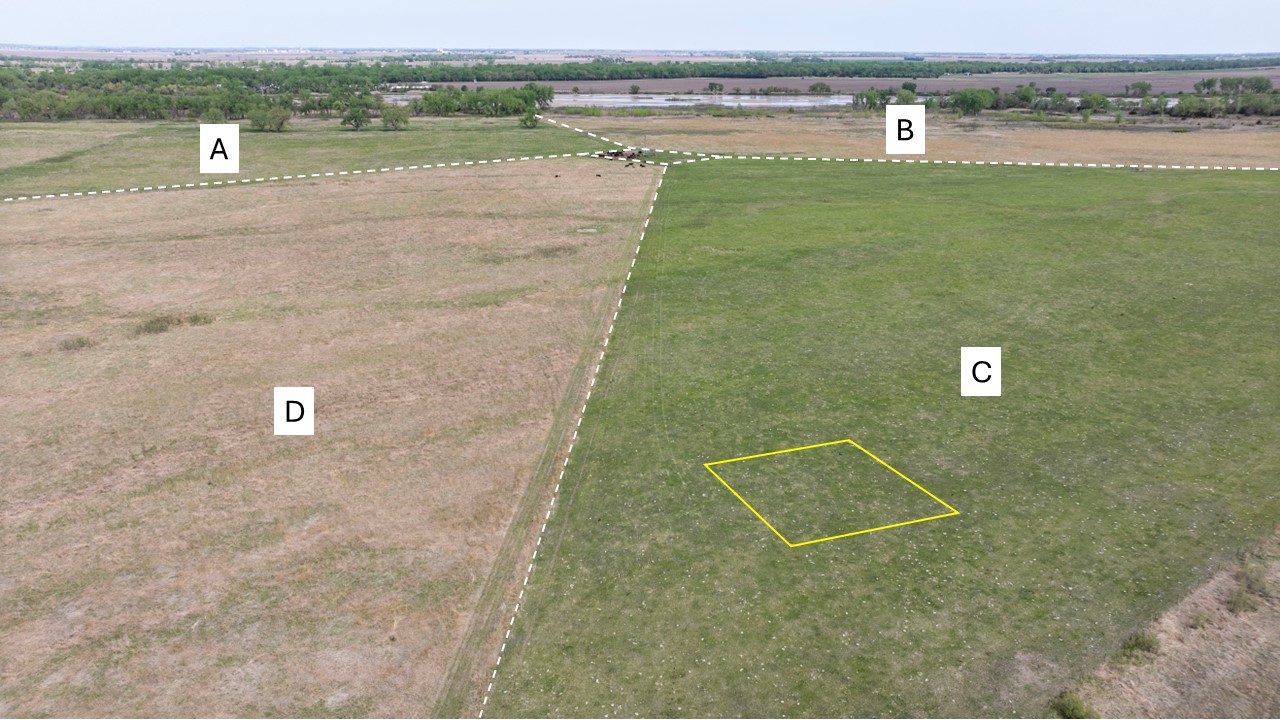
A variety of habitat conditions across one swath of grassland at The Nature Conservancy’s Platte River Prairies in Nebraska back in 2023. Click on the photo if you want to see a bigger version.
Speaking of prairie management, as I was preparing a presentation on the topic last week, I came across an aerial photo I’d taken a couple years ago at our Platte River Prairies. The image does a great job of illustrating what habitat heterogeneity can look like across one management unit.
Variation in available habitat conditions (habitat heterogeneity) can be created by many factors. Some of those factors are unrelated to our actions as land managers. Topography, soil texture, and soil moisture, for example, all have big influences on what plant species can grow in a particular place. The same conditions can also drive the height and density of plants – high/dry/south facing slopes will have much shorter/sparser vegetation than low-lying/moist valleys, for example.
In the photo shown above, that influence can be seen in at least a couple ways. First, in the foreground of the photo, there are yellow stripes created by concentrations of blooming perennial sunflowers and goldenrods. Those plants are spread throughout the site, but are most lush and abundantly flowering in soils laid down by old river channels hundreds/thousands of years ago when this part of the prairie was part of the active Platte River.
Similarly, in the top part of the photo, you can see a broad slough that looks slightly darker than the surrounding vegetation. That slough is also an old river channel and has not only different soils, but is also lower in elevation and closer to groundwater, which helps determine both the plant species growing there and the height and vigor of those plants.
The management history of this site also plays a big role in the available habitat today. The top portion of the photo is unplowed (remnant) prairie, though it had some years of chronic overgrazing that decreased its plant diversity before The Nature Conservancy acquired it. We’ve replenished some of that lost plant diversity by overseeding missing species, but the plant community is still not what it was. On the other hand, it does have a very strong native sedge community and a pretty nice set of early season wildflowers that aren’t in the portion of prairie shown at the bottom of the photo.
That area shown in the lower portion of the photo was in row crops for years before being planted (not by us) back to grassland with a few wildflower species. Since then, it has increased in plant diversity, but no botanist would mistake it for an unplowed remnant prairie. It provides excellent habitat for many animal species, but has obvious differences from the adjacent remnant site.
Finally, the most dramatic variation in vegetation structure at the time this photo was taken was driven by recent management actions taken by Platte River Prairies manager Cody Miller and others. The entire prairie shown in the photo had cattle on it during the year of the photo (and in prior years). However, the grazing pressure across the site was very uneven, driven by prescribed burning.
In 2023, a spring fire was conducted in the area shown in the foreground, and a late July burn took place near the top right of the photo. When the 2023 growing season started, cattle focused most of their grazing in the recent spring burn, keeping that vegetation short and allowing plants elsewhere to grow tall. After the smaller August burn took place, cattle shifted some of their grazing there, reducing grazing pressure on the spring burn – which is partly why the sunflowers are blooming so abundantly. If you’re interested, you can read more about that summer fire and see more photos of it here and here.
Meanwhile, most of the remainder of the site had lots of tall vegetation and relatively thick thatch (accumulated dry vegetation from previous years’ growth) because it hadn’t been burned recently and had recovered from previous grazing bouts.
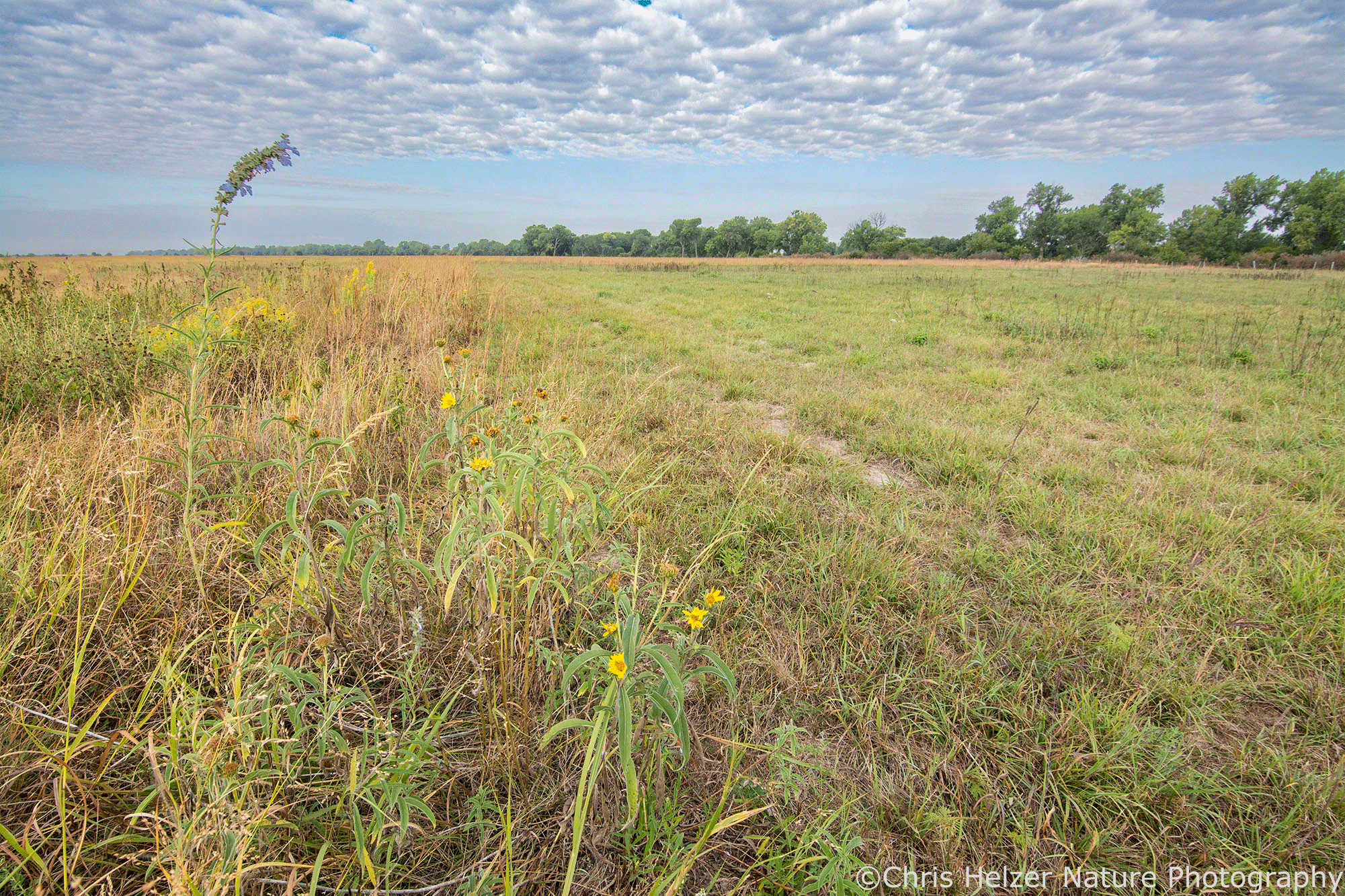
This mid-September photo shows part of the remnant prairie, with unburned grassland on the left and the summer burn on the right. The two areas provide very different habitat conditions for plants and animals, each of which is valuable.
As a whole, this management unit (roughly 500 acres, with more prairie across the creek to the north – out of frame to the right) provided a wide variety of habitat conditions for the plants and animals living in it back in 2023. Last year, in 2024, we burned yet another patch, which shifted grazing pressure to a new portion of the site and allowed the 2023 burned areas to start growing tall again. New management treatments in 2025 will continue to shift things around, while maintaining the same kind of habitat variety – just in different places.
If you missed it, I talked much more about habitat heterogeneity and why it’s important in this recent post. Our primary objective for the Platte River Prairies is to sustain high ecological resilience, which relies heavily upon species diversity (animals, plants, and more). We’re working under the assumption that providing a constantly-shifting mosaic of habitat types is the best way to support that species diversity.
There’s a lot of science that backs up that shifting mosaic assumption, but we try to test it whenever we can. Plant diversity has been very stable over the last 20 years or so on the sites I’m able to monitor closely. Habitat use by wildlife, including insects, is harder to quantify, but what we’ve seen has been positive. Birds species appear in different places each year, but all the species we’d expect to see always show up. Similarly, regal fritillary butterflies and other insect species seem to be doing well, but follow their favorite habitat conditions around the site. The plains pocket mouse – a species of concern in this part of the world – maintains surprisingly consistent populations, regardless of our management actions.
We’re always looking for researchers who’d like to help us look more closely at any aspect of the system – let me know if you’re interested! In the meantime, we’ll keep experimenting and learning the best we can.
Last week, I
attended a science and stewardship conference of The Nature Conservancy in
Madison, Wisconsin. It was an inspiring
and thought-provoking week. There were a
lot of topics that will provide fodder for future blog posts, but I wanted to
start with an issue that came up in several sessions. The topic had to do with setting appropriate
objectives for conservation strategies, and for land management in
particular. In short, it’s really
important to make sure we’re not setting objectives that are focused on
strategies rather than outcomes.
This mixed-grass prairie is managed with both prescribed fire and grazing. However, neither fire nor grazing is the objective, they are tools that are strategically employed to create desired outcomes. Gjerloff Prairie – Prairie Plains Resource Institute
Here’s an
illustration of what I mean. If I was
planning a vacation for next summer, I probably wouldn’t start with the
following question: “What mode of transportation should I take on my vacation
next year?”
Clearly, it’s tough to answer that question without knowing more about the ultimate objectives of the vacation. Where do I want to go? What time of year am I going? How many people are going with me? If I’m planning to travel from Nebraska to Ireland, I probably won’t be able to do that by bus. I could conceivably travel by motorcycle (if I had one) to the Rocky Mountains, but probably not if I was going during the winter or planning to take little kids with me.
It seems
silly to start by thinking about how to get somewhere before deciding where to
go, but as land managers, it’s easy to fall into exactly that mindset. We sometimes set objectives about using fire
or grazing, for example, instead of first defining the outcome we want and then
thinking about what tools and strategies might get us there (which may or may
not include fire or grazing). In this
post, I’ve provided examples of how this trap can present itself, both to
managers of conservation land and private landowners, and some thoughts about
how to avoid the trap.
Significant
research has helped us understand the kinds of fire and grazing patterns under
which North American prairies developed.
For example, in many places, we have a pretty good idea how often a particular
site burned, on average, before European settlement. We also have reasonably good information on
the presence, abundance, and behavior of historic grazers. Based on that information, a land manager
could decide that the best management for their prairie would be to reinstate,
as closely as possible, the timing and intensity of historic fire and grazing
that site likely evolved under.
Historically, prairies in this region probably burned on an average of every 4-5 years. However, within that average range, there would have been wide variation. More importantly, this prairie sits within a very different landscape today, with challenges not faced by those historic prairies.
Patch-burn grazing is often described, for example, as “mimicking historic fire and grazing patterns.” Mob grazing advocates trumpet (though I’m skeptical) that their system replicates the way bison moved across a landscape. Some in the Upper Midwest region of North America point to research showing high populations of indigenous people and scarce evidence of abundant bison and argue that their prairies should be managed only with fire. We can argue about all three of those examples – and many more – but the bigger point is that none of those arguments should determine our management strategies. Again, we shouldn’t be setting objectives about the strategy we want to use without first identifying the outcome we want.
To make a
clunky return to my vacation travel analogy, it would be silly of me to choose
horseback as my preferred mode of transportation across the Great Plains to the
Rocky Mountains just because it’s what worked several hundred years ago. Today’s landscape is broken up into countless
fenced off private land parcels, which would make cross-country horse travel
difficult, to say the least. In
addition, there is a pretty nice set of modern opportunities (roads and vehicles)
I can take advantage of nowadays.
Likewise, our prairies exist within a different world today, with a new set of challenges and opportunities. Mimicking historic disturbance regimes won’t necessarily keep prairies in good shape in a world with habitat fragmentation, massive invasive species pressure, climate change, nitrogen deposition, and other factors. And speaking of good shape, our first and primary concern should really be to define what “good shape” is, right? Are we managing for plant diversity or a few rare plants? Are we trying to sustain diverse bird populations? Habitat heterogeneity? Is ecological resilience the goal? If so, what are the factors driving resilience, and how to we sustain those? There are countless reasonable goals for land managers to choose from, many dependent upon scale, but those goals should be based on the outcome we want.
This annually-hayed prairie maintains high plant diversity but provides only one type of habitat structure for nesting birds and other wildlife species. Depending upon the objectives for the site, that could be fine, but it very much depends upon what the manager wants to accomplish.
I feel it’s important to say this here: I am a big proponent of both fire and grazing as management tools – you can find myriad examples of that by searching through my previous blog posts. However, while I think combining fire and grazing can create some fantastic results, those strategies/results don’t fit all objectives. More importantly, your particular site may or may not respond well to those kinds of fire and grazing combinations.
Let’s say
your primary objective is to provide habitat for as many species of grassland
birds as possible. First, you’ll need a
pretty big swath of land – many bird species have minimum habitat size
requirements. Assuming you’ve got
sufficient land, the major factor grassland nesting birds respond to is habitat
structure. Some birds prefer tall thatchy
structure, others like short/sparse vegetation, and others want something
in-between. A reasonable outcome-based
objective might be that you want to provide all three of those habitat types
across your prairie each year (and you’ll want to make sure the habitat are
being successfully used by a diverse bird community). Perfect.
Now, how will you create those habitat types?
Grasshopper sparrows tend to nest in prairies with relatively short structure, but with some thatch (which they use to build nests) along the ground. Some of the highest abundances of grasshopper sparrows around here are found in relatively heavily-grazed prairie.
Fall or
spring fires can create short habitat structure that some birds really like to
nest in. However, some bird species
(e.g., grasshopper sparrows) usually like short habitat with a little more
thatch in the ground layer than is usually found in recently burned
prairies. Also, while burned areas are
short and unburned areas are tall, it’s difficult to create in-between
height/density habitats using only fire.
This is where other tools such as mowing and grazing might be
helpful. Mowing can reduce the height of
tall vegetation and create short or mid-height structure that grasshopper
sparrows, meadowlarks, and other species prefer. Grazing can do the same and can have the advantage
that cattle or bison are selective grazers, eating some plants and leaving
others. This can create structure with
both tall and short vegetation mixed together and can also help suppress
grasses and allow for greater expression of forbs (broadleaf plants) –
something birds such as dickcissels often prefer.
Upland sandpipers prefer to nest where vegetation structure is short, but often move to sites with strong forb cover and a little patchier structure when their chicks become active.
If we’re
trying to create optimal bird habitat, then, fire, mowing and grazing might all
be useful tools to consider. It’s
important to understand how each tool can be used to affect habitat structure,
as well as the potential risks of using each (fire can sometimes kill
aboveground animals and stimulate invasive plants, grazers can sometimes target
vulnerable plants and create issues via trampling). With all of that information, you can start putting
together strategies that employ the right tools, and then test those strategies
against the OUTCOMES you desire. Notice
that the process I’ve just described is independent of the kinds of historic
fire returns for your area or whether or not you think grazing was a significant
factor in the evolution of regional plant communities. Define your objective by the outcomes you
want and test/adapt strategies based on that objective.
Other examples:
At my family prairie, we aren’t using prescribed fire because we’ve been able
to use grazing to meet our objectives of habitat heterogeneity and increasing
plant diversity, and we use loppers/herbicide to successfully control woody
invasion. In small prairies where
preserving particular plant species is the objective, a strategy using only
fire or mowing could be most appropriate.
If that small prairie has rare insects or reptiles that are especially
vulnerable to fire, maybe mowing is the best tool. Regardless, the right tools and strategies
depend upon the outcome-based objective.
This photo was taken in the burned patch of a patch-burn grazed prairie at Konza prairie, near Manhattan, Kansas. The grazing created varied habitat structure because of the selective grazing by cattle. Leadplant and other ungrazed forbs contrast with surrounding short grasses.
For ranchers
and farmers who manage prairies, this same objective setting process should
apply, but of course those prairies also have to help provide sufficient income
to keep a family or business thriving.
Even in those cases, however, it’s still important to start with
outcome-based objectives. Those
objectives can include a certain amount of needed income but should also include
specific habitat or other ecological objectives. Once you’ve decided, for example, that you
really want to manage in a way that provides a certain amount of quail habitat
or provides consistent pollinator resources through the season, you can look
for ways to accomplish that while still providing the needed income. When a conflict between income and habitat
objectives arises, you can make the decisions that make sense to you, but at
least you’re making those decisions with all the information needed to fully
consider the options.
Prescribed fire can be a great tool for accomplishing some objectives, but it can also be difficult to implement for some managers. While it is an important ecological process in prairies, employing prescribed fire should still be seen as a tool/strategy, rather than as an objective in and of itself.
There are
plenty of reasonable prairie management objectives to choose from, but they
should be based on outcomes rather than on tools and strategies. Employing more frequent prescribed fire is
not a good objective. However, using
more frequent prescribed fire might be a great strategy to reach a particular
outcome. (It could also be a terrible
strategy, depending upon your objective.)
Don’t fall into the trap of choosing your transportation method before
you know where you want to go.
P.S. I’m sure some of you are thinking it, so let me address what might appear to be a weakness of my vacation transportation analogy. Yes, it’s perfectly fine to start vacation planning by deciding that you want to take a cruise ship or motorcycle if the OUTCOME you really want is to ride on a ship or motorcycle. If you don’t care where you go, the destination isn’t the outcome, it’s just a by-product of your mode of travel. Fine. But I think you understand what I was trying to say, right? Sure, you could argue that conducting prescribed fires could be your objective if all you want is a legal way to light things on fire and watch them burn. If that’s your objective, though, you’re not managing prairies, you’re lighting things on fire – and there’s a big difference. Ok? Ok.