Saving Pollinators One Thistle at a Time

Pollinator populations are in trouble for a lot of reasons.  Loss and degradation of habitat, pesticides, and diseases are all major contributors.  However, at least in the Central United States, much of the pollinator decline can be tied to spiny pink/purple-flowered plants and the way humans react to them.

Tall thistle, a native annual wildflower, is a big favorite among pollinator insects.

Tall thistle, a native annual wildflower, is a big favorite among pollinator insects.  However, it is seen by many people as a weed that needs to be eliminated from the earth.

On the face of it, thistles seem like they’d be pretty well-liked.  Thistle seeds are a major food source for birds and other wildlife, as well as for a variety of invertebrates. The abundant nectar and pollen found in thistle flowers make them one of the most popular plants among both pollinator and non-pollinator invertebrates.  As if that wasn’t enough, most thistles have large and/or abundant blossoms, which you’d think would make them very attractive to people.  Sure, they’ve got spines, but so do cacti, yucca, and many other plants gardeners love to landscape with.  So why do we hate thistles so much?

The cultural dislike of thistles is not at all a new phenomenon; references to the unpopularity of thistles can be found at least as far back as the Book of Genesis in the Bible.  There, thistles are mentioned when God curses Adam after he eats the forbidden fruit. Genesis 3:17-18 – “Cursed is the ground because of you… Both thorns and thistles it shall grow for you…”  Clearly, if God includes thistles as part of His curse on all humanity, they are not a crowd favorite.

Regardless of why thistles are so widely disliked, our contempt for them causes serious problems for pollinators.  This happens in two ways: 1) direct destruction of an important floral resource for pollinators, and 2) major side effects associated with #1.

Because thistles are so important to pollinators, our compulsion to destroy them is a major problem.  Sure, some thistle species are invasive and can cause enough ecological damage that their control is warranted.  Most thistle species, however, are targeted for destruction purely because they are thistles.  Many of those are native wildflower species and are not at all aggressive or problematic.  Regardless, there are few places where thistles are tolerated, let alone encouraged.  The result is the loss of a big source of food for many pollinators.

Musk thistles and regal fritillaries (before we chopped them because they are designated as noxious weeds and we are legally obligated to eradicate them.) The Nature Conservancy's Platte River Prairies, Nebraska.

Musk thistles and regal fritillaries.  Musk thistles are designated as noxious weeds and we are legally obligated to eradicate them.) The Nature Conservancy’s Platte River Prairies, Nebraska.

While the loss of thistles themselves is a big problem for pollinators, the methods we use to eliminate them can have much bigger impacts.  If we were content to dig thistles out of the ground one by one, things wouldn’t be so bad.  Of course, that’s not always feasible – some perennial species such as Canada thistle are rhizomatous and can’t be killed by digging.  Herbicide use is the other available option.  Spot spraying individual plants or clumps can be relatively innocuous, but only if the person spraying is judicious and selective about what they spray.

However, working thistles one by one takes a lot of time, and just because we hate thistles doesn’t mean we want to spend a lot of time getting rid of them.  Broadcast herbicide spraying, by airplane or boom sprayer, can kill lots of thistles in very short order.  It’s a great way to get rid of all those unsightly pink flowers in one fell swoop…at least for that season.  Unfortunately, broadcast spraying also kills a wide array of other wildflowers, and most of those never recover (the ones that do are the ones we tend to like least – like ragweeds).

The grand irony is that because broadcast spraying kills so many non-target plant species, the spaces left open by those dead wildflowers are usually colonized by thistles.  Thus, while broadcast spraying is quick, it tends to perpetuate thistle populations by destroying their competitors.  (Also, most large thistle populations are there because of chronic overgrazing or some other major disturbance that weakens perennial vegetation and creates space for thistles to grow.  Broadcast spraying doesn’t address those underlying issues.)  Oh, and by the way, killing off all the wildflowers in a pasture or roadside also wipes out the pollinators that depend upon them for food.

Our cultural dislike of thistles leads us to kill off as many as we can each year.  Since thistles are a major food source for pollinators, that’s grave news for pollinator conservation.  Our desire for more “efficient” ways to kill thistles has led to even worse news, however – the loss of plant diversity across millions of acres.  Since plant diversity sustains pollinators by providing varied and consistent food through the season, losing that diversity at a large scale is devastating.  We can rebuild some of what we’ve lost through restoration, and we can save what’s left, but only if we change the way we think about thistles.  We’d better hurry; pollinator declines are not slowing down.

I think we need a thistle fan club.  Who’s with me??  Let’s do this thing.  I’ve come up with a basic logo and tag line (below) to get us started.  Click here to get an easily printable version you can hang on your office door or tape to your car window.  It’ll be a great conversation starter!  In fact, let’s have fun with this.  If you feel like it, take a picture of how you displayed the logo and put it on your favorite social media with the hashtag #thistlehelp.  Not a social media person?  Feel free to email me a photo – maybe I’ll collect some of them and use them in a future post.  If you email me, please keep the file size below 1 mb…   Use this email address: chelzer(at)tnc.org.

The bees and butterflies of the world are depending on you.  This is going to sweep the nation, you’ll see!

ThistleFanClub


Photo of the Week – July 30, 2015

During our trip to the Grassland Restoration Network workshop in Minnesota last week, several of us got up early enough to catch sunrise at The Nature Conservancy’s Bluestem Prairie on two beautiful mornings.  I shared a few photos from those outings last week, but thought I’d post a few more today.  I’ve got lots more…it wasn’t hard to find subject matter to photograph!

Leadplant and wildflowers.  TNC Bluestem Prairie, Minnesota.

Leadplant (Amorpha canescens) and other wildflowers abound on The Nature Conservancy’s Bluestem Prairie near Glyndon, Minnesota.

Woundwort (Stachys palustris).

Marsh hedge nettle, aka woundwort (Stachys palustris).

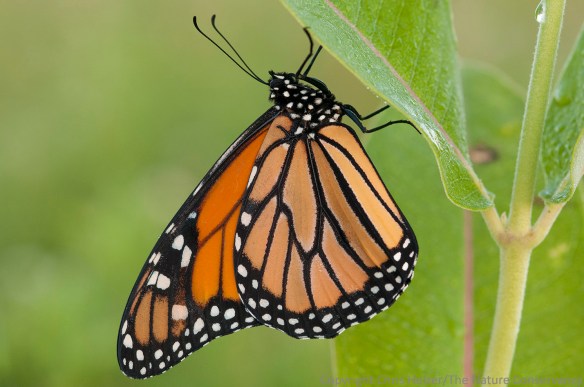
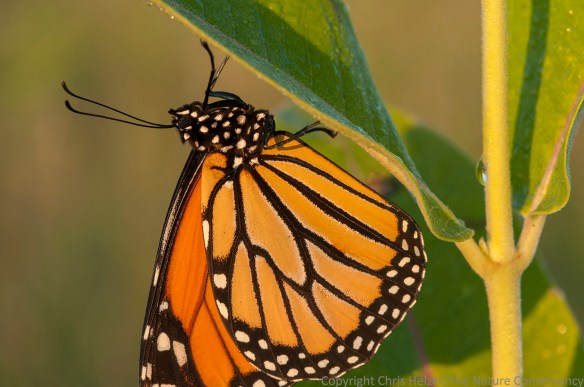
The cool dewy morning allowed me to get pretty close to this resting monarch butterfly...

The cool dewy morning allowed me to get pretty close to this roosting monarch butterfly…

Beetle on Flodman's thistle.  TNC Bluestem Prairie, Minnesota.

This beetle was feeding its way across the top of this Flodman’s thistle (Cirsium flodmanii) – at least I think that’s what I think the thistle species was… it’s always dangerous to guess when I’m far from home.

Common milkweed.  The Nature Conservancy's Bluestem Prairie - Minnesota.

Common milkweed flower buds can be just as attractive as the open flowers…

Bee on milkweed.  TNC Bluestem Prairie, Minnesota.

This bee spent the night on a milkweed leaf and wasn’t quite warm and dry enough to fly off when I spotted it.  If you look carefully, you can see pollinia stuck on two (maybe three?) of its feet.  If you’re not familiar with the fascinating (and unlikely) story of how milkweed is pollinated, you can learn more here.

Purple coneflower (Echinacea angustifolia).  The Nature Conservancy's Bluestem Prairie - Minnesota.

Purple coneflower (Echinacea angustifolia).  This is a species we don’t find very often in the Platte River Prairies (though it’s fairly common nearby) so I always enjoy seeing and photographing it when I can.  As with other “composite” flowers, coneflowers are actually collections (composites) of two kinds of flowers – the ray flowers that look like petals and the disk flowers in the center.  Occasionally, as in this case, a genetic signal gets crossed and ray flower pops up where a disk flower should be.

If you find yourself traveling to or through northwestern Minnesota (just east of Fargo, ND), I encourage you to make the time to visit Bluestem Prairie Scientific and Natural Area.  You can find directions and more information on the site here.  The Nature Conservancy owns about 6,000 acres of prairie there, and their ownership is bolstered by several other tracts of conservation land right next door.  The prairie hosts nesting prairie chickens and beautiful tracts of northern tallgrass prairie.  It’s worth the trip to see it.