Perspectives of the Prairie: Jennifer Rumery and Karen Hemberger

Hi everyone.  The following blog post is written by 2024 Hubbard Fellow Claire Morrical.  Claire put together a fantastic series of interviews with people working in conservation here in Nebraska and we thought you’d enjoy reading and listening to their stories. 

This project – Perspectives of the Prairie – uses interviews and maps to share the perspectives and stories of people, from ecologists to volunteers, on the prairie. You can check out the full project HERE.

This post also contains audio clips. You can find the text from this blog post with audio transcripts HERE. If you’re reading this post in your email and the audio clips don’t work, click on the title of the post to open it online.


Jennifer and Karen have volunteered at Platte River Prairies for over 10 and 20 years, respectively. After a volunteer day of gathering mountain mint seeds, Jennifer, Karen, and I sat down to discuss the healing and learning they get from the prairie, what makes volunteers unique, and to share stories of young volunteers connecting to the prairie.

Volunteers harvest seed in East Dahms (photo: Chris Helzer)

Interview: November 2nd, 2024

Part 1: Meet Jennifer

It’s an overcast Saturday in November and I’m sitting outside the Platte River Prairie’s main office waiting for volunteers to arrive. In a white pickup truck, there’s a handful of five-gallon buckets, leather gloves, and a couple pairs of gardening clippers. It’s a seed collection day.

Throughout the year, we collect and stockpile native prairie seeds from our sites, to be scattered back on our prairies in the following years.

In the past, we’ve used most of our seed for restorations, returning crop fields to prairie. With no seed bank in restorations, no prairie seeds lying in wait under the soil until conditions are just right to emerge, we start from scratch. As a result, we needed a lot of seed. Seed collecting meant having four five-gallon buckets strapped to you as you tore your way through the prairie, trying to fill a bucket every 5 to 10 minutes.

This year we have no active restorations. During these years, we use seed to help our sites along, bolster the plant community, fill in patches. With less demand for seed, seed collection is a much more social affair. 

It’s one of the last weeks to find much seed as the prairie creeps towards winter dormancy, and our volunteer, Karen Hemberger, has led us to where she recalls seeing our day’s targets, New England Aster and Mountain Mint. We meander through the wildflowers and grasses, chatting as we scan for plants. By the end of two hours, we’ve collected a 5-gallon bucket’s worth of seed between the four of us. But we’ve accomplished our primary objective, spending time in the prairie and spending time together.

Afterwards, I sat down with two of our volunteers, Karen Hemberger and Jennifer Rumery, to talk about their experiences working at Platte River Prairies.

This is Jennifer-

Notes for Context:

  • Mardell Jasnowski: Worked as a land steward at Platte River Prairies and continues to help as a volunteer
Prairie gentian (Eustoma grandiflorum), a wildflower that Jennifer especially likes (photo: Chris Helzer)

Overseeing volunteer days is the responsibility of Hubbard Fellows, including myself (year-long employees getting early career experience at Platte River Prairies). During our first volunteer days, seasoned volunteers like Jennifer and Karen are amazing guides as we get our footing, ready for any task and happy to answer questions along the way.

 Jennifer has been a volunteer with us for about 10 years. Both she and her husband, Grant, help us at PRP.

Notes for Context:

  • Brandon Cobb: One of the 2022 Hubbard Fellows (you can hear from him HERE)

Part 2: Meet Karen

Location: The Derr Sandhills site at Platte River Prairies

Karen Hemberger is another long-time volunteer who’s helped us for over twenty years and is her own force of nature when it comes to seed collecting.

Notes for Context: Karen mentions “keys to the house”. Our main office, the Derr House, is an extremely 70’s brick house that past landowners sold to us in the 2000’s

  • The Crane Trust: A conservation non-profit and preserve to the East of Platte River Prairies
  • Chris Helzer: Director of Science and Stewardship for Nebraska TNC. Chris has spent much of his career at Platte River Prairies
Male blue sage bee (Tetraloniella cressoniana), a specialist of pitcher sage (Salvia azurea). Karen especially likes this wildflower (photo: Chris Helzer)

Through learning and growing and sharing, Karen’s passion for this work is unending. She is fierce in her love for the prairie and tender in her approach to caring for it.

Notes for Context: Karen mentions a plant named sweet clover. Depending on where you are in the United States, sweet clover is either a very invasive species (a non-native plant that outcompetes native plants), or a non-native plant of little concern. In central and western Nebraska, we tend not to worry very much about sweet clover. It is abundant when there are few plants competing with it, but makes way when other species move in.

Karen is referring here to Chris Helzer.

Plants mentioned: Sweet Clover (Melilotus officinalis), Sun Sedge (Carex heliophila)

An ant colony on a large anthill

Part 3: Healing and Learning

Location: The site Caveny at Platte River Prairies

Karen and Jennifer are reflective on what they receive in return for the time that they give. They take something home with them, and for Jennifer, that something carried her through her work as a school psychologist

Sandhill cranes flying off from the river

Every spring, hundreds of thousands of sandhill cranes pause their migration north to eat their fill of invertebrates and corn along the central Platte River (where we are). They store the energy they’ll need to hatch and raise chicks in the coming months. At the migration’s peak, there is a constant trill of cranes calling in the mornings and evenings. When they fly to the river to roost for the night, the line of cranes, wing to wing, can stretch from the eastern to the western horizon. This great migration of sandhill cranes is followed closely by the endangered whooping cranes.

For many, even those who have watched the cranes year after year, seeing them return in the spring can be a deeply impactful experience. Jennifer finds meaning in her own experience with the cranes. For both Karen and Jennifer, time spent in the bluestem and switchgrass and sunflowers has shaped the way they take care of themselves and others.

In addition to healing, spending time in the prairie has helped shape how and what Karen and Jennifer see.  

Plants mentioned: Pussy Toes (Antennaria neglecta), Star grass, Blue-eyed grass, Pale spike lobelia (Lobelia spicata)

Four-point evening primrose (Oenothera rhombipetala) in sand prairie at The Nature Conservancy’s Platte River Prairies (photo: Chris Helzer)

Part 4: The Youngest Volunteers

Location: The site Derr West at Platte River Prairies

Jennifer and Karen share special moments watching young volunteers experience the prairie.

Notes for Context:

Plants mentioned: Milkweed (Asclepius sp.)

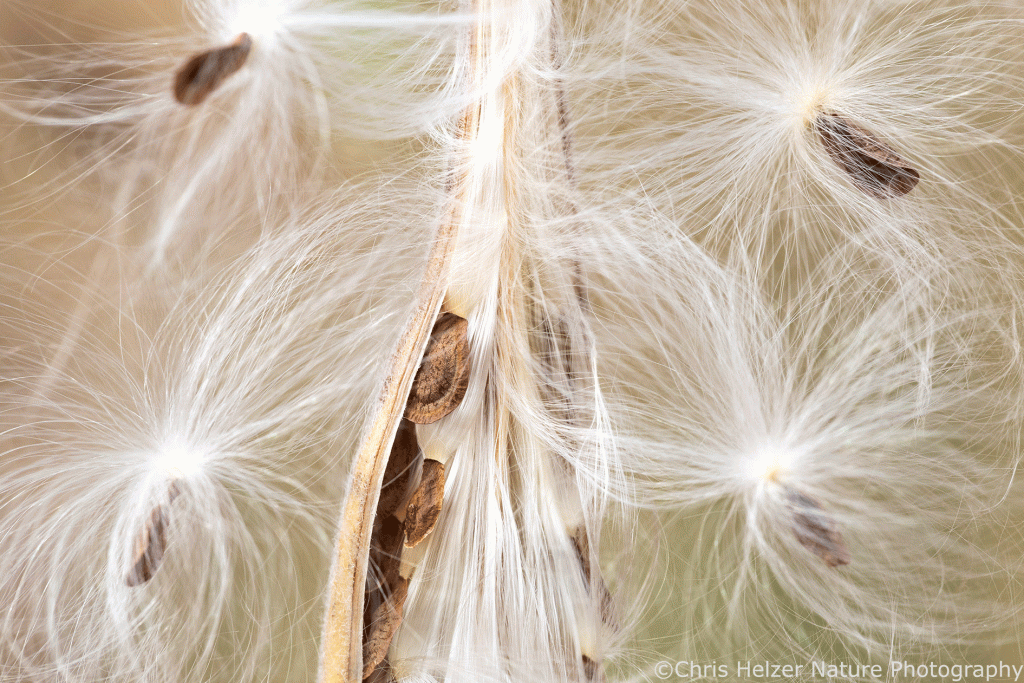
Common milkweed seeds (photo: Chris Helzer)

Photos of the Week – November 14, 2025

I mean, you knew this was coming, right? If you’re on any social media platforms, you’ve already seen enough northern lights photos this week to last a lifetime. Well, guess what? I took some too. Then I waited until everyone was already saturated with images from other sources before dumping mine out there into the world. It’s a terrible marketing strategy.

So, feel free to ignore this post and move on to more important things in your life. You know, things like deciding whether that white powdery substance on the bread is mold or flour. No one knows. It’s impossible to know.

Stiff goldenrod and the Aurora Borealis, just south of Aurora, Nebraska

On the first night of the colorful sky lights (Tuesday), I went down to our family pasture at about 10pm and stayed until midnight. The show got less interesting as the night went on, but it was fun to wander around the prairie in the dark and look for interesting shapes to silhouette in front of the colors.

Indiangrass; Landscape format

One particular clump (clone) of Indiangrass really caught my eye. I liked it so much I photographed it in both landscape and portrait format and then circled back to it 15 or 20 minutes later and tried again.

The biggest challenge with this kind of silhouette photography was focusing. I had my camera low to the ground and was shining a flashlight on the plants I wanted in focus so I could see them through the camera and manually focus on them. I got it right about 50% of the time, which meant I took a lot of photos I can’t use, but since I anticipated that, I got multiple tries in on each composition and mostly came out ok.

Indiangrass: Portrait format.
Stiff sunflower
Stiff goldenrod again
Indiangrass again

On Wednesday, there were clouds in the area and the forecast for good northern lights visibility was uncertain. I decided to chance it and made a run out to the Platte River Prairies and my favorite restored wetland to see if I could get some reflections in the water. Right when I arrived, the show was terrific, but it didn’t last long.

Beaver pond and eagle tree.

Also, the beavers had done a lot of work since I’d last walked around that wetland. Stumbling about in the dark, I quickly found out that most of my favorite photography spots were under water. I made it work, though I startled several mallards into flight as I blundered through the tall vegetation and shallow ponded water, trying to find good vantage points for photos.

The ol’ eagle tree was a dependable focal point, as always. Of course, no one but me calls it the eagle tree because no one here has been around long enough to remember the bald eagle nest that used to be there.

Plus, of course, the nest wasn’t actually in the tree I’m talking about. It was in the tree right next to it, but during the restoration project (which included tree removal), we left both trees standing so as not to disturb the nest. When the tree with the actual nest fell down (15 years ago?), I kept referring to the other one as the eagle tree anyway. It’s weird that no one else calls it that.

A different part of the same beaver pond. It all seemed like one big beaver pond, actually.

Anyway, I only got 10 or 15 minutes of good northern lights on Wednesday before the clouds spoiled things, but it was still worth the trip. Just listening to owls hoot and ducks grumble while I splashed around in the dark would have been enough, actually. The brief sky spectacular was a really nice bonus.

Fading northern lights, but good stars! (And the glow of two nearby towns in the distance)

It sounds like it might be another decade or more before we get a similar show, especially this far south. I hope you got your fill of northern lights photos, if not the opportunity to see them in person.