Submarine Sora

The photo below is about 15 years old now, but is connected to one of my favorite stories.  A co-worker and I were walking in a recently-restored prairie/wetland along the Platte River when we flushed a sora (a kind of rail – a long-toed, weak-flying wetland bird).  We watched it fly, and saw it land in an isolated patch of vegetation in the middle of a small wet slough.

Being good naturalists, we decided to see if we could get a closer look at the bird.  If you’ve spent any time chasing rails, you know they can be very difficult to find – even when think you know exactly where they are – but we tried anyway.  Sure enough, when we got up to the little patch of rushes where we saw the sora land, there was no sign of the bird.  The slough was only about 5 feet wide, and there was very little vegetation other than the rushes, which covered an area of only 2-3 feet in diameter.  There didn’t seem to have been anywhere it could have gone, and if it had walked or flew off, we surely would have seen it go as we approached.  But there was no sora in sight.

And then…  There was a big mat of algae floating on the surface of the water.  Out of the corner of my eye, I suddenly noticed a small lump appear in the middle of it.  Not really believing my eyes, I reached slowly down to the algae, pulled away a small bit – and exposed the head of the sora.  (!!)   As soon as I uncovered it, the sora submerged – again.  During the next several minutes, we kept careful watch on that little area of slough, and we saw the sora’s head pop out of the water two or three more times.  I tried to count the seconds between appearances, and got up to more than a minute at least once.  During one of its brief appearances, I managed to get a couple of photos – something I’m very grateful for, because I doubt anyone would believe my story otherwise.  Eventually, we decided we’d better leave the poor bird alone so it could resume its life.


The submarine sora during one of its brief appearances above water.

I’d never heard of soras or other rails going underwater, and I’ve since asked ornithologists and other naturalists about this and have never found anyone who’s ever seen or heard of this phenomenon.  Those familiar with rails know they have extra long toes, which helps them scamper across wetland vegetation – much like using snowshoes in snow.  I’d always assumed that soras just ran around most of the time, and flew when they absolutely had to…  However, I’m no bird expert, and when trying to learn about birds, it’s always good to go to Bent (Arthur Cleveland Bent, author of Life Histories of North American Birds – a series of books published between 1919 and 1968) – and sure enough, I found what I was looking for.

“The sora, like other rails, can swim well or even dive, if necessary. It often swims across narrow strips of water, rather than fly. C. J. Maynard (1896) writes:

All the rails swim and dive well but I think the Carolinas [Soras] rather excel them all in this respect, for they will not only take readily to the water, but will pass beneath it with great facility, and I once saw one run nimbly along the bottom of a brook, the water of which was about a foot deep, by clinging to aquatic plants, and crossing it obliquely, emerged on the other side, thus passing over some 15 feet while submerged.”

Knowing that soras can dive explains an awful lot about why they’re so difficult to find.  Bad enough that they can sneak around in the rushes by essentially walking on top of the water with their snowshoe toes.  Now, I find out they can play submarine too?  It’s just not fair!  On the other hand, I can better understand why a little clown-footed bird that flies like it’s half drunk is still abundant and widespread across North America.

I think this story also shows what can happen when we take time to be naturalists.  If, 15 years ago, I hadn’t taken a few minutes to go looking for that rail, I never would have found that submarine sora, and you wouldn’t be reading this right now.  Taking time to smell the roses really is important – not just for our own sanity, but also because those moments tend to lead to discovery.  My learning that soras can dive isn’t going to change the world, but it’s one more small piece of the ecological puzzle we’re all trying to put together.  The better we understand the world around us, the smarter conservation decisions we can make. 

And the sora is depending on us to get it right.

A Prolonged Visit

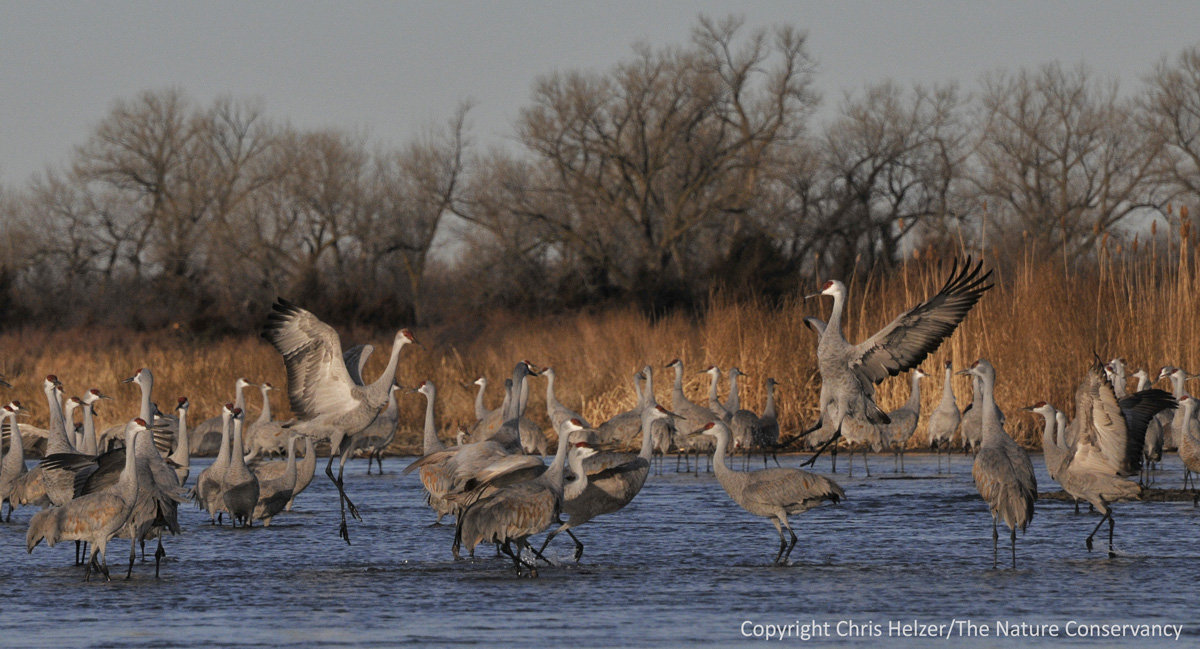
Sandhill cranes are regular visitors along the Platte River.  During the spring, more than half a million cranes stage here from mid February through early April.  Once they build up sufficient fat reserves they continue north to breed in Minnesota and Canada. 

In the fall, we see the sandhill cranes again, but normally just for a quick visit as they hurry south toward their wintering grounds.  Usually, we see them less than we hear them, as they glide far overhead.  A relative few stop and roost on the river for a night or so, and those overnight guests might do a little feeding in the recently harvested corn fields or meadows while they’re here.  But unless the weather keeps them longer, they usually arrive one evening and leave the next morning.

This fall, however, something’s different.  As I write this, there are thousands of sandhill cranes roosting and feeding along the river – and they’ve been here for more than two months.  For the first several weeks, we assumed it was an anomaly, and that they’d be moving on soon.  Now we’re starting to wonder if they’re planning to stay all winter!

Alright, so this is really a photo from the spring migration, not the fall. (But the cranes look the same)

The unexpected congregation of cranes is causing considerable discussion and speculation among biologists around here.  No one can remember this ever happening before, so why this year?  Is it related to the severe drought in Texas and other places in the south where the cranes typically spend their winter?  If so, did the cranes go down, look around, and turn back north? 

For a while, we figured it was just the mild November temperatures and strong river flows that were keeping them here.  If it’s not cold and snowy, why leave?  But since then, we’ve had some very cold (albeit short) snaps and two substantial snowstorms come through.  And they’re still here.

I emailed Dave Brandt, with the US Geological Survey’s Northern Prairie Wildlife Research Center to get his input on the discussion.  Dave is part of a team (along with Gary Krapu) that has been doing a lot of telemetry work on the mid-continent sandhill crane population, and tracking where they go.  He said that “reflux migration” (cranes bouncing back in the direction they came from) because of severe weather conditions is not unheard of, but is very rare.  They’re not following cranes intensively now, but he did say that there were 16 marked birds they’d been watching, and that all had migrated all the way south. 

Dave was actually in Texas when he emailed, and said there were sandhill cranes there, but that it was very very dry.  His best guess was that “our cranes” were just taking their time coming south because of the nice weather.  That makes good sense to me.  However, that was a month ago, and before the cold and snowy weather hit!

This is one of those phenomena that makes it great to be a biologist.  You think you’ve got a species really figured out, with strong patterns of behavior that repeat time after time – sandhill cranes have been very well studied – and then the species throws you a curve ball.  Out of left field.  Or something. 

Will they stay all winter?  Will they leave in the spring?  Will they do this again next year and for the foreseeable future? 

No one knows.  Fun, isn’t it?