It’s going to be a big day. I’m not sure what to call it yet, but it’ll be big. Mark July 13 on your calendar, and make plans to travel to the Platte River Prairies in Nebraska!
Prairie Ecologist readers may remember previous posts about how to measure success in prairie restoration (reconstruction) and some early attempts to evaluate how insects are reacting to our prairie restorations. Next July, I’m taking the next big step, and you’re invited to join in the fun.
With the help of entomologists James Trager (Shaw Nature Reserve, Missouri) and Mike Arduser (Missouri Department of Conservation) – and hopefully some others – I’m going to try to do three things.
1) Ramp up efforts to establish an inventory of the insect and animal species in our prairies – including both our remnant prairies and those we restored from cropland. I have a pretty good handle on the plant communities, but we’ve just scratched the surface on the insect and animal communities.
2) Build a list of species that can help indicate whether or not our restored prairies are functioning correctly (e.g. expanding and re-connecting our fragmented prairies). That list will include habitat specialists with specific needs our restored prairies will have to meet if we are to be successful.
3) Establish sampling protocols that we can follow, using staff and volunteers, to track those species over time to see if they are moving into and through our restored prairies.
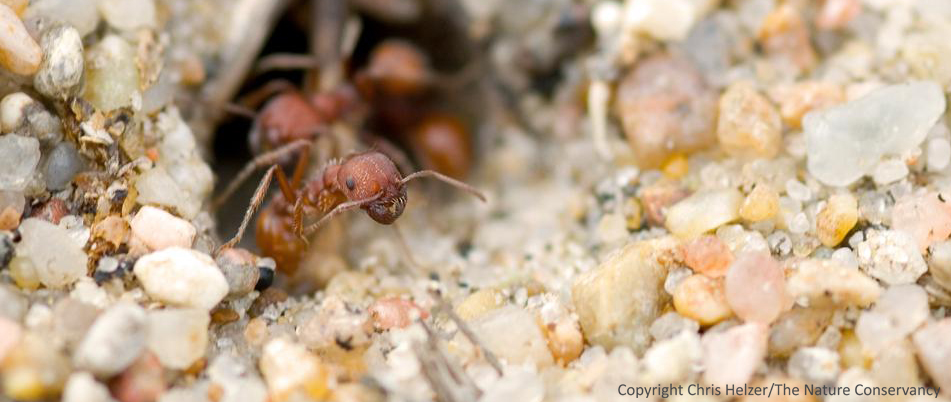
Do you know what kind of ant this is? Me neither!! That's why I'm excited to have James Trager - who DOES know - coming to our prairies to help me figure out what we've got, and why.
James and Mike have already committed to come to the Platte and help me do some initial sampling and think about how to set all of this up for the future. We’ll spend a good part of the week of July 9th collecting critters, analyzing what we find, and thinking about what makes the most sense for future evaluation work.
Then, the big day is Friday (yes, Friday the 13th) and you’re all invited to join in the conversation. The agenda is still under development, but at this point, the plan is to have a public field day/open house revolving around prairie ecology, management, and restoration – with a particular emphasis on insects and other prairie animals. We’ll have tours and demonstrations of prairie management and restoration work and research projects, displays of plant and animal species from our sites, and presentations by various prairie ecologists. Besides James and Mike, I hope to have several other experts on insects and other prairie animals on hand to talk about those species and their ecology, and hopefully give you a close-up look at them (the animals, not the experts). It should a great time of year to see wildflowers, birds, and lots of insects – including regal fritillaries, which should be near their peak abundance at that time of year.
Overall, the day should be a great opportunity to learn more about the natural history and identification of prairie species, trade ideas about prairie management, restoration and research, and network with other people who are just as interested in prairies as you are. In addition, it will allow us to build upon some of the conversations we’ve had through this blog – but to do it in person. We can walk through the same prairies, look at the same fire, grazing, and seeding results, and compare observations. I hope that a number of the regular readers of this blog will be able to come – especially those of you from outside Nebraska – because I think it can only increase the value of our future blog conversations to have you see our prairies in person.

We work hard to maximize native plant diversity in our prairie restoration work, then use fire and grazing to maintain that diversity - and hopefully also ecological resilience. Does it work? Come judge for yourself. Most importantly, we need to know how insects and other animals are responding, and I hope to learn more about that.
So – if you’re interested, please put the day on your calendar, start thinking about your travel plans, and we’ll hope to see you next July!
(Stay tuned for more details)



 The Prairie Ecologist