Photo of the Week – March 31, 2017

Prairie clover is a term that gets used pretty broadly among the public.  Ok, not necessarily the among the GENERAL public, but among people who have at least some idea what grasslands look like.  I’ve heard the term prairie clover applied to a number of different legume species, including sweet clover.  Botanically, prairie clover – as far as I know – refers only to plants in the genus Dalea, and including familiar species like purple prairie clover (Dalea purpurea) and white prairie clover (Dalea candida).

In Nebraska, we have eight species of prairie clover.  I finally saw large-spike prairie clover this past summer (though not in bloom), which means I’ve now seen all of them.  I’m still waiting for my certificate to arrive in the mail.  I’ve only been able to photograph five of the eight, but I’ll try to do better in the future.  Maybe I can earn the prairie clover photography patch someday.  (I’m just assuming that patch exists.  If it doesn’t, someone needs to answer for that.)

Purple prairie clover is well-known and well-distributed across Nebraska. It is a big favorite among bees, and while cattle will often eat it – especially under relatively high stocking rates – it survives periodic grazing very well in our prairies.

White prairie clover is also widespread across Nebraska and popular among pollinators. This one is hosting both a long-horned beetle and weevil.

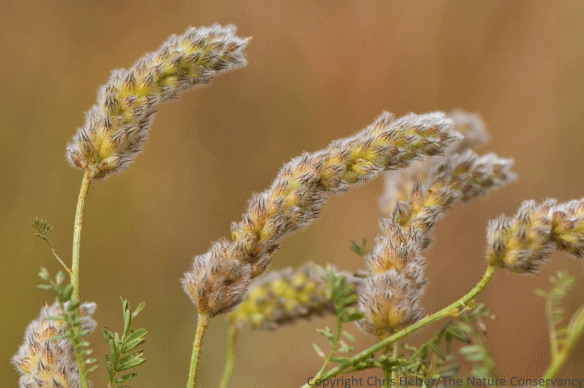
While purple and white prairie clover are the best known of this group of wildflowers, the lesser known and more specialized prairie clovers are also worth seeing and learning about.  Golden dalea (Dalea aurea) has gorgeous yellow flowers, but you’re not likely to run across it unless you go searching for it in one of the scattered locations it occurs.  Hare’s foot dalea (Dalea leporina) is an annual prairie clover that is a real enigma to me, and I’ve only seen it in our restored prairies.  Silky prairie clover (Dalea villosa) might be my favorite of all.  It has beautiful long pale pink-lavender flowers and fuzzy sea-green leaves and is common throughout much of the Nebraska Sandhills, as well as other sandy places.

Golden dalea is a beautiful prairie clover found on prairie hillsides here and there around the state.

Hare’s-foot dalea, aka annual dalea, is not a showy prairie clover, but is still pretty. It comes and goes in our restored prairies, often responding positively during the recovery periods following bouts of fire and grazing.

Silky prairie clover has a subtle beauty that fits well in the sandy prairies it inhabits.

The remaining three species in Nebraska are large-spike prairie clover (Dalea cylindriceps), round-head prairie clover (Dalea multiflora), and nine-anther dalea (Dalea enneandra).  Round-head prairie clover just barely comes into the southern tier of Nebraska counties.  The other two are found in scattered locations around the state.

It would be hard to think of a group of wildflowers that contributes more to prairie communities than prairie clovers.  At least purple and white prairie clover provide very high quality forage for herbivores, including livestock.  Bees and other pollinators focus heavily on prairie clovers, and the pollen and nectar are abundant and easily accessible.  The seeds are big and nutritious, and eaten by birds, small mammals, and insects.  During drought years, purple and white prairie clover are among the wildflowers that are mostly still green and blooming, even when surrounded by brown crispy plants, so they keep contributing even in difficult times.  Oh, and of course, as legumes, prairie clovers are nitrogen fixers.  From a land manager’s standpoint, prairie clover is easy to harvest seed from, germinates easily in restored prairies, and survives well under our fire and grazing management here on the Platte River.

If you haven’t seen all the different prairie clovers in your area, I hope you get a chance to remedy that soon.  Personally, I can’t wait until summer wildflower season arrives so I can keep working toward earning that prairie clover photography patch.  Maybe I can talk my wife into knitting me a prairie clover-themed stocking cap to sew the patch onto!

(For you young people out there, a patch is a kind of decorative embroidered thingie folks used to sew onto their clothing to recognize an award or achievement, or to signify membership in a particular club or group.  Trust me, it was super cool.  Your friends would be impressed if you showed up to a party wearing one.)

Photo of the Week – March 9, 2017

I hope I’ve made it clear through the years that I am really grateful to have my job.  During each March, one of the major perks is access to viewing blinds that allow a front row seat to watch migratory sandhill cranes on their overnight roost.  This morning, I took my wife, two of our kids, and my in-laws out to the Platte River to watch the cranes wake up.

Atticus braved a cold morning breeze in his face to watch cranes dance and loaf around before lifting off to go feed in fields and meadows for the day.

Our viewing blinds aren’t fancy, but they put you right at the edge of the river to watch one of the greatest wildlife spectacles on earth.

Most crane viewing tours I lead each year are for our current or prospective members and donors, and I really enjoy helping people experience one of the best migratory bird phenomena in the world – especially when our guests are seeing it for the first time.  On the other hand, it’s pretty hard to beat sharing that same experience with my family.  Did I mention how fortunate I am?

This morning provided good crane viewing (we had around 1000 cranes in front of the blind and maybe another 10,000 or more within view), but it was far from the most spectacular visit I’ve had.  The cranes weren’t close enough to our blind for me to get fantastic photos, but I played around a little with my camera anyway.  Today wasn’t about photography though, it was about family time in nature, and in that regard, it was pretty near perfect.

You can read more about the crane migration through Nebraska’s Platte River, and see many more photos, in a couple of previous posts here and here.

A couple small groups of sandhill cranes roosting in the river prior to sun-up.

Early morning silhouettes.


PLANT GAME RESULTS

It’s not that I’m competitive, but I’ve decided that I’ll consider it a win when more of you guess a wrong answer than the right one in our Plant Game.  Using that criteria, I won twice this week.  In the first question, Earthsmoke got the most guesses as a fake plant (35%), but it’s actually a real plant (Fumaria officinalis), introduced from Europe, and present (though uncommon) in Nebraska.  The actual fake plant was Lady-of-the-Lake, which I totally made up.  To your credit, that got the second-most votes (32%).

For the second question, the fake plant was Mountain Oats, which sounds real enough that only 32% of you guessed it was fake.  Almost half of you (47%) guessed Raccoon Grape was the fake plant, though, and it’s actually a native vine that grows in eastern Nebraska (Ampelopsis cordata).  Don’t worry, you’ll get plenty of chances to redeem yourselves in the future – but congratulations to those of you who guessed right!