Why Aren’t More People Talking About Migratory Flies??

About a century ago, there were lots of reports of migrating insects along the East Coast of North America. Among those were numerous sightings of large, apparently migratory congregations of flies. And then, for reasons no one seems able to explain, there is nothing about North American fly migration in the scientific literature for almost 100 years.

WHAT HAVE WE BEEN DOING THAT’S MORE IMPORTANT THAN FOLLOWING UP ON REPORTS OF MIGRATORY FLIES??

It’s unconscionable, really. There are flies. Migrating long distances. And no one thought to go out and learn more about this?

Ok, that’s not fair. There’s been some great work in Europe on migratory flies (and other insects) – much of it in topographic locations like mountain passes where flying migrants of many kinds are funneled through narrow locations. They’ve documented numerous fly species, especially in the family Syrphidae (hover/drone flies), making seasonal flights in huge numbers. There’s still an awful lot to learn, but at least they’ve made a good start.

What’s especially frustrating is that some of those same migratory fly species are here in North America, too, along with many other close relatives. If they’re migratory in Europe, they’re almost surely migratory here, right? So why has no one checked?

Eristalis tenax, the common drone fly, appears to be a migratory species in both Europe and North America.

Well, after the long, inexplicable century of ignoring this fabulous field of research, there have finally been two recent North American studies (One in California and one in Illinois) on the topic. Both have confirmed that flies do still migrate on this continent, but we still know almost nothing about which species migrate, where they go, and why. Let’s fix this!

In the meantime, while we don’t know much about fly migration here in North America – and have huge knowledge gaps in Europe and elsewhere – we can at least marvel at it. First of all, as is the case with most migratory species on our continent, fly migration is probably a way to escape cold temperatures in the winter and then to spread out (and escape competition) when temperatures are moderate. Birds aren’t the only animals cool enough to do this, no matter what snooty ornithologists will tell you.

(I don’t mean to imply that all ornithologists are snooty. In fact, many are surprisingly decent and nice to talk to. If an ornithologist was snooty, though, they’d surely be braggy about bird migration, wouldn’t they?)

You might not think of flies as cold tolerant animals, but many can survive sub-freezing temperatures. Body size is one predictor of that (bigger flies can generally survive colder temperatures.)

It appears that within at least many fly species, part of a population migrates south for the winter and the other part doesn’t. This is common among other insect groups as well. It’s a good way to hedge bets. If the subpopulation that stays put is wiped out by a particularly nasty winter, the migratory party can return and keep the species going. Or, if the migrants all die during their perilous journey, the ones who stayed home will persist.

How does an individual fly know if it’s supposed to migrate or hunker down for the winter? GEE, WOULDN’T IT BE GREAT IF WE KNEW SOMETHING ABOUT THAT??

Generally speaking, the assumption is that fly migration is a multi-generational phenomenon. The flies that head south in the winter have babies that then start the northward migration the following spring. By summer, either those progeny or their offspring will return to where their parents/grandparents had been the previous year. Of course, we don’t really know that BECAUSE NO ONE IS PAYING ATTENTION.

Drone flies like this one resemble bees but have bigger eyes, short antennae, and only two wings instead of four. THEY ALSO MIGRATE.

I’d love to continue this incredible, compelling story and provide lots more details. Unfortunately, as you might have gathered by now, we scientists have largely wasted a century doing less important work than fly migration research. As a result, I’ll just stop here.

This drone fly is clearly staring at us in astonishment because we’ve not been curious enough to learn about its (surely) epic migratory activities.

2014 Sandhill Crane Migration – Platte River, Nebraska

March is always a busy time on Nebraska’s Platte River.  It’s the beginning of prime prescribed fire season, of course, and a good time to work on fence repair and tree clearing projects.  But there’s no question that sandhill cranes rule the month.

The early morning scene on the Platte River in March.  Note the abundance of feathers floating down the river...

The early morning scene on the Platte River last week.  Note the abundance of feathers floating down the river…

About 600,000 sandhill cranes spend a good portion of late February, March, and early April along the Platte River before heading north to nesting grounds.  It’s one of the greatest migratory phenomena in the world, and it happens right in our backyard.  Because of that, our staff spends quite a bit of time taking groups of people into our viewing blinds where we watch the cranes land on the river at sunset and take off again in the morning.  It’s an important fundraising opportunity for The Nature Conservancy, and a way to show our Nebraska members what we’ve been working on and thank them for their support.  It’s really gratifying to watch the reaction of people as they see the crane spectacle for the first time.

My son Daniel got his first trip to a crane blind on his birthday this year.  It was very cold, but he was still glad to go.

My son Daniel got to take his first trip to a crane blind on his 10th birthday this year. It was very cold, but he still had a great time.

Because I’m in the blinds fairly frequently, I get quite a few opportunities to photograph cranes – though the number of nights and mornings when the light is favorable can be limited.  Also, I’m really not a wildlife photographer, either in terms of my equipment or aptitude.  Despite that, I usually end up with a few decent photos by the end of each season, though not as many as I should.

This year, I also tried to get some video footage of the cranes – something I have even less experience with and aptitude for than wildlife photography!  Also, my only video camera is the video function on my Nikon D300s SLR camera, and I’m still learning to use it.

You can see two of my attempts by clicking on the links below:

Video 1 – Cranes preparing to leave the river on a cold morning.  This 30 second clip gives you a feel for the density, activity, and noise of a crane roost.

Video 2 – Cranes chasing each other around on a sand bar.  There is a lot of jumping and chasing among cranes.  Some of it is courtship and pair bonding, some of it is just posturing.  This clip is about 30 seconds long.


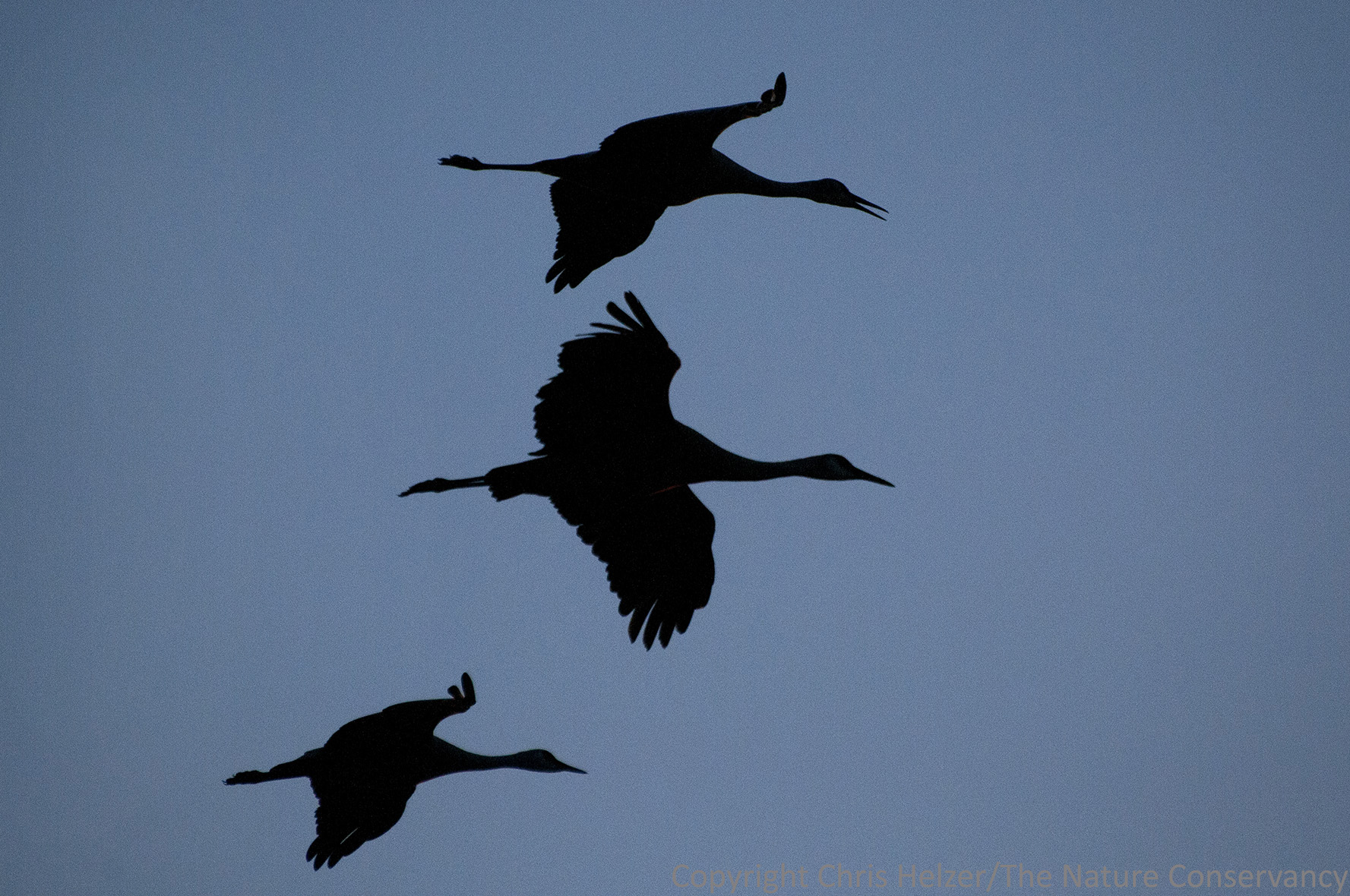
Silhouettes against the evening sky.

Silhouettes against the evening sky.

In the evenings, the cranes often wait to come to the river until it is getting dark, making photography difficult.  In those cases, the best photo opportunities are usually silhouettes of the birds against the sky as they drop into the river.  On nights when the light is nice and our guests are fully engaged watching the big event, I manage to snap off a few shots.  Both close-ups on a few birds at a time and more wider views can be attractive.

Sandhill cranes coming to the river after sunset.

Sandhill cranes coming to the river after sunset.

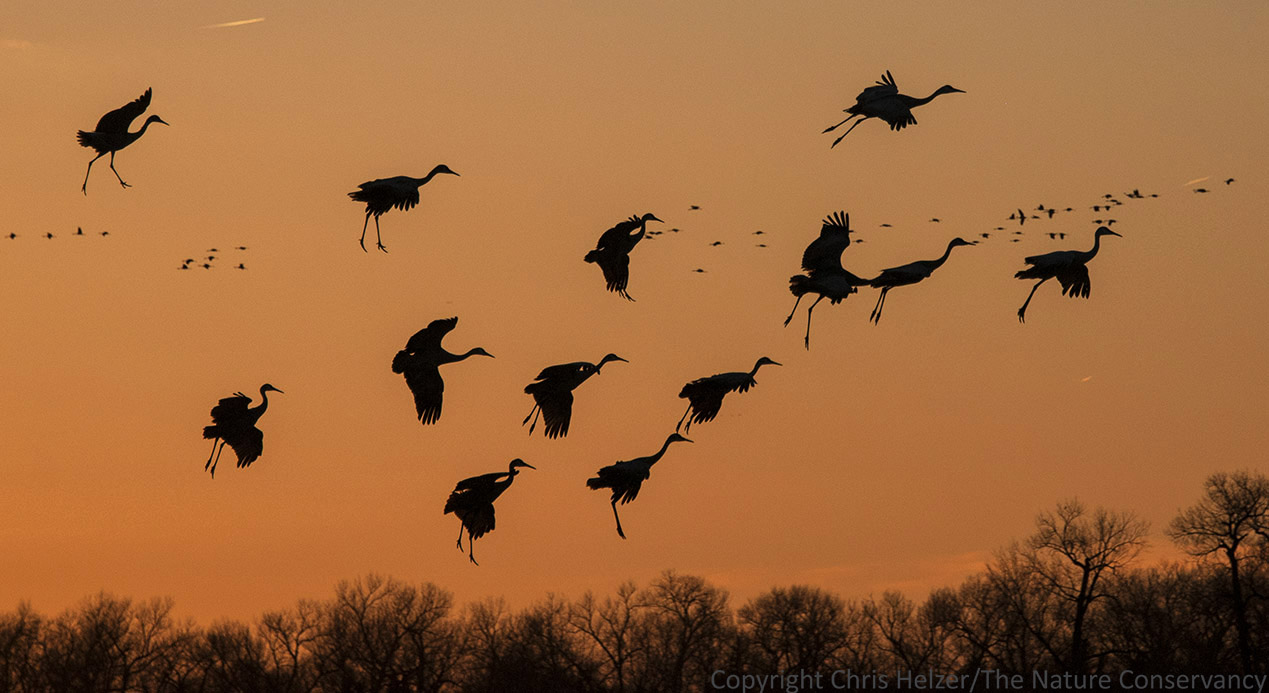
This year, my favorite image was the first shot I took one evening.  The sunset was beautiful and the cranes were parachuting gracefully toward the water as I poked my camera lens out the window of the blind.  The resulting photo reminded me of the theme song to a 1980’s TV show – The Greatest American Hero.

"Believe it or not, I'm walking on air..."   Cranes floating down to the river at sunset.

“Believe it or not, I’m walking on air…” Cranes floating down to the river at sunset.

.

Bonus Coverage

On one of the crane tours I led this spring, I met 11-year-old Jack McDowall and his dad.  Jack is a fellow blogger who is working on a year-long project to photograph and document his bird sightings.  I think many of you would enjoy his photos and the natural history information he includes along with them – including a post from his trip to our viewing blind.  If you’d like to visit his blog, you can link to it here.