Photo of the Week – June 30, 2011

It’s a great time to hike the trails at The Nature Conservancy’s Platte River Prairies!  Regal fritillaries are out in force, along with a number of other butterfly and insect species, and big wildflower season has begun, with many of the more showy species just starting to bloom.  Find out more about the public trails and download directions and trail guides here.  We’re only two hours west of Omaha, and just south of the Wood River I-80 exit (#300).  If you’re passing through our area on the interstate and need a place to stop and stretch your legs, stop by!

Common milkweed in restored (reconstructed) prairie. The Nature Conservancy's Platte River Prairies, Nebraska. In the week since this photo was taken, many of the more showy wildflowers in our prairies have begun to bloom.

This season has been an intriguing one so far, ecologically speaking.  Each time I walk the prairies I’m learning something new and surprising.  The abundance of rain and the high groundwater level has meant lush growth and wet wetlands.  The cool weather has meant delayed blooming for many plant species, leading to an interesting mix of flowers right now (a combination of species normally done by now and others that are blooming on time).

We weren’t able to get all the prescribed burning done that we wanted to this spring, so have been using alternative strategies to get the kind of disturbance impact we want on those sites.  On the prairies where we did burn successfully, the patch-burn grazing impacts look really really nice.  Much of my time in the field so far has been trying to interpret what I’m seeing in terms of the response of plants and insects to those management strategies.

My most recent attempt at ecological interpretation deals with our patch-burn grazing and milkweeds.  Over the last 10 years, I’ve spent a lot of time collecting formal and informal data on the impacts of grazing on prairie plants.  Up till now I’ve spent a little time thinking about milkweeds, but since I’m trying to see my prairies through butterfly eyes this year (a good idea, by the way – looking at your site through the eyes of various species) milkweeds have become a higher priority.  I’ve known that milkweed flowers can be a target for cattle grazing, but now I’m looking more directly at how many flowers are grazed or ungrazed within our patch-burn grazing systems.

This week, I looked at one of our prairies under patch-burn grazing, and counted milkweeds (grazed and ungrazed) within both burned and unburned portions.  It was still an informal data collection attempt, but instructive.  I looked at about 150 common and showy milkweed plants (Asclepias syriaca and A. speciosa), and found that 83% of the flowers had been nipped off in the burned portions of the prairie, and about 57% in the unburned.  Those are pretty high percentages in a system that is set up to encourage grazing in burned areas but not unburned areas, and contrasts with the selective preferences of grasses over wildflowers that we typically see.  It’ll be interesting to watch what happens during the rest of the season.

There are various layers of interpretation here.  First, the fact that the cows are eating blooms in the first place is intriguing because while that’s common in many grazing systems, it’s not common in our lightly-stocked patch-burn grazing system.  The attractiveness of those flowers ito cattle is apparently very high.  Second, the grazing of flowers in the unburned portions of the prairie is REALLY interesting because there is almost no other grazing taking place there.  In fact, I wondered if the flowers were being grazed by cattle or deer, and had to check the exclosure we have on the site to confirm that there are no flowers grazed off there (there aren’t).  It still could be deer, but I doubt it.

On the positive side of things, there are still milkweed flowers available throughout the site, even in the burned/grazed portions.  There could be more, but from a pollinators standpoint, there are still milkweeds there.  (And the grazed milkweeds are still alive and growing – they just don’t have flowers)  Also, the grazing is not having a severe immediate negative impact on the plants – in fact several that were grazed earlier in the season have re-bloomed now.  If those plants are prevented from flowering successfully for many years in a row, it could hurt the population, but periodic grazing shouldn’t be a big deal to these perennial plants.

The same prairie as above - with more context. You can see that most of the grass is grazed, but few of the wildflowers are. In the background, you can see the unburned portion of the prairie as a sliver of yellow. Grasses in that unburned area are about 2 1/2 feet tall - a stark contrast with the burned area where grazing is keeping them short. In another week or so, this prairie will be awash with color from all of the big wildflowers that are on the edge of blooming.

As I try to find management strategies that optimize biological diversity in prairies, one of the biggest objectives is to prevent any species, plant or animal, from being negatively impacted by our management year after year.  I’ll continue to watch milkweed grazing as the season progresses, but it might be that these species are more vulnerable to grazing than most, and that they could be a good indicator that can help me tweak our management over time.  The current plan under which this particular prairie is being managed calls for patch-burn grazing for two years, followed by one year of  complete rest.  Under that system, I’m not concerned about the long-term vigor of the milkweed plant populations because they’ll have at LEAST one year out of three to bloom and reproduce successfully (through both seed and rhizome).  I’m also not worried about insects that use those milkweeds because in addition to those in the prairie, there are numerous milkweeds in exclosures, outside fencelines, and other locations in the very nearby neighborhood.  Plenty of milkweed to go around.

So – this upshot is that it’s been valuable to look at the prairie from a perspective that forces me to consider species I hadn’t paid as much attention to in the past.  I’m not seeing anything that makes me think we’re heading in the wrong direction, but milkweed flower grazing seems to be a good thing to add to the aspects of this and other prairies that are part of my annual evaluation efforts.

As an aside, the patch-burn grazing system we’re trying on the prairie mentioned above includes a fairly high stocking rate early in the season, followed by a lighter stocking rate in the summer/fall.  In May, I saw fairly regular grazing of forbs such as compass plant, Canada milkvetch, Illinois bundleflower, and rosinweed.  Now that the stocking rate is reduced, I see very little grazing on those plants, and rosinweed and compassplant are just getting ready to bloom.  The milkvetch and bundleflower plants are growing strong, and should also bloom.  Also, most of the milkweed plants that are being grazed are only getting the tops nipped off, so the vigor of the plant is not really being reduced much.  It’s all very interesting to watch.
Neighborhood Watch

When making management plans for a prairie, it’s a good idea to look over the fence to see what the neighbors are doing.  It’s important to think about how your prairie fits into the landscape, and even more important to think about what you can do to complement the prairie habitats/conditions around you.  If your prairie is the only one around for miles, you’ve got bigger problems than this post will be able to address (I’ll hit that topic in the future, though).   If there ARE other prairies – or at least grasslands – nearby, continue reading…

There are many ways to make your prairie provide a complement to the ecological contributions of others in the landscape.  Rather than trying to cover all of them, here are three examples:

Grassland Birds

Though focused on birds, this section really applies to small mammals, insects, and any other animals that rely on a particular kind of habitat structure (or multiple kinds) for survival as well.  Many times, the majority of prairies/grasslands in a neighborhood are managed so that the vegetation structure in all of them looks pretty much the same.  In some cases, the landscape may be full of grazed pastures – all with relatively short grass.  This might provide excellent habitat for species like grasshopper sparrows and upland sandpipers (depending upon how large each grassland patch is) but doesn’t do much for dickcissels and Henslow’s sparrows.  On the flip side, other landscapes have an abundance of Conservation Reserve Program (CRP) or other grasslands that are rarely burned or grazed and consist mainly of tall thatchy vegetation.  In either case, thinking about how your prairie could provide some vegetation structure that is rare or absent from the surrounding landscape can really benefit species requiring that habitat type.

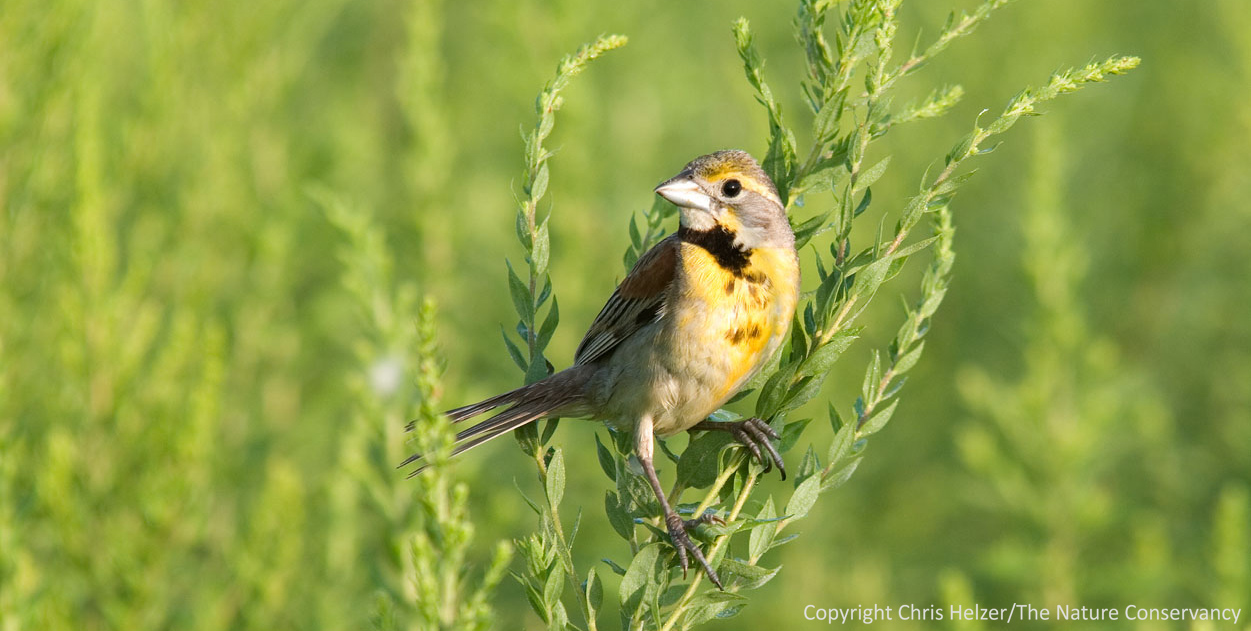
Dickcissels are large sparrows that prefer tall weedy habitats, and aren't likely to be found in prairie landscapes with only short vegetation structure.

A somewhat more complicated scenario applies to a few species that require different habitat types for each season.  Prairie chickens, northern bobwhites, and ring-necked pheasants, for example, need to be able to move back and forth between nesting and brood-rearing habitat without having to travel very far.  Nesting cover (which may double as winter cover) typically consists of relatively dense vegetation that can conceal a nest and the female sitting on it.  However, newly-hatched chicks have to be able to travel through that cover to nearby feeding areas, so it can’t be so dense that those chicks can’t make their way around in it.  Ideal brood-rearing cover has areas of relatively tall wildflowers or weedy vegetation without dense grass at the ground level – this allows adults and chicks to easily move around and chase insects, but also provides overhead protection from predators.  The interspersion of nesting and brood-rearing cover across the landscape is a key factor in the annual survival of these species.  If the prairie adjacent to yours is providing excellent habitat for one of those two life stages, providing the other in your prairie might fill a critical habitat need.

Obviously, there are any number of other vertebrates and invertebrates that have habitat structure requirements.  Even without knowing what those requirements are, you can help provide for them by simply trying to manage your prairie to fill in gaps in the landscape – or to improve the interspersion of those habitat types in the neighborhood.  Sometimes it’s as simple as ensuring that the vegetation structure in your prairie contrasts with what’s around you.  In other cases, timing of management can be important.  If your neighbor cuts hay in mid-July, for example, there will likely be quite a few newly-fledged grassland birds, small mammals, and other animals looking for refuge.  If you plan to hay your prairie as well, delaying for a month or so can give those species at least a temporary reprieve – and in the case of many birds, may give them enough habitat to last them until migration time.  Leaving a portion of your prairie unhayed, of course, could also be valuable.  Another example related to timing could be to try to stagger the timing of your prescribed fires with your neighbor so that you’re not both burning your prairie in the same year (or season). 

Bees

Bees are one of the most important groups of insects in prairies because of their effectiveness as pollinators.  The two primary needs of bees are nesting habitat and food.  Bees have varying requirements for nesting habitats, but many either need bare ground for burrows or old woody debris.  Looking around to see whether neighboring properties provide that kind of habitat could help you think about what to do on your own land. 

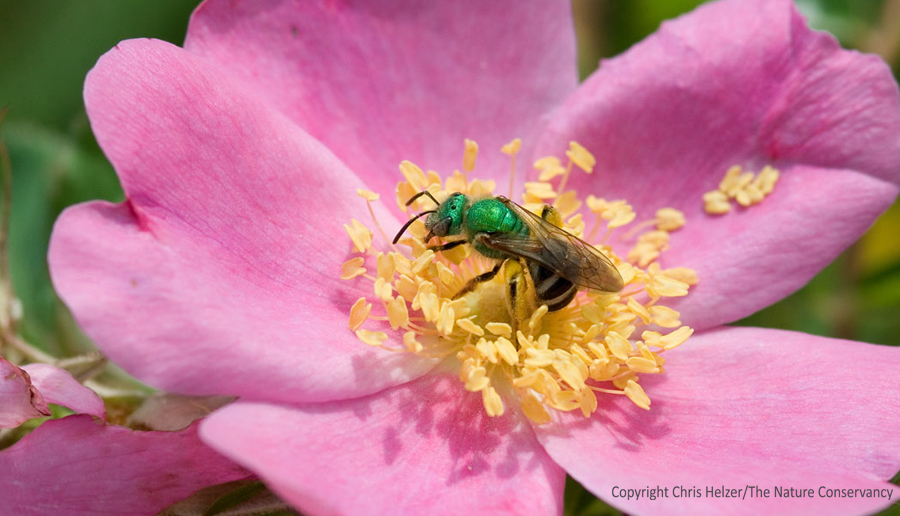
A native bee on a prairie wild rose.

In terms of food, it’s important for bees and other pollinators to have consistent sources of nectar and pollen throughout the season.  It can be valuable – and instructive – to keep track of when each flower species blooms in your prairie and that of surrounding prairies (including roadsides and gardens).  Imagine yourself as a native solitary bee with a feeding radius of about ¼ mile around its nest.  Could you find something to eat on every day of the growing season?  If there are gaps during the season when there’s really nothing blooming in the neighborhood – or only a few flowering species blooming – that could identify an important gap to address.  Often, early season flowers are hard to come by, but there may also be mid-season gaps due to management practices (haying, burning, grazing) or simply because there are no/few flower species that happen to bloom at that time.

Providing for pollen and nectar resources in your neighborhood could be as easy as ensuring your prescribed fires, haying, and/or grazing activities aren’t happening simultaneously with that of your neighbors.  In other cases, it might be that you could manage in a way that encourages flowering plants during a time period when not much is blooming elsewhere nearby.  Regardless, it’s an interesting and important aspect of habitat to pay attention to.

Plants

In landscapes where land management practices are very similar across all land parcels, there are likely to be plant species that become rare because they never get favorable growing conditions.  Identifying those species and altering your management to accommodate them – at least periodically – can be an important strategy.  If most of the neighbors are burning every spring, skipping a year now and then on your land might help some of those spring-growing plants to survive.  In landscapes where grazing is commonplace, most ranchers/farmers tend to employ a fairly standard – and repetitive – grazing system.  Identifying the impacts to plant species (good and bad) of the grazing systems around you can help you facilitate success for those species in your prairie.  On the other end of the spectrum, if no grazing is occurring in the surrounding landscape, there may be species that thrive under grazing that could benefit from some grazing on your own land.  Whatever the local situation, recognizing the impacts of the management occurring around you on plant species can help you design management strategies that can prop up populations of plants that are otherwise struggling.

Caution!

It’s important to remember that the above examples and suggestions are just that – and may not apply to your situation.  Even more importantly, it’s not a good idea to implement a repetitive management system on your own prairie to contrast with the repetitive management system(s) of your neighbors.  (In other words, don’t manage exclusively for dickcissels just because the neighbors are managing exclusively for grasshopper sparrows…)

Repetitive management that decreases the ecological resilience of your prairie can lead to a weakened prairie community that can be more vulnerable to invasive species and other threats.  There’s no need to sacrifice the integrity of your prairie for the good of the neighborhood.  Instead, think about trying to maintain the highest plant and animal diversity you can on your own prairie – while also watching for opportunities to contribute rare or missing habitat components to the surrounding landscape.  The latter is an important, but secondary, consideration.

The prairie looks very much the same on both sides of this fenceline.

The ideal situation is one in which adjacent neighbors (or an entire neighborhood) coordinate their management so that each prairie is well-managed, but so that management actions aren’t synchronized across the landscape.  Staggering the timing of prescribed fires, haying, and grazing between neighbors to ensure that everyone isn’t doing the same thing during the same season can be very important. 

(Communication between neighbors about management can have additional benefits, of course, besides simply coordinating the timing or other aspects of management.  For example, talking about the success or failure of invasive species control efforts or observed trends in plant or animal responses due to particular management strategies can help everyone improve their own properties. )

The Upshot

Regardless of the size or location of your prairie, it’s valuable to look around the neighborhood as you plan your management each year.  I’ve provided a few examples of how one prairie can fill gaps left by the management of nearby prairies, but there are many more – each landscape is unique.  The key is simply to be thoughtful about your prairie management, and to remember that wildlife and plant populations don’t stop at the edges of your property.