
Prairies Forever? Collaborative Conservation for Pheasants, Pollinators, and People.

Effective prairie conservation requires a collaborative effort among a wide variety of interests, including ecologists, naturalists, birdwatchers, ranchers, educators, hunters, and others.  Each of these might approach prairie conservation from a different perspective, but they have more in common than you might expect. 

People outside Nebraska might be surprised to learn that one of the strongest forces for prairie conservation in our state is Pheasants Forever.  Pheasants Forever, along with its sister organization Quail Forever, is helping protect, restore, and manage prairies in multiple ways, including:

–          Private lands biologists (17) who work with landowners on habitat projects, providing both advice and access to federal, state, and private cost-share assistance.

–          Promoting and facilitating the use of prescribed fire across the state by providing equipment and training opportunities, helping to establish and coordinate prescribed fire associations, and organizing landowner tours to showcase the value of prescribed fire.

–          Promoting the use of, and helping to provide, diverse native seed mixtures for habitat restoration/improvement projects.

–          Organizing workshops and field tours on habitat management, prairie restoration, plant identification, and pollinator conservation.

Pheasant hunters

These pheasant hunters enjoyed a very successful day in a recently-restored high-diversity prairie.  The Nature Conservancy’s Platte River Prairies, Nebraska.

The man who has provided most of the energy for these efforts for more than 20 years is Pete Berthelsen, who has just stepped into a new role for Pheasants Forever, Inc. and Quail Forever; the Director of Habitat Partnerships.  He is now charged with taking the kinds of habitat partnerships and statewide habitat programs he helped develop in Nebraska and replicating those programs across the organization at the national level.
Continue reading

Lessons From a Project to Improve Prairie Quality – Part 1: Patch-Burn Grazing, Plant Diversity, and Butterflies

We recently completed a large multi-year restoration and management project at our Platte River Prairies.  Our specific objectives were to improve habitat quality for various at-risk prairie species and evaluate the impacts of our management on at-risk butterflies – particularly regal fritillaries.  The project was supported by the Nebraska Game and Parks Commission, who funded our work with two State Wildlife Grants (U.S. Fish and Wildlife Service money).  Over five years, we conducted fire/grazing management in our prairies and enhanced plant diversity through overseeding and seedling plugs.  We measured the results of that work by measuring changes in prairie plant communities and by looking at the use of our prairies by regal fritillaries and other butterflies.

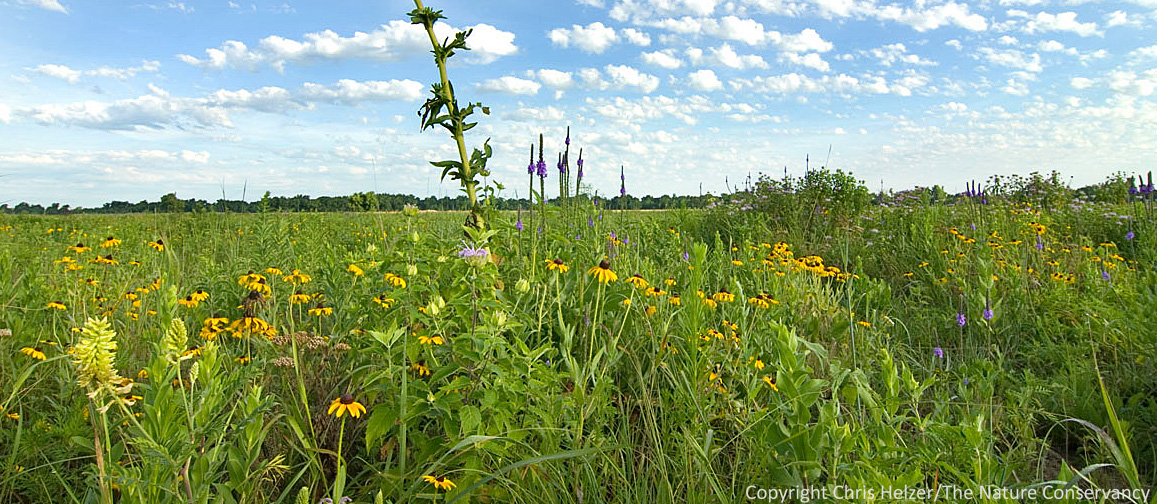
Plant diversity and buttterfly habitat were the objectives of our 5-year project.

We’ve worked hard to get plant diversity in our restored prairies, including this one.  We wanted to know whether or not our management was maintaining that diversity, and also how it was affecting butterflies.  The prairie shown here was being grazed at the time of the photo – July 2009.  The Nature Conservancy’s Platte River Prairies, Nebraska.

The following is a brief summary of the major lessons we’ve gleaned from the fire/grazing component of the project, including implications for future management and restoration work.  I will summarize the overseeding/seedling work in a separate upcoming post.  If you want more details, you can see our entire final report to the funding agencies here.  As a warning, the report is 14 pages long, with an additional 21 pages of Appendices, full of tables and graphs.

What We Did
Between 2008 and 2012, we treated over 1,500 acres of prairie with varying applications of patch-burn grazing management.  During that time, we altered the timing of burning and the intensity of grazing from year to year, and included years of complete rest from grazing in some prairies.  For the purposes of this project, we evaluated the results of our work in two main ways:

–          We measured changes in plant diversity and mean floristic quality.

–          We conducted three years of butterfly surveys to evaluate how regal fritillaries and other butterfly species responded to our restoration and management work.

Continue reading