
Lessons From a Project to Improve Prairie Quality – Part 1: Patch-Burn Grazing, Plant Diversity, and Butterflies

We recently completed a large multi-year restoration and management project at our Platte River Prairies.  Our specific objectives were to improve habitat quality for various at-risk prairie species and evaluate the impacts of our management on at-risk butterflies – particularly regal fritillaries.  The project was supported by the Nebraska Game and Parks Commission, who funded our work with two State Wildlife Grants (U.S. Fish and Wildlife Service money).  Over five years, we conducted fire/grazing management in our prairies and enhanced plant diversity through overseeding and seedling plugs.  We measured the results of that work by measuring changes in prairie plant communities and by looking at the use of our prairies by regal fritillaries and other butterflies.
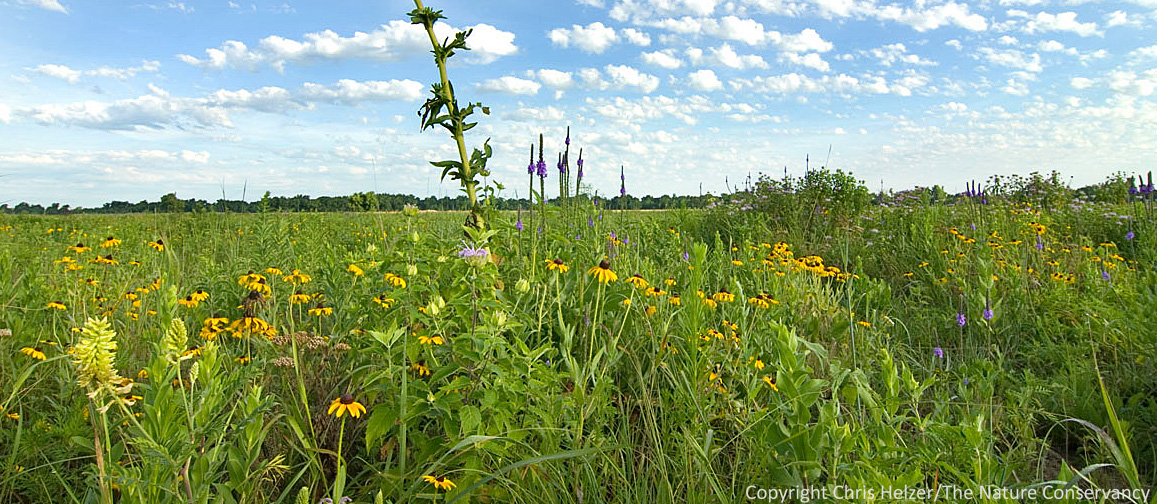
Plant diversity and buttterfly habitat were the objectives of our 5-year project.

We’ve worked hard to get plant diversity in our restored prairies, including this one.  We wanted to know whether or not our management was maintaining that diversity, and also how it was affecting butterflies.  The prairie shown here was being grazed at the time of the photo – July 2009.  The Nature Conservancy’s Platte River Prairies, Nebraska.

The following is a brief summary of the major lessons we’ve gleaned from the fire/grazing component of the project, including implications for future management and restoration work.  I will summarize the overseeding/seedling work in a separate upcoming post.  If you want more details, you can see our entire final report to the funding agencies here.  As a warning, the report is 14 pages long, with an additional 21 pages of Appendices, full of tables and graphs.

What We Did
Between 2008 and 2012, we treated over 1,500 acres of prairie with varying applications of patch-burn grazing management.  During that time, we altered the timing of burning and the intensity of grazing from year to year, and included years of complete rest from grazing in some prairies.  For the purposes of this project, we evaluated the results of our work in two main ways:

–          We measured changes in plant diversity and mean floristic quality.

–          We conducted three years of butterfly surveys to evaluate how regal fritillaries and other butterfly species responded to our restoration and management work.

Continue reading

Killing Small Trees in Prairies – A Helpful Tool

One of the greatest challenges of prairie management, especially in small eastern prairies, is managing the invasion of small deciduous trees.  Most prairie species (plant and animal alike) thrive best in open treeless habitats.  Encroaching trees can fragment large prairies into smaller pieces, shade out many species of prairie plants, and harbor both predators and invasive species that can change the whole balance of power in a prairie community.

Siberian elms are fast becoming a major threat to many prairies.  Killing numerous small trees like these without impacting the diverse prairie community around them can be difficult.

Siberian elms are fast becoming a major threat to many prairies. Killing numerous small trees like these without impacting the diverse prairie community around them can be difficult.

So what to do?  Controlling species such as eastern redcedar is relatively easy – they can simply be cut down, or even more quickly wiped out with a well-timed and planned prescribed fire.  Unfortunately, most deciduous trees resprout after being cut or burned, so killing them usually requires the use of herbicide to prevent that regrowth.  Cutting trees down and painting their stumps with a small amount of herbicide is a simple and clean way to eliminate them, but that task becomes much more daunting when there are hundreds (or more!) of small trees to deal with.

Over time, we’ve been using and refining a simple tool that makes the task much more manageable.  Some herbicides for controlling woody plants can be applied through a technique called “streamlining” or “basal bark treatment”, in which the herbicide is mixed with oil and applied to the outside of a young tree without first cutting it down.  It’s a nice alternative method, but after using it for several years, we had to keep replacing sprayers because the oil (and maybe the herbicide) was pretty hard on gaskets and other rubber/plastic components.

Then our former land steward, Chris Rundstrom, came up with the idea of adapting a tool developed by Jack McGowan-Stinski in Michigan called a PVC herbicide wand.  The wand has a sponge at the end, and was developed to apply herbicide to cut stumps cleanly and easily.  Chris thought it might also work well for the basal bark treatment – and he was right.

The "killstick" can make the difficult task of suppressing invasive trees much more manageable.

The “killstick” can make the difficult task of suppressing invasive trees much more manageable.

Over time, Chris modified the design of the “killstick”, as it became known to us, to make it work better for its new purpose.  Recently, our technician-turned-fulltime-land manager, Nelson Winkel, has been further refining it.  Now, we’ve got it working pretty smoothly and have decided to share what we’ve learned with everyone else struggling to fight off invading small trees.

Below are two links to instructions that will show you how to build and use the killstick yourself.  We’ve had good luck using it against every species of deciduous tree we’ve tried it on, as long as the trees are smaller than about 3″ or so in diameter and have smooth bark.  The brand of herbicide probably isn’t very important, as long as it contains the chemical Triclopyr and is labeled for the basal bark or streamlining technique.  Be sure to follow the label directions for the mixing and handling of the chemical.  The killstick allows you to apply the herbicide mixture to the tree through a wick rather than with a sprayer, but all other label directions should still apply.

Detailed Instructions

A Printable Tri-Fold Guide

If you try it out, we’d love to hear your opinions and ideas for further refinement.  You can leave a comment below or contact Nelson directly by phone or email (his contact info is included in the directions).

Good luck!

P.S. – the instructions for the killstick are stored on the PrairieNebraska website we’ve developed as a clearinghouse for information on prairies, prairie management, and prairie restoration.  If you haven’t seen the site, check it out – we hope it’s helpful to you.

.