If You Were a Bee…

During the past two Mondays, I had the opportunity to help out with Prairie Plains Resource Institute’s Summer Orientation About Rivers (SOAR) program.  It’s the best summer day camp I’ve ever been involved with, and my kids, my wife, and I have all enjoyed being part of it over many years.  This year, I was tasked with talking to kids (about 8 kids at a time) about the value of biological diversity in ecosystems.

Dip netting for aquatic animals at SOAR 2010.  Daycamp for kids put on by Prairie Plains Resource Institute. Day 1 at Lake Mary, near Hordville, Nebraska.

Dip netting for aquatic animals at SOAR back in 2010.

I needed an activity that would keep the kids engaged for about 15 minutes and send them away with an appreciation of why prairies need to have so many species in order to function well.  With the help of my wife, I came up with a pretty good plan.  Then I refined it a little each time I presented it to a new group of kids.  It turned out well enough that I decided I’d share it here as well – I hope it helps you think about the same concepts I was trying to pass on to the kids.

I started off by talking about ordering food at a fast food restaurant.  When you walk in, you go up to the counter and order food from the cashier.  What happens if that cashier is sick that day?  Do you just go home hungry?  No, of course not – the restaurant has more than one person who can do that job, so someone else fills in and you still get to eat.  Well, the same kind of thing happens in nature.  Each organism in a prairie plays a certain role – it has a job to do – but if one species is unavailable (because of a disease outbreak, bad weather, etc.) other species can usually fill in and cover for it.

Next, I asked the kids for an example of a prairie species that plays an important role.  Most of the time, someone said “bees”, which was perfect.  If not, I provided that answer after discussing the ones they came up with.  We talked briefly about the importance of pollination, the number of bee species found in many prairies (often 50-100 species), and that most of those bee species are “solitary bees”, meaning a single female trying to build and care for a nest of eggs.  That female digs a tunnel in the ground (usually), lays an egg and then collects enough pollen and nectar to feed the larva until it becomes an adult.  She seals the egg and food into a cell and then starts another cell on top of it.

This

This tiny bee was visiting purple prairie clover outside our field headquarters yesterday.  Its nest must have been fairly close by because an insect that size can’t travel very far.

I then showed them a couple sweat bees, and we talked about how bees that small couldn’t fly very far from their nest.  Then I had them look at a circle of flags I’d put up around us (a circle with about a 50 meter radius) and told them that for some very small bees, a circle that size was basically their entire universe with their nest in the center.  Within that circle, a female bee would have to go out every day and find enough food to both stay alive and provision her eggs.

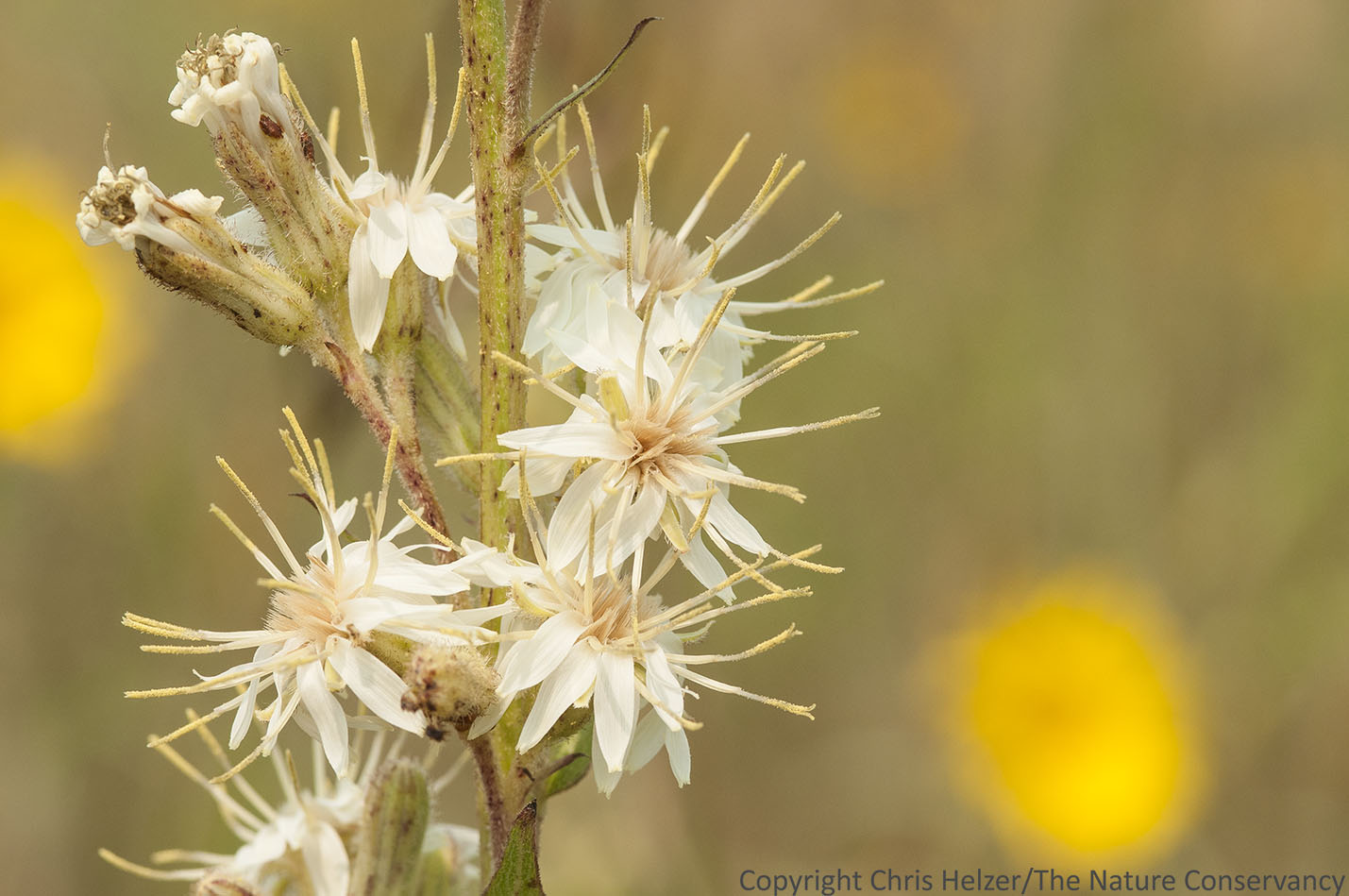
Next I split the kids into groups of two or three and handed them a little bag with a wildflower in it.  All of the flowers in the bags could be found within our circle of flags, but some were much more abundant than others.  I told the kids they were solitary bees and their job was to spend the next five minutes counting the number of flowers (blossoms, not plants) within the circle that matched the one in their bag.  Off they went!

After five minutes, I called them back in so we could talk about their search.  Some of the kids struggled to find any flowers that matched their sample, while others came back with counts of between 100 and 200 blossoms.  This led to a great discussion about the importance of plant diversity to bees.  If a bee relied on only one plant species and it wasn’t very common within the “universe” around its nest, it would probably starve – especially because it would be competing with other pollinators for the pollen and nectar from those few flowers.  Even if the bee’s flower species was really abundant, it might only bloom for a few weeks, so once it was gone, the bee wouldn’t have anything left to eat.  However, if the bee’s universe contained lots of flower species it could feed from, the bee was likely to find enough food for itself and its eggs throughout its entire life.

What would this prairie look like through the eyes of a tiny bee trying to find food for itself and its eggs?

What would this prairie look like through the eyes of a tiny bee trying to find food for itself and its eggs?

To wrap up, I reinforced the point that bees rely on having lots of choices of plant species to feed on.  If one plant species is unavailable, there are others that can provide the food the insects need.  At the same time, most flowers also do best when there are lots of pollinator species available to visit them.  In a prairie with a diverse community of bees, it’s less of a big deal when a few of those bee species are low in abundance because of weather or disease.  Other bee species can cover for them and flowers still get pollinated.

Finally, I said that while we’d been talking about bees and flowers, biological diversity was important in many other ways as well.  Many herbivores need lots of different kinds of plants so they can find high quality food all year round.  A wide range of available prey species is important to predators.  And so on.  When a prairie, or other ecosystem, loses too many species, it’s just like a restaurant losing too many employees.  At some point, there’s no one left to cover for someone who gets sick, and the system breaks down.

Two quick asides:

1. The fast food restaurant example I used with the kids was not my first idea.  I actually started talking about bank tellers, and asked the kids what would happen if the bank teller was sick when you went to get money out of your account.  However, my wife helpfully pointed out that most kids have probably never met a bank teller since so many people do their banking electronically or through ATM machines…

2. The circular “universe” around a solitary bee nest has been a really useful idea for me over the last several years.  While the size of that circle varies quite a bit by bee species, the concept has changed the way I evaluate our prairie restoration and management.  When I walk around our prairies, I often stop and think about what a solitary bee would experience if it were nesting there.  If you’re in charge of a prairie, I’d encourage you to try it sometime – maybe it’ll be helpful to you as well.

My Little Buddy

What would you do if a big hairy bug landed on your hand?  Smash it?  Flick it off?  Hop and and down, flail your arms, and make loud high pitched noises?

Well, you COULD do one of those things.  OR, you you could lift your hand slowly toward your eyes, examine the minute details of the bug’s multi-faceted eyes, and admire the design of its predatory body.

Robber fly  TNC Platte River Prairies, Nebraska.

A robber fly on my hand.  The Nature Conservancy’s Platte River Prairies, Nebraska.

I was finishing some vegetation monitoring last week when a robber fly landed on my hand.  Since I didn’t figure it would stay long, I stopped what I was doing and took a closer look.  After ten seconds or so, I decided I’d try to take a photo of it, so I carefully pulled my phone out of my pocket (the only camera I had with me) and snapped a couple photos.

The fly was still sitting still, so I tried some closer shots and got some decent quality (for a phone) close-up images of the fly.  After a couple minutes, I really needed to finish the last couple sampling plots, so I carefully went about that work while trying not to move my left hand faster than necessary.  The fly stayed on my hand for about 10 minutes!  Just as I finished the last plot and decided to head back to the truck where my actual camera was, the fly apparently decided it had better things to do and took off.

Robber fly  TNC Platte River Prairies, Nebraska.

The robber fly stuck around long enough for photos.

I’m not sure why my little buddy decided to land and hang out on my hand for as long as it did.  My previous experience with robber flies is that they are very difficult to get close to, and even more difficult to photograph.  This one, however, seemed very comfortable sitting on my hand, even as I moved around and continued my work.  For a brief moment, a second robber fly (looked like the same species) landed next to my buddy, but it flew off again almost immediately.

If you’re not familiar with robber flies, they are true flies – just like house flies, horse flies and roughly 37,000 other species of flies in North America.  They have the short simple antennae, sucking mouthparts, and greatly reduced club-like hind wings that distinguish flies from bees, beetles, bugs, and all other kinds of insects. However, robber flies are predatory, which may not fit your mental image of flies, (though there are actually quite a few different predatory flies).  The robber flies I see in our prairies are mostly fuzzy long-bodied predators that often perch on a tall plant, watching for prey to fly past.  When they spot a likely target, they dart out after it, capture it (they hope) and return to a perch to eat it.

I could come up with all kinds of unrealistic and anthropomorphic reasons the robber fly stayed on my hand for so long, but the truth is that I have no idea.  Maybe it just needed a rest, and was too tired to be picky about where it landed (any port in a storm?).  If so, I’m sure glad it picked me to hang out with.

…and not someone who might have responded differently to a big fuzzy bug landing on their hand…