
Bees in a Restored Prairie Landscape – So far, So Good

Mike Arduser has (mostly) finished identifying the bees we found during our insect week in early July this year.  Though the data we collected during that week was just a first step, the early results are very positive.  It appears that our restored prairies are providing adequate habitat for most bee species, including some that have fairly specialized needs for nesting or feeding habitat.  Below is a summary of what we’ve found so far, what I think it means, and what our next steps are.
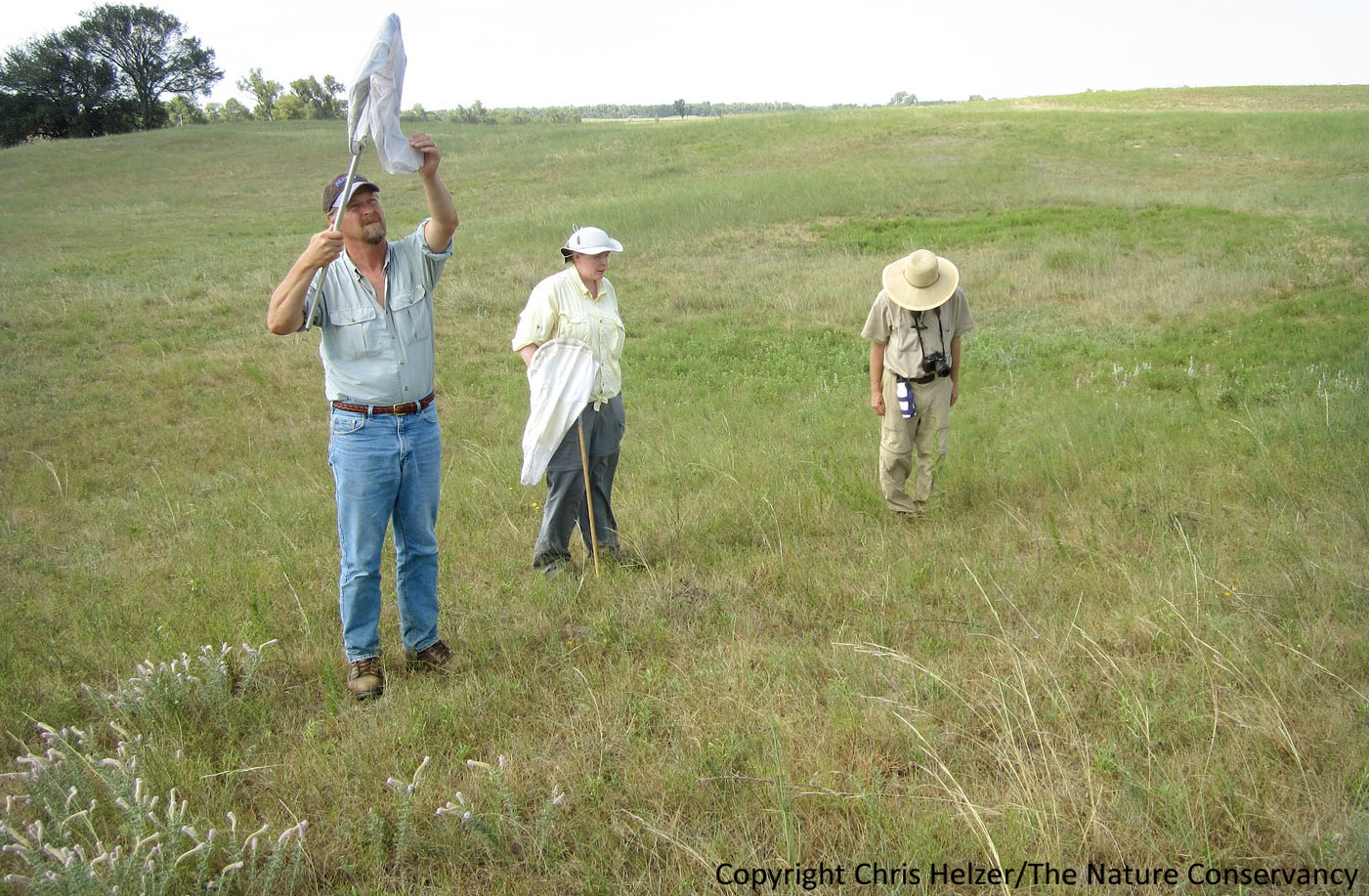
Mike Arduser (left) inspecting a captured bee in the Platte Prairies back in July, 2012.

As a reminder, our restoration objective is to reconnect and enlarge existing prairies by converting nearby crop fields to high-diversity prairie plant communities.  We hope the result is a larger, more connected, and more ecologically resilient prairie landscape.  The diverse plant communities in those restorations have successfully established, and we’ve been able to measure that by tracking plant species diversity and floristic quality.  It’s been more difficult to measure whether or not those restored prairies are actually stitching the surrounding landscape back together.  Our insect week this summer was an important step in evaluating that.

Continue reading

Photo of the Week – June 29, 2012

This week I visited a portion of one of our restored prairies that I hadn’t been to for a while.  During the last couple of years we’ve been grazing it fairly hard, so the wildflower displays haven’t been fantastic.  I was pleased to see that the rest we’re giving the prairie this year has allowed those wildflowers to do their thing.

The site was seeded in 2003, and included a number of excavated wetlands.  Portions of the upland seeding came in well and others have some issues, but for the most part, the wetlands look great. 

This year, for the second time since we seeded the site, some of the wetlands are experiencing an explosion of an annual plant called prairie gentian (Eustoma grandiflorum).  The plant is closely related to, but in a different genus than, the gentian species familiar to many tallgrass prairie enthusiasts.  Our gentian is an annual that shows up mainly in wet prairies, with an apparent affinity for alkaline soils.  It’s an awfully pretty flower, and when it’s blooming in abundance, makes for a spectacular floral show.

Prairie gentian blooming along the edge of a restored wetland slough. The Nature Conservancy’s Platte River Prairies, Nebraska.  You can click on this and any of the other photos in this post to see a larger, clearer, version of the image.

Click below to see more photos from yesterday morning.

Continue reading