Photo of the Week – May 19, 2016

Gjerloff Prairie, formerly known as Griffith Prairie, is a beautiful site on steep loess hills adjacent to the Platte River.  It’s owned and managed by Prairie Plains Resource Institute, and was burned earlier this spring.  I walked around the prairie for an hour or so this week to see how things were progressing since the fire.  From a distance it didn’t look like there was much to see – just a lot of short green grass.  Up close, however, there was a lot going on, and I didn’t have any trouble finding photography subjects..

The topography of Gjerloff Prairie is always interesting - if challenging to hike - but especially so after a fire.

The topography of Gjerloff Prairie is always interesting – if challenging to hike – but especially so after a fire.

Many plants, including this leadplant (Amorpha canescens), were growing strongly after the fire and a month of good rains.

Many plants, including abundant leadplant (Amorpha canescens), were growing strongly after the fire and a month of good rains.

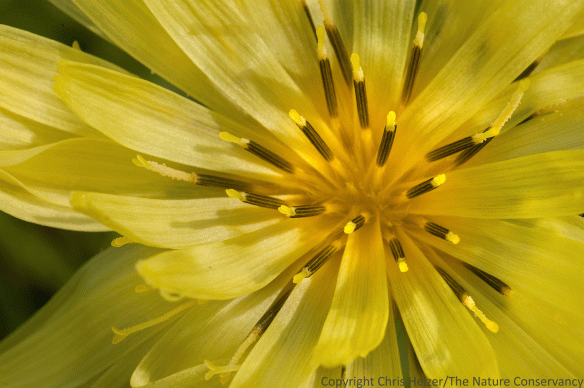
It was nice to visit the only population of tuberous false dandelion (Pyrrhopappus grandiflorus) in Nebraska. The southern Plains wildflower was discovered at Gjerloff prairie in 2004.

It was nice to revisit the only population of tuberous false dandelion (Pyrrhopappus grandiflorus) in Nebraska. Normally found only in Kansas and southward, this wildflower was discovered at Gjerloff prairie in 2004.

Smooth sumac (Rhus aromatica) can be overly abundant in some prairies in our area, but hangs out mainly on a few waslopes at Gjerloff prairie. It resprouts easily after fires, and looked vibrant and healthy this week.

Smooth sumac (Rhus glabra) can be overly abundant in some prairies in our area, but hangs out mainly on a few steep slopes at Gjerloff prairie. It resprouts easily after fires, and looked vibrant and healthy this week.

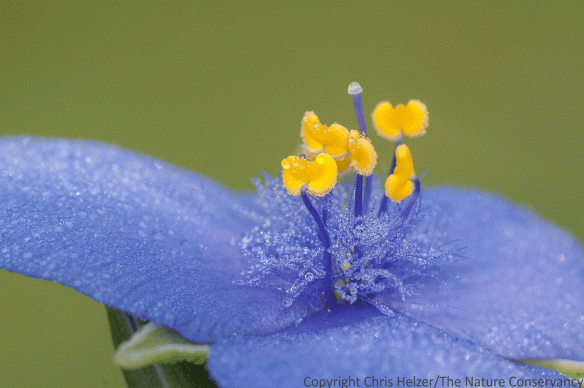
Spiderwort (Tradescantia occidentalis) was just starting to bloom on the warmer south-facing slopes of the prairie.

Spiderwort (Tradescantia occidentalis) was just starting to bloom on the warmer south-facing slopes of the prairie.

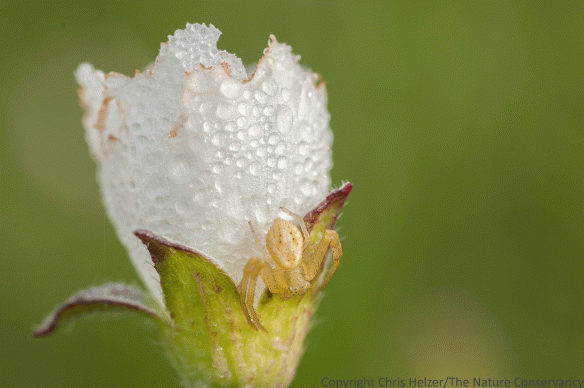
And, of course, I found a crab spider to photograph. Although they are particularly small this time of year, they are all over the place on flowers, and weren't difficult to find once I started looking.

And, of course, I found a crab spider to photograph (on pale poppy mallow – Callirhoe alcaeoides). Although they are particularly small this time of year, crab spiders are all over the place on flowers.


Photo of the Week – July 30, 2015

During our trip to the Grassland Restoration Network workshop in Minnesota last week, several of us got up early enough to catch sunrise at The Nature Conservancy’s Bluestem Prairie on two beautiful mornings.  I shared a few photos from those outings last week, but thought I’d post a few more today.  I’ve got lots more…it wasn’t hard to find subject matter to photograph!

Leadplant and wildflowers.  TNC Bluestem Prairie, Minnesota.

Leadplant (Amorpha canescens) and other wildflowers abound on The Nature Conservancy’s Bluestem Prairie near Glyndon, Minnesota.

Woundwort (Stachys palustris).

Marsh hedge nettle, aka woundwort (Stachys palustris).

The cool dewy morning allowed me to get pretty close to this resting monarch butterfly...

The cool dewy morning allowed me to get pretty close to this roosting monarch butterfly…

Beetle on Flodman's thistle.  TNC Bluestem Prairie, Minnesota.

This beetle was feeding its way across the top of this Flodman’s thistle (Cirsium flodmanii) – at least I think that’s what I think the thistle species was… it’s always dangerous to guess when I’m far from home.

Common milkweed.  The Nature Conservancy's Bluestem Prairie - Minnesota.

Common milkweed flower buds can be just as attractive as the open flowers…

Bee on milkweed.  TNC Bluestem Prairie, Minnesota.

This bee spent the night on a milkweed leaf and wasn’t quite warm and dry enough to fly off when I spotted it.  If you look carefully, you can see pollinia stuck on two (maybe three?) of its feet.  If you’re not familiar with the fascinating (and unlikely) story of how milkweed is pollinated, you can learn more here.

Purple coneflower (Echinacea angustifolia).  The Nature Conservancy's Bluestem Prairie - Minnesota.

Purple coneflower (Echinacea angustifolia).  This is a species we don’t find very often in the Platte River Prairies (though it’s fairly common nearby) so I always enjoy seeing and photographing it when I can.  As with other “composite” flowers, coneflowers are actually collections (composites) of two kinds of flowers – the ray flowers that look like petals and the disk flowers in the center.  Occasionally, as in this case, a genetic signal gets crossed and ray flower pops up where a disk flower should be.

If you find yourself traveling to or through northwestern Minnesota (just east of Fargo, ND), I encourage you to make the time to visit Bluestem Prairie Scientific and Natural Area.  You can find directions and more information on the site here.  The Nature Conservancy owns about 6,000 acres of prairie there, and their ownership is bolstered by several other tracts of conservation land right next door.  The prairie hosts nesting prairie chickens and beautiful tracts of northern tallgrass prairie.  It’s worth the trip to see it.