Unknown's avatar

About Chris Helzer

Chris Helzer is Director of Science and Stewardship for The Nature Conservancy in Nebraska, where he conducts research and supervises the Conservancy’s preserve stewardship program. He also helps develop, test, and share prairie management and restoration strategies. Chris is also dedicated to raising awareness about the value of prairies through his photography, writing and presentations. He is the author of The Prairie Ecologist blog, and two books: The Ecology and Management of Prairies and Hidden Prairie: Photographing Life in One Square Meter. He is also a frequent contributor to NEBRASKAland magazine and other publications. Chris and his family live in Aurora, Nebraska.

How Do You Evaluate Your Prairie?

The most challenging aspect of prairie management may be evaluating what’s happening on the land and what to do about it.  What should you focus on as you walk around a prairie?  Which plant species can tell you the most about the current condition of the prairie community?  How do you know whether changes in the plant community are short term weather-related changes, versus an indication of a long term trend?  What characteristics of wildlife habitat are the most important to monitor?  It can all seem overwhelming.
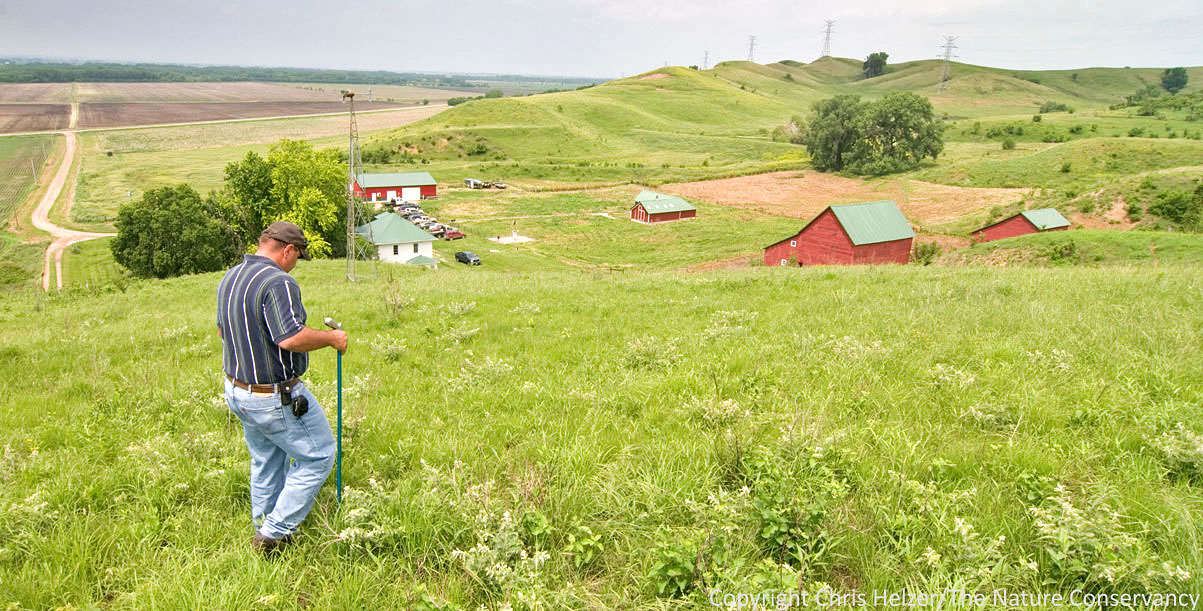
Evaluating prairies and impacts of management is important but can seem overwhelming.  What should you look for as you walk through a prairie?  (Scott Moats at The Nature Conservancy's Broken Kettle Grasslands in northwest Iowa.)

Evaluating prairies and impacts of management is important but isn’t necessarily easy. What should you look for as you walk through a prairie? (Scott Moats at The Nature Conservancy’s Broken Kettle Grasslands in northwest Iowa.)

This is something I’ve been thinking a lot about lately.  One of my main jobs is to help people restore and manage their prairies more effectively.  I try to share tips and techniques gleaned from our work on the Platte River Prairies, as well as from my experiences visiting and collaborating with other prairie managers across the country.  However, suggestions of management strategies are only useful if a prairie manager knows what challenges his/her prairie is facing.  Some managers are good at thinking about wildlife habitat needs but struggle to evaluate plant composition changes.  Others may focus so heavily on invasive species encroachment they ignore the needs of pollinators or grassland birds.  With so many things to think about, what are the most important?

As I walk through the prairies I work with, I pay close attention to (among other things) the abundance and vigor of particular plant species and note the distribution of certain habitat qualities.  My mental checklist is influenced by years of watching those sites respond to weather and management, as well as by the management objectives I’m evaluating.  However, I also enjoy having other ecologists and managers visit our sites because I can learn a great deal from their perspectives.  Because they have a different set of experiences than I do, they notice and evaluate different factors than I do.

This prairie was burned and grazed with a fairly light stocking rate last year.  It has not been grazed this year.  When I walked it this week, I was looking at the vigor of the dominant grasses (still low) and the wildflowers (high).  I also wanted to see if it had maintained the mixed-height habitat structure I was hoping for (it had).

This prairie was burned and grazed with a fairly light stocking rate last year. It has not been grazed this year. When I walked it this week, I was looking at the vigor of the dominant grasses (still low) and the wildflowers (high). I also wanted to see if it had maintained the mixed-height habitat structure I was hoping for (it had).

Because the process of evaluating prairies and their management needs is both important and potentially overwhelming, I want to try to develop some basic guidelines – a kind of checklist for evaluating prairies.  I need help, so I’m reaching out to others, including the readers of this blog, for their input.

What do you look at as you walk through the prairies you’re familiar with?  How do you know whether a prairie you’re managing is headed in the right or wrong direction?  Are there particular plant or animal species that you feel are good indicators of the larger prairie community?  Tell me about your mental checklist…

Please leave any suggestions and ideas you have in the comments section below (if you don’t see a comments section, click on the title of this post and then look again).  I’ll try to synthesize your thoughts and mine and see if we can come up with something useful.  Thank you very much for your help.

To get you started, here are a few examples of items on my personal mental checklist:

How many species of pollinator plants are blooming right now, and how abundant are they?

Are the populations of our most dangerous invasive species increasing or decreasing?

Which plant species are being grazed by our cattle and which are they ignoring?

Are new plants germinating and establishing themselves or is the “canopy” of existing plants stifling new growth?

Are there patches of vegetation structure types present that represent the full spectrum of habitat types? (tall/rank, short/sparse, mixed-height, etc.)
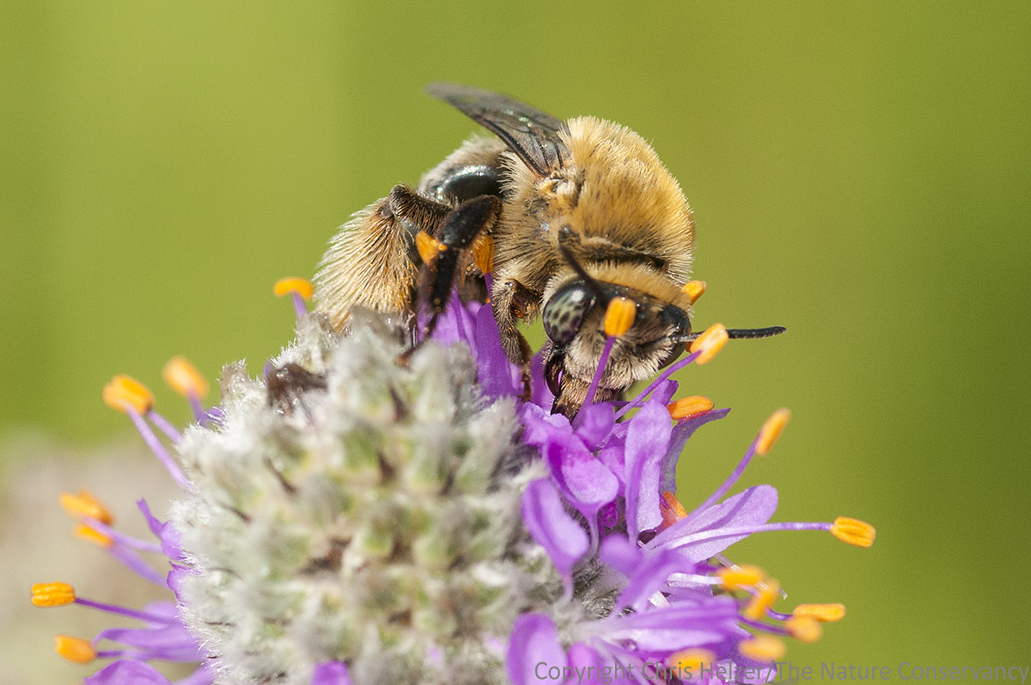
 

if you were a bee, would you find a good selection of feeding options throughout the season?
If you were a bee, would you find a good selection of feeding options throughout the season?


Emergence of Life in a Wetland

After many years of wanting to, we finally installed some solar-powered pumps and livestock water tanks in our family prairie.  (Thanks to the U.S. Fish and Wildlife Service and Nebraska Game and Parks for providing cost-share money!)  Those two water tanks give the cattle nice cool clean water to drink and allow us more flexibility in the way we design our grazing each year.  Most importantly, they allow us to exclude the pond/wetland from grazing so it can start to function as a wetland rather than as a big mud hole for cattle to stand around in.

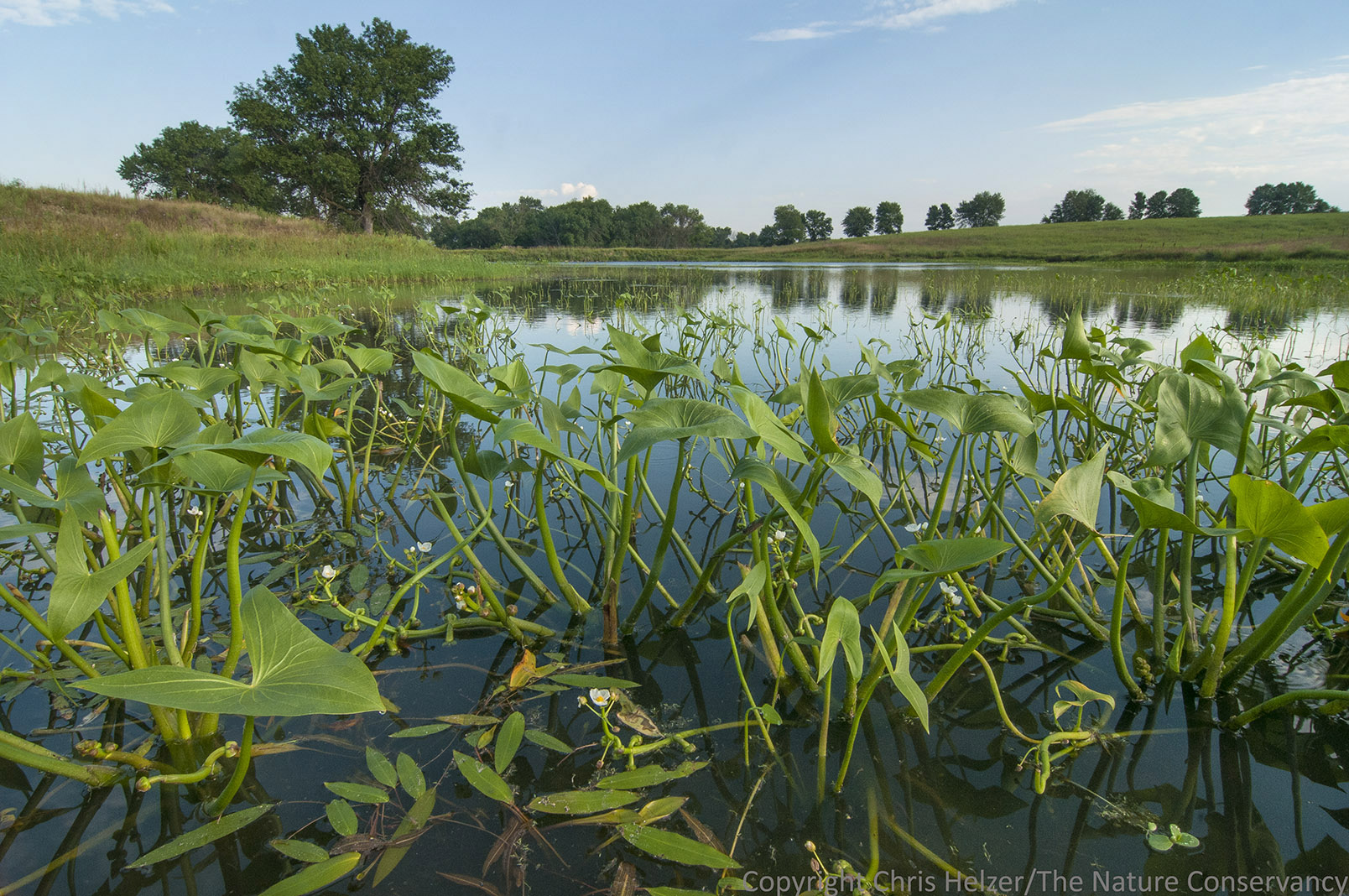
Because we’ve had good rains this year, the wetland has been pretty full.  That’s nice, but it has also prevented much of the wetland-edge seed I planted from germinating and growing.  Despite that, the recovery of the wetland is well underway.  There is now grass growing right to the water’s edge and arrowhead and other emergent plants are starting to appear in shallow water.  I’ve been spraying the few reed canarygrass plants growing nearby in the hope of preventing that invasive species from taking over the margins of the wetland, and hopefully I can get some more diverse wetland plants to establish there instead.

The pond/wetland at the Helzer family prairie with abundant arrowhead (Sagittaria sp.) in the shallows.

The pond/wetland at the Helzer family prairie with abundant arrowhead (Sagittaria sp.) in the shallows.

My daughter and I went for a walk at the prairie over the weekend and visited the wetland to see what was happening.  As I waded into the shallow water to take the above photo, leopard frogs scattered from my footsteps and red-winged blackbirds scolded me for encroaching upon their territories – very good signs of recovery.  However, looking more closely at the arrowhead plants poking through the water, I found even more evidence of new life.

Abandoned exoskeletons of damselfly nymphs were littered around the wetland.

Abandoned exoskeletons of damselfly nymphs were littered around the wetland.

Adult damselflies fluttered around everywhere, and many of them had apparently just appeared on the scene because the larval exoskeletons they’d just emerged from were stuck to leaves and stems all over the place.

ENPO140802_D008

ENPO140802_D010

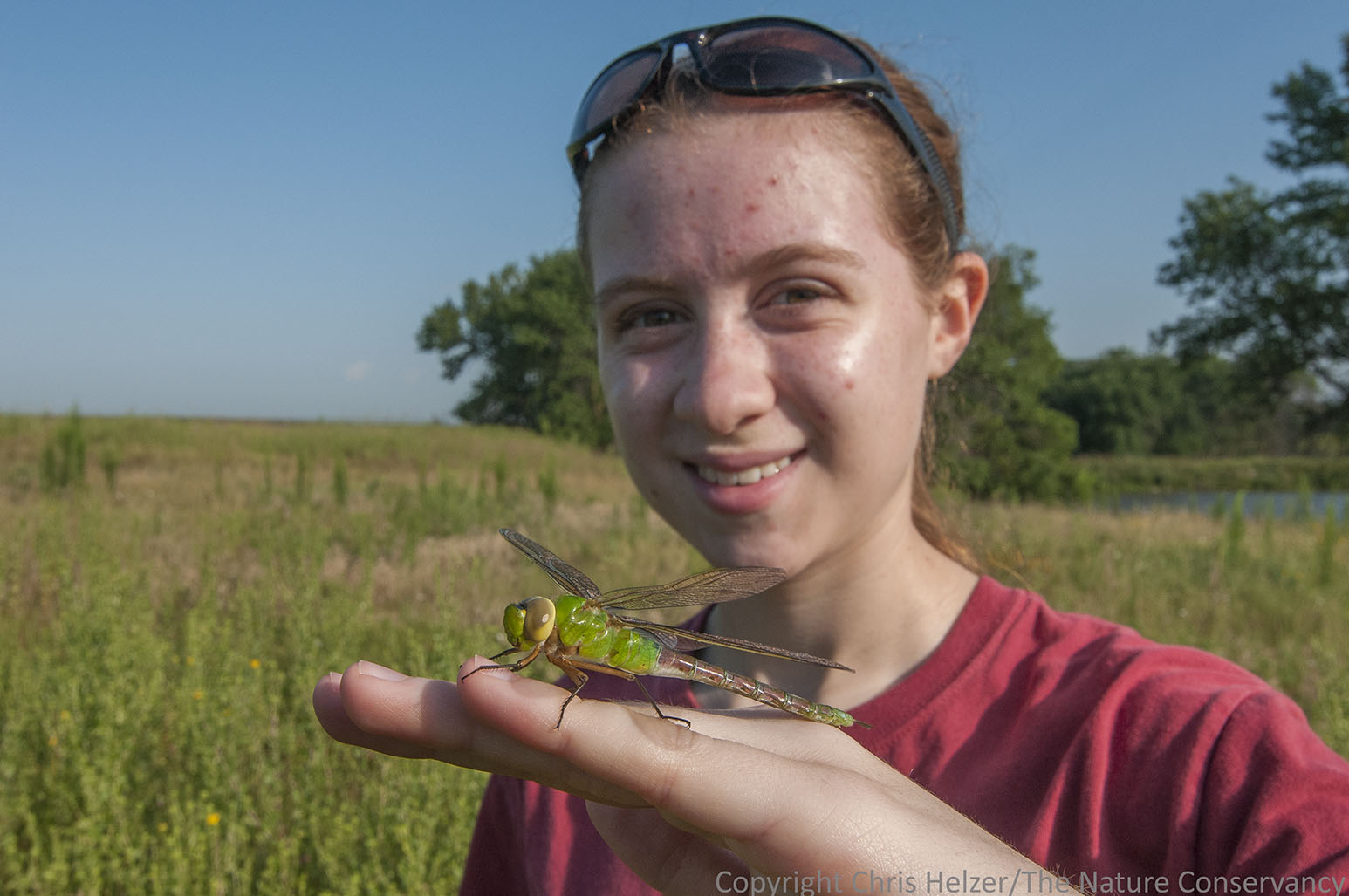
While I was too late to see the actual emergence of the damselflies, I did manage to find a green darner dragonfly that had just popped out of its larval skeleton and was fluttering its wings and waiting for its body to dry and harden.  I snapped a few pictures of it in place and then carried it over to Anna so she could get a good look at it.

A green darner dragonfly and the larval exoskeleton it had only recently escaped from.

A green darner dragonfly and the larval exoskeleton it had only recently escaped from.

Anna enjoyed getting a close-up view of the dragonfly and even posed for a photo with it.

Anna enjoyed getting a close-up view of the dragonfly and even posed for a photo with it.

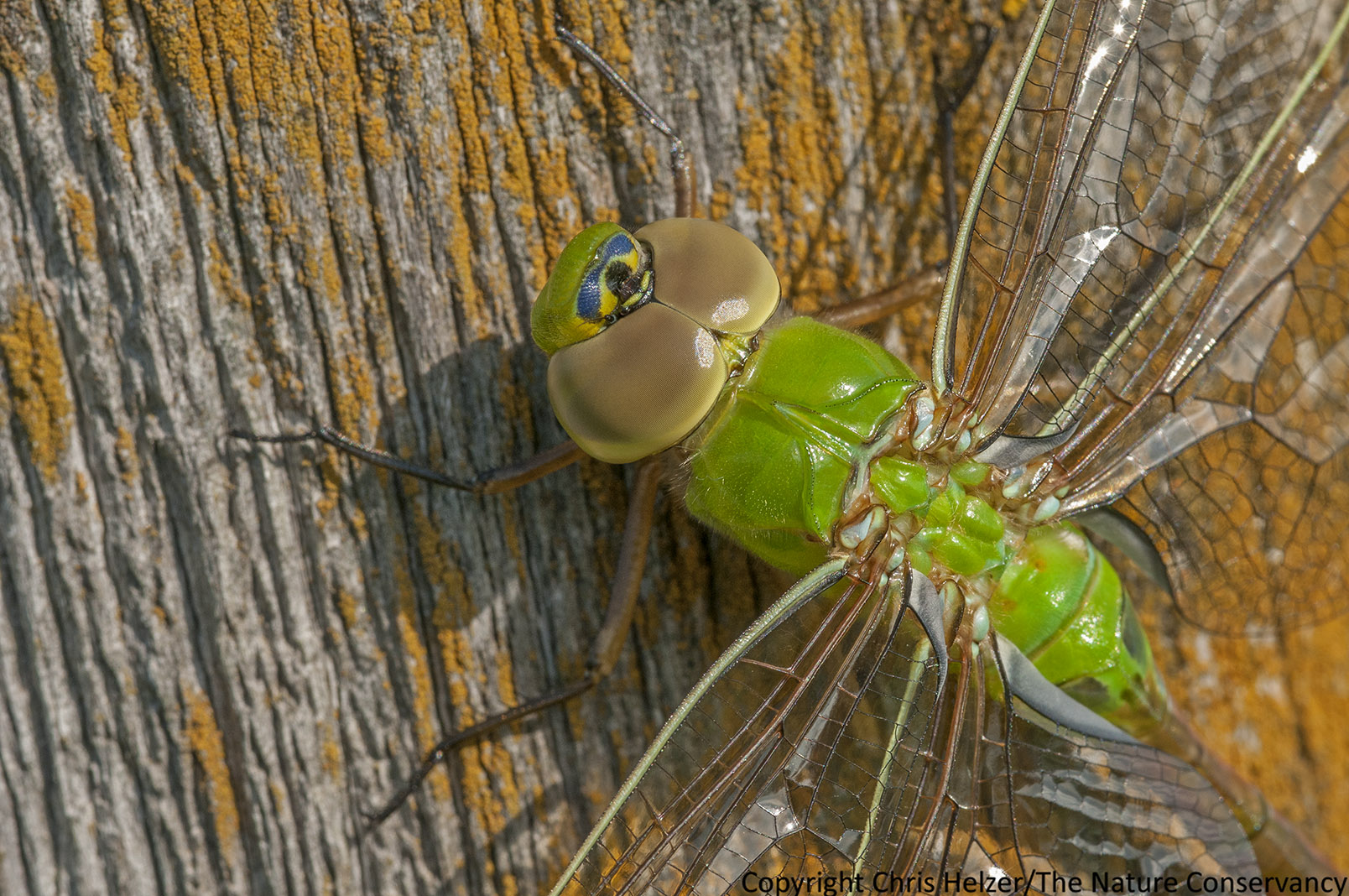
After we became a little better acquainted with the new dragonfly, we set it safely on a fence post so it could finish hardening up in the warm sun.  I took a few more quick photos of it on the post and then left it alone.  It was gratifying to see other dragonfly species zipping around nearby too – I’m hoping that’s a sign that a number of other aquatic invertebrates are also colonizing our recovering wetland.  It should be fun to watch the changes in the coming years.

Our new friend on the top of a fence post.

Our new friend on the top of a fence post.

ENPO140802_D019