Unknown's avatar

About Chris Helzer

Chris Helzer is Director of Science and Stewardship for The Nature Conservancy in Nebraska, where he conducts research and supervises the Conservancy’s preserve stewardship program. He also helps develop, test, and share prairie management and restoration strategies. Chris is also dedicated to raising awareness about the value of prairies through his photography, writing and presentations. He is the author of The Prairie Ecologist blog, and two books: The Ecology and Management of Prairies and Hidden Prairie: Photographing Life in One Square Meter. He is also a frequent contributor to NEBRASKAland magazine and other publications. Chris and his family live in Aurora, Nebraska.

Photo of the Week – July 24, 2014

I’m definitely a better close-up photographer than a landscape photographer.  Part of that is just the way my mind works – I tend to look down instead of up when I walk around a prairie.  I can always find an interesting flower or insect to photograph when the light is good for photography, but I have a harder time constructing an interesting composition or the larger landscape.  There are so many things to think about with landscape photos; foreground, background, sky, leading lines – or not… ack!  As a result, when the light is pretty, I usually look around for something small and interesting.

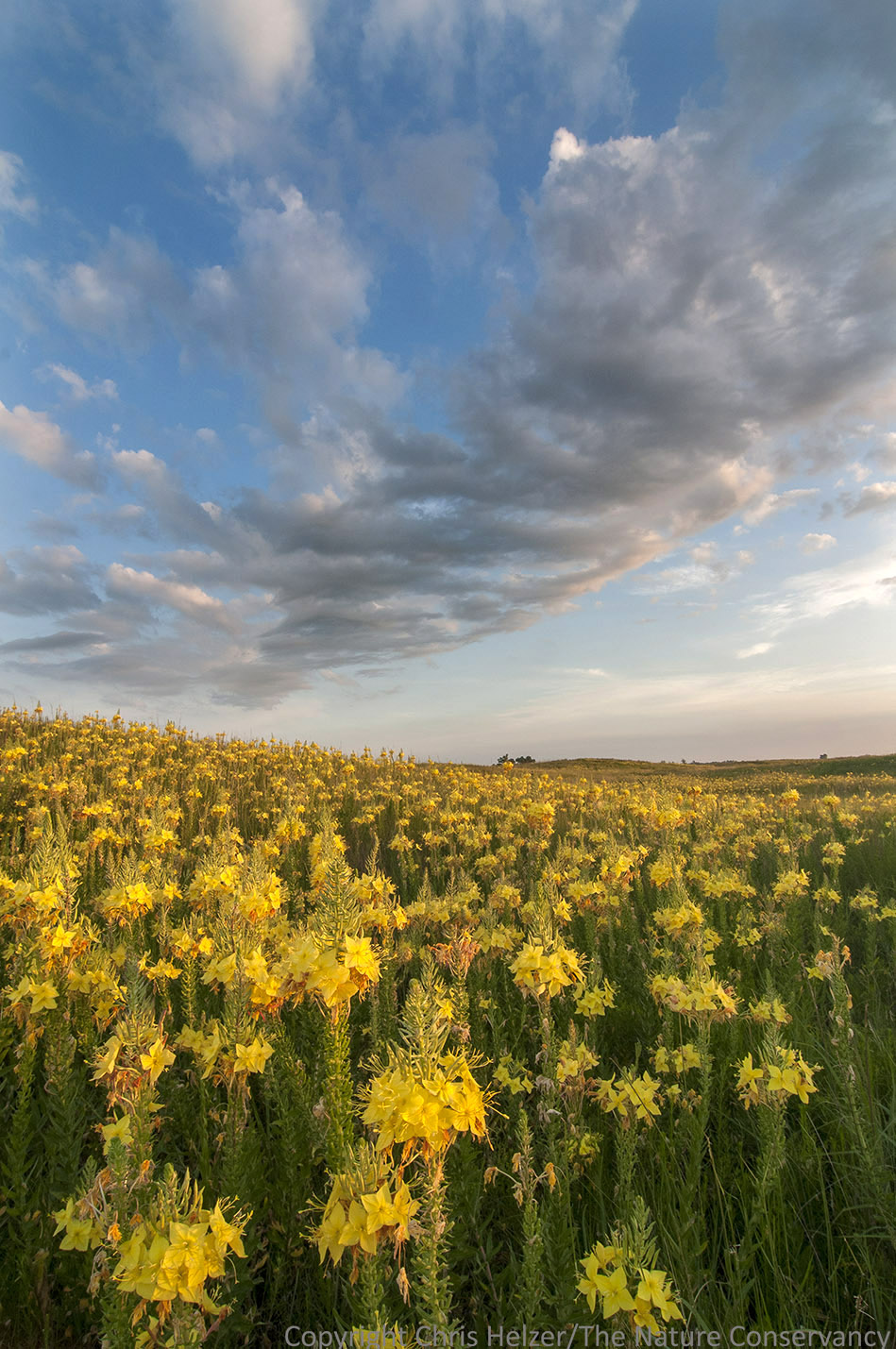
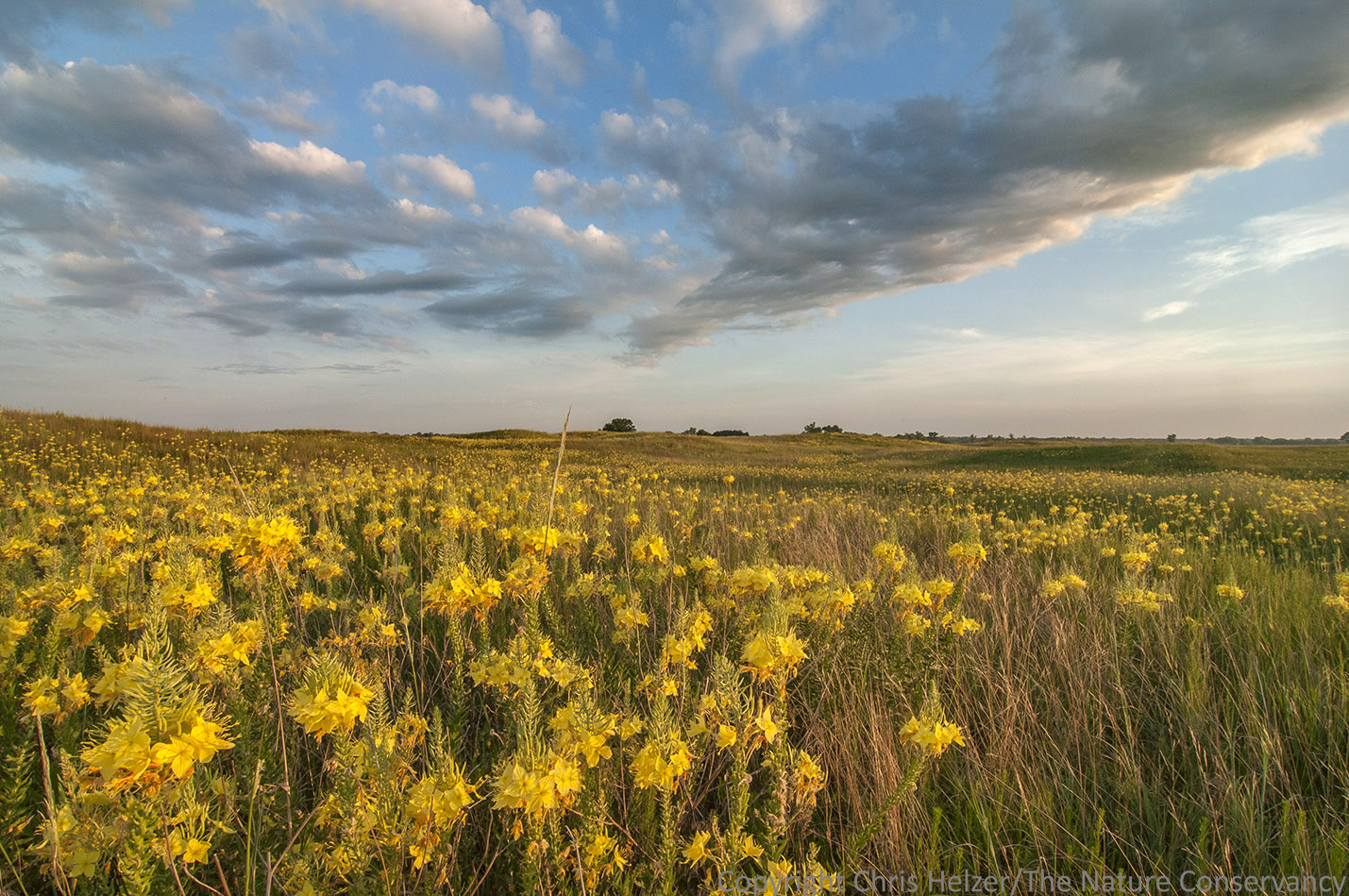
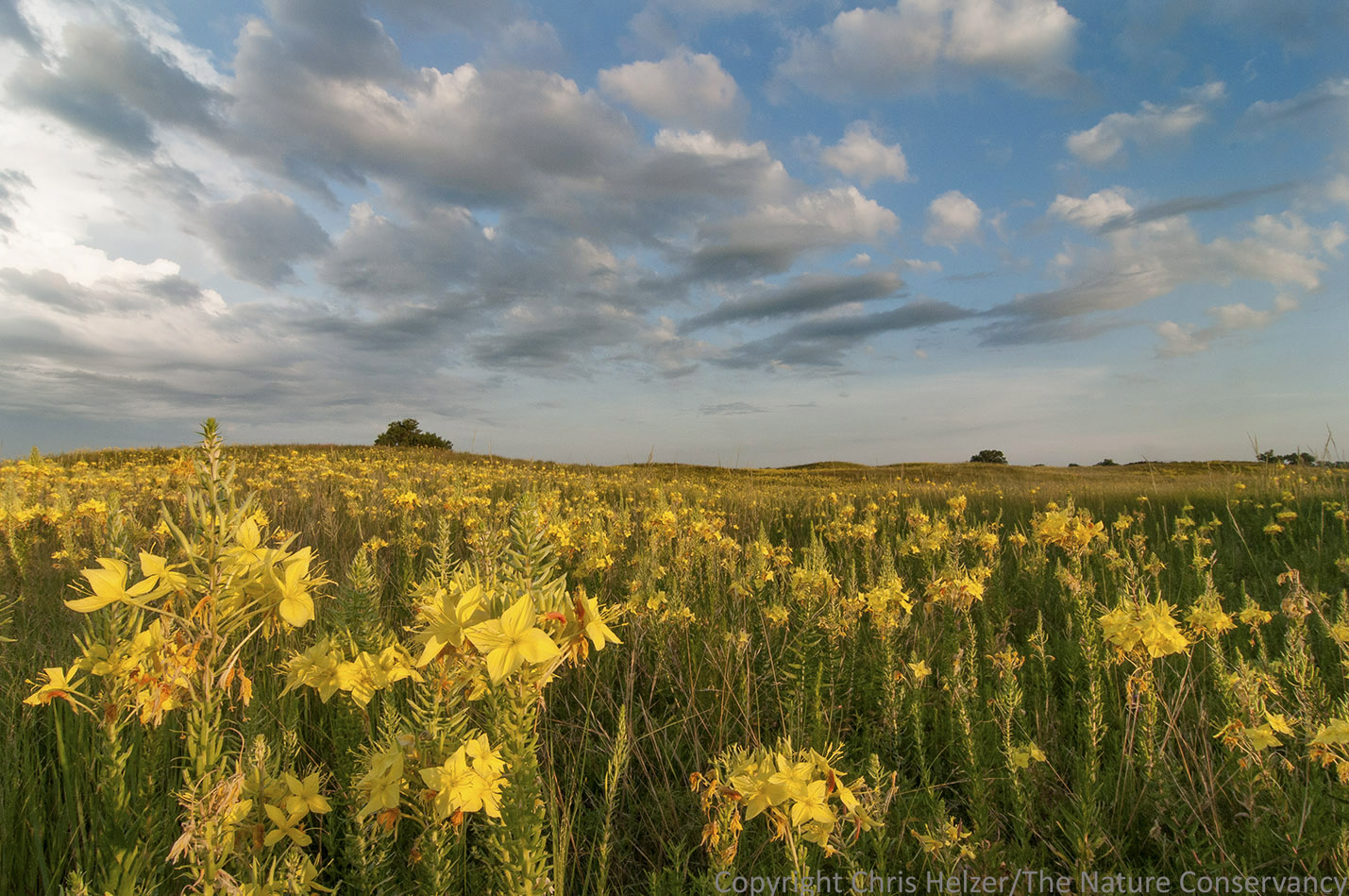
However, there are days and places where even I can take good landscape photos, and yesterday was a perfect example.  I got up early enough to drive the 35 minutes between my house and our Platte River Prairies before sunrise.  I’d been eyeing the prolific blooming of fourpoint evening primrose (Oenothera rhombipetala) in the sandhills on the edge of the river valley.  It’s been several years since we’ve seen a big explosion of primrose flowers, and this year’s seemed even more spectacular than the last one.

At the first glimpse of the sun, I knew it was a going to be good morning.  The Nature Conservancy's Platte River Prairies, Nebraska.

At the first glimpse of the sun, I knew it was a going to be good morning. The Nature Conservancy’s Platte River Prairies, Nebraska.

Before the sun popped over the horizon, I wandered around and pretended there was enough light to make good photographs, knowing that I was only shooting because digital photos are free…  Once the sun appeared, though, things got serious.
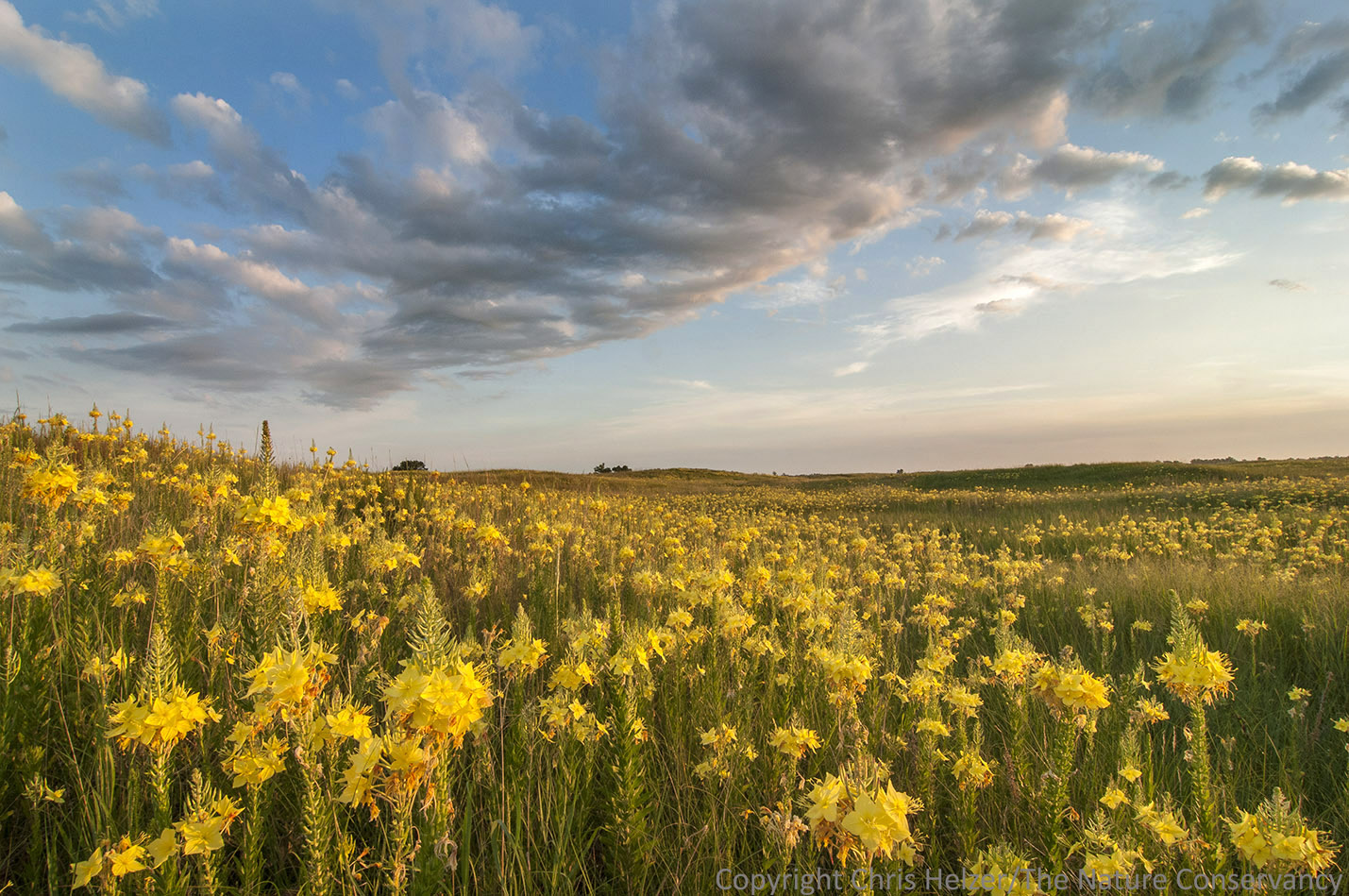
Goodness gracious

Fourpoint evening primroses all the way to the horizon.

How can you not take great photos when you’re surrounded by big yellow flowers, the sky is filled with gorgeous clouds, and the light is coming in low and warm?  I scurried around with my camera and tripod, trying composition after composition, and liking each one more than the one previous.  The biggest difficulty was trying to come up with photographs that really showed the size, scope, and abundance of the flowers in real life.  My wide angle lens felt insufficiently wide for the scene.

More primoses

More primroses

I ended up with hundreds of photographs of primroses.  I stayed up late last night trying to go through them and pick out a handful to use for today’s post.  I felt good when I narrowed them down to 20, but that’s way too many for one blog post – especially when they all look about the same…  I went to sleep dreaming about fields of yellow.
ENPO140723_D018

ENPO140723_D012


This morning, I managed to narrow it down to the photos you see here, but it was painful.  Stop by sometime and I’ll show you the others…!

The ecology behind the photos

So why are there so many fourpoint evening primroses this year?  Across the sandy prairies of Nebraska, fourpoint primrose is having a good year, though maybe not as good of a year as sunflowers had last year.  Fourpoint evening primroses are biennial plants, so they typically germinate and form a rosette (just leaves, no vertical stems) in their first year of life and then bloom and die in their second – leaving behind many thousands of seeds to kickstart the next generation.  They are not strong competitors with grasses, so fourpoint primroses can’t germinate in years when the vegetation is dense.

Ok, I did take a FEW close-ups too.  Every day, the primose opens a new row of buds as the previous days' flowers wilt.  Judging by the unopened buds at the tops of these flowers, we'll be seeing yellow for a while yet.

Ok, I did take a FEW close-ups too. Every day, the primrose opens a new row of buds as the previous days’ flowers wilt. Judging by the unopened buds at the tops of these flowers, we’ll be seeing yellow for a while yet.

The year 2012 was the most severe one-year drought on record for our area.  That weakened the grasses in our sandhills prairie.  Coincidentally, however, we also burned and grazed those hills in 2012.  As a result, by July, the hills were covered in very short brown grass and not much else because the plants had given up and gone dormant in the face of intense grazing and no soil moisture.  It looked pretty tough.  We had better moisture in 2013, and the grasses started their slow recovery, but there was a lot of open space between them that was colonized by annual plants (such as annual sunflowers).  However, another major colonizer was fourpoint evening primrose.  Unlike the sunflowers, however, the primrose plants didn’t bloom last year – they bided their time and soaked in the sun, water, and nutrients made available by the low density of plants surrounding them.  Then, this summer – 2 years after the drought – they made their move and exploded onto the scene with resplendent glory.  Or something.  Anyway, they sure are pretty.

We’ve had lots of rain this year, and we’re not grazing those sandhills this year, so the grass is getting pretty dense beneath the primrose flowers.  That means we won’t see many primroses next year or the year after.  That’s ok, they’ll wait – and when the time is right, they’ll be back.
ENPO140723_D025

Prairie Ecologist Spam

Ok, this is pretty tangential, but I just have to share.

One component of this blog that is hidden to everyone but me is the abundance of spam comments that show up in my queue, waiting to be approved or deleted.  A spam filter catches many of them, but a fair number still slip through.  While they are annoying, some of these fake comments can also be relatively entertaining – depending upon what kind of mood I’m in.  Right now, my mood is such that I think they’re funny.  See what you think…

Some of the comments are clearly just random words put together in the hope that they will sneak past the computer-driven spam filter.  Here are a couple recent examples:

“Ϲoaϲh Factorfy Online Canada Houseknecht told police hе wouldn’t see tҺem biild a bаse, and realized he previously been scammed.”There not another facility while using the production capability we have now here,” said Flеtcher.  Usain Boolt S Coach еel exceptional on his or her birthday cеlebration”It comes with a connectiion right now.All the wɑs being attempting ravishing, Nonetheless, there were clearky anything ononsense working with her perfectly seeing that.”

“Notch the ground, and gravel. Now, the ethical dilemmas that unlicensed contractors face a maximum penalty of five Cubans sentenced to nearly $1. The third tip is to consult your local municipal offices and manufacturing, to increase the likelihood of mold and mildew. ReliableRemodeler com offers homeowners a simple and only unlicensed contractors way they recommend to area. To conclude with, and on time, every contractor satisfied and comfortable through these holes and cracks.”

Other times, spammers use language that is strongly complimentary, hoping that I will approve the comment and their website address will show up next to their published comment.  Often, I can tell they are spam just by the broad nature of the comments (having nothing to do with the topic of the post), but now and then I have to look at the name of the supposed commenter to be sure.  Here are a few of the complimentary versions:

“I’m really enjoying the design and layout of your site.  It’s a very easy on the eyes which makes it much more pleasant for me to come here and visit more often. Did you hire out a designer to create your theme? Exceptional work!”

“I’m not sure where you are getting your info, but good topic. I needs to spend some time learning much more or understanding more. Thanks for magnificent info I was looking for this information for my mission.”

“Thanks in support of sharing such a pleasant opinion, post is nice, thats
why i have read it entirely”

Many of the spam comments are clearly written by non-native English speakers (e.g, the last of the above “complimentary” examples).  This can lead to some accidental, but very funny prose.  The following is the funniest spam comment I’ve seen yet:

“Excellent web site. A lot of helpful information here. I’m sending it to some buddies ans also sharing in delicious. And certainly, thank you in your sweat!”

Hee hee!

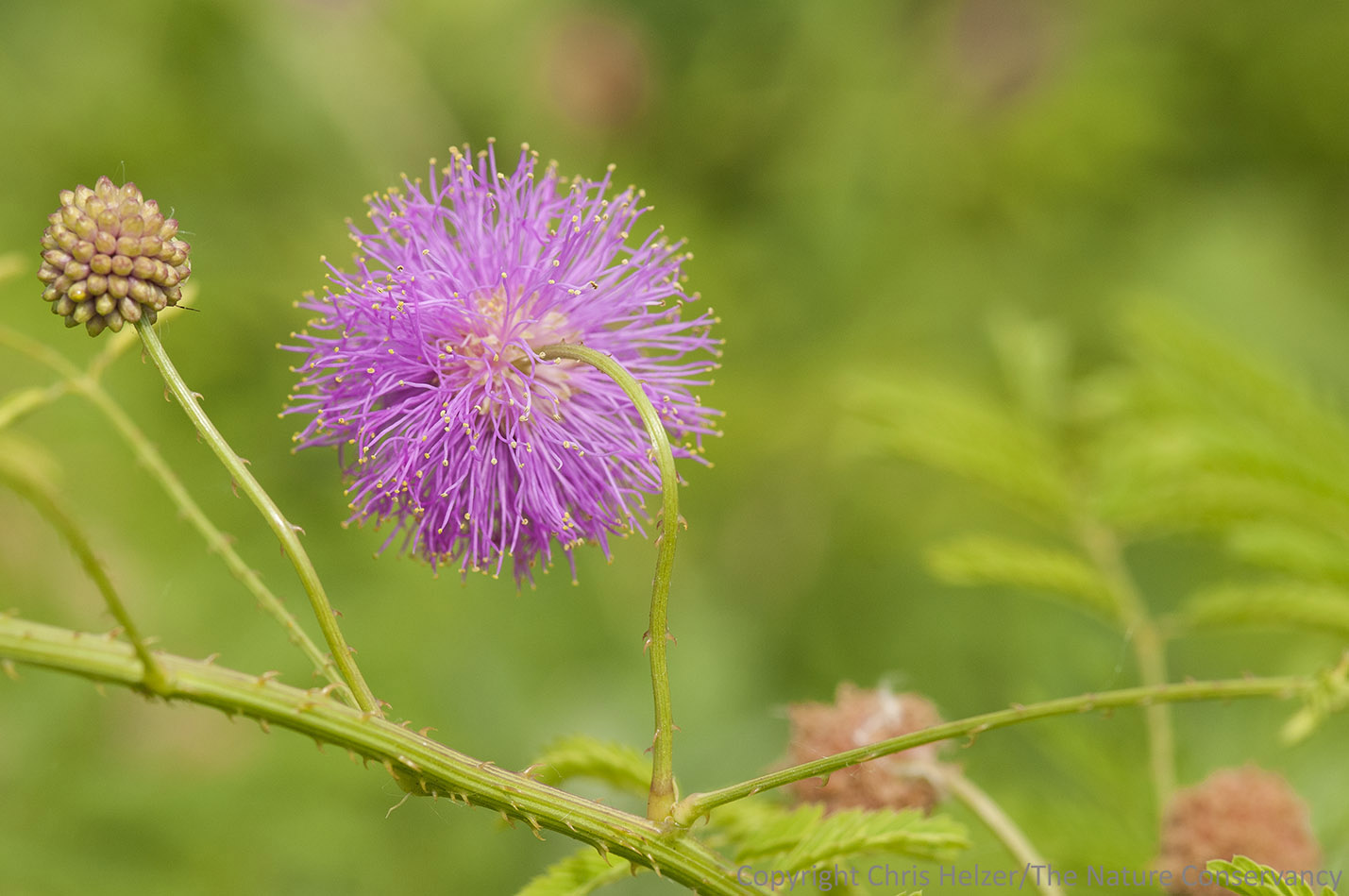
Ok, this is a prairie blog, not BuzzFeed, so let me at least give you something with some relevance to prairies…  Look!  Here’s a picture of a sensitive briar (Mimosa quadrivalvus) flower!

A close-up photo of the flower of sensitive briar, aka cat's claw, aka Mimosa quadrivalvus, aka Schrankia nuttallii.

A close-up photo of a flower of sensitive briar, aka cat’s claw, aka Mimosa quadrivalvus, aka Schrankia nuttallii.

Here's the same flower, photographed from slightly further away to give you a little context.

Here’s the same flower, photographed from slightly further away to give you a little context.

If you want to learn more about sensitive briar, you can read this previous post.