Unknown's avatar

About Chris Helzer

Chris Helzer is Director of Science and Stewardship for The Nature Conservancy in Nebraska, where he conducts research and supervises the Conservancy’s preserve stewardship program. He also helps develop, test, and share prairie management and restoration strategies. Chris is also dedicated to raising awareness about the value of prairies through his photography, writing and presentations. He is the author of The Prairie Ecologist blog, and two books: The Ecology and Management of Prairies and Hidden Prairie: Photographing Life in One Square Meter. He is also a frequent contributor to NEBRASKAland magazine and other publications. Chris and his family live in Aurora, Nebraska.

Hubbard Fellowship Blog – Cranes and Blind Mice

The sandhill cranes have returned for their annual visit to the Platte River of Nebraska, one of the greatest migratory phenomena in the world.  The following is a guest post by Hubbard Fellow Anne Stine:

Have you ever been scolded by a deer mouse? I have.  That was just one of the new experiences I’ve shared with visitors in the past few weeks, now that the cranes have returned to the Platte River Valley.

Sandhill cranes roosting on the Platte River in Nebraska.  March 2007.

Sandhill cranes roosting on the Platte River in Nebraska. March 2007.

I actually got scolded twice. When a deer mouse scolds you, it sounds like a cheeping bird:  “ZHee zeezezezezeze”. That mouse was so put-out that her rumpus-room (our crane blind) was filled with people, she stuck her head out of a hole in the wall and twittered at us to scram. I cannot imagine that telling-off a roomful of large predators is evolutionarily adaptive to a small mammal, but evidently even mice can be curmudgeons.

Our group of large predators was gathered in the blind to stalk cranes. The snow geese, Canada geese, and Sandhill cranes have all returned to the Platte River.  If you angle your neck to look straight up in the sky, you can see threads of birds waving and intersecting with the breeze. Their numbers are unlike anything I’ve seen back east. The way they ride the wind at different heights, so you see and hear layers of their lines crossing in the air, is totally mesmerizing.

The night before last the cranes roosted directly downriver of our large blind.  At first, we weren’t sure we’d get to see any of these birds up close. Whirlpools of birds circled and landed below the western horizon, their skinny long legs stretched out in front of them.  They flew low overhead, but they didn’t seem to find what they were looking for in a roost on our part of the river. A lonely Canada goose stuck her neck straight up and honked at the sky, trying in vain to call down companions.

Then, as the sky was just beginning to darken, four cranes landed on a sand bar about 50 feet down stream of our building.  At first they just stood around, sometimes pacing in their goofy prancing walk, as if waiting for their cue. More cranes passed overhead, but continued to settle downstream. Finally, a line of cranes heading east noticed their comrades loitering down below. They trilled loudly and initiated their descent, wings cupped like a parachutist and legs stretched out. After the first large group settled with our four pioneering friends on the near sandbar, the population of cranes downriver swelled and built upon itself. Cranes are gregarious birds, so a few trendsetters can determine where everyone sleeps for the night.
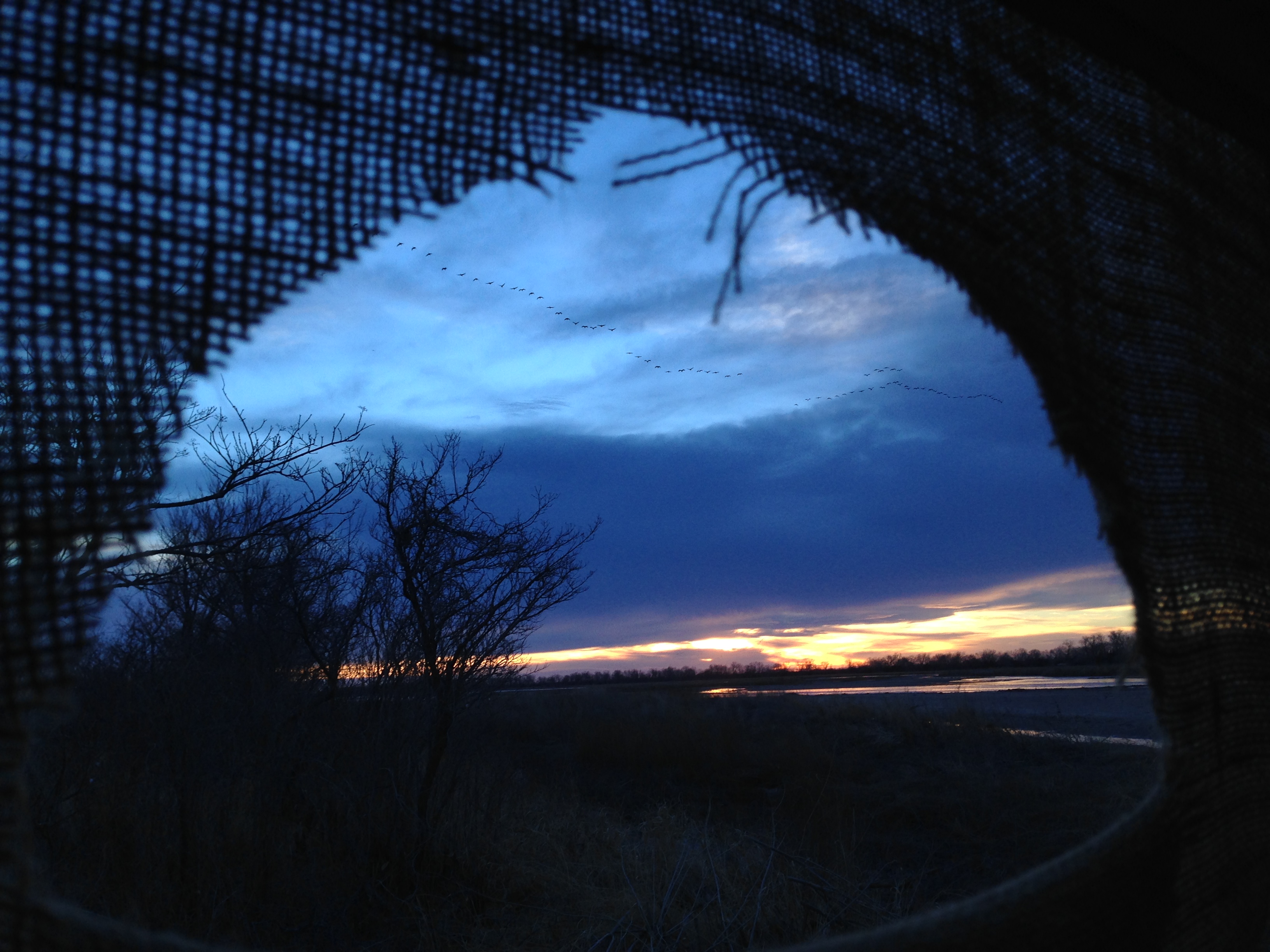
Looking out the crane blind, cranes flying by.  Photo by Anne Stine.

Looking out the crane blind, cranes flying by. Photo by Anne Stine.

Cranes may roost on the river, but they don’t linger there all day- they have work to do. The next day we were mowing and raking burn breaks in our prairies when we heard a party going on in the trees at the north end. The cranes were feasting along the stream! Half the flock would rise and trill, and then settle, while the ones on the ground poked around, looking for invertebrates.  We worried about flushing them from their daytime hunting grounds, but they didn’t seem to mind us too much as long as our machinery kept moving.

Seeing these pre-historic goofballs reminds me that spring is upon us, and soon I’ll be trading my hot tea for lemonade and my fuzzy robe for a hammock in the yard. I can’t wait.

Photo of the Week – March 13, 2014

Here are two photos that caught my attention as I was going through timelapse imagery the other day…

In my last post, I showed some timelapse photos from a fenceline at The Nature Conservancy’s Niobrara Valley Preserve in north-central Nebraska.  At the time, I promised a good story about the trail that developed on the cattle side (right side) of the fence.  As a reminder, the fence in these photos was installed in what had been a cattle pasture, but the left side is now grazed by bison (light stocking rate) and the right side is grazed by cattle (moderate stocking rate).  More details on the stocking rates below…

The first photo in which cattle appear in their pasture is this one, taken on June 21 at 6:36 pm.

Cattle

June 21, 2013.  6:36 pm

Notice the absence of a cattle trail in this first photo.  Then look at the photo below, which was taken ONE HOUR LATER.

trail

June 21, 2013.  7:41 pm

Seriously?  A trail formed the very first time cattle walked along the fenceline??

I’m not surprised or bothered by the development of the trail, but I’m relatively shocked that it only took one pass by cattle to make it!  I would have expected the gradual development of a path over a few weeks.  On the other hand there were 110 cows and 110 calves in the pasture.  Rich Walters, Niobrara Valley Preserve manager, pointed out that if all those cattle followed the fence line in single file formation, that was 880 hooves stepping on those relatively loose sandy soils.  I suppose that would have an immediate impact.

Here’s one more surprise.  The cattle were brought into this pasture on June 2.  Why did it take until June 21 for them to (apparently) make their way to the north edge to graze and then create a trail?  I can’t say for sure that they hadn’t explored this part of the pasture prior to the 21st, but there isn’t any indication of grazing impact in the timelapse photos taken between June 2 and June 21.  It may be that the cattle had enough forage further south (and closer to their water tank) that they just never wandered very far, but I would have expected them to have made an exploratory pass around the pasture within the first few days – just to see what they had to work with…

Before I go further, I’m sure some people are already mentally condemning cattle for their trail-making and other faults, but that’s not the point I’m making here.  As I wrote in a recent post, I think cattle are very useful as prairie management tools, and are comparable to bison in most respects – though the formation of these narrow trails is certainly one difference between the two animals.  Sure, cattle trails can cause problems, especially in chronically overgrazed sites with steep slopes and erodible soils, but the vegetation beneath cattle trails can also recover pretty quickly if given the chance.  In the meantime, trails can provide valuable habitat for reptiles and invertebrates looking for a place to warm up in the morning sun, and are used as transportation corridors by many other animals besides cattle.

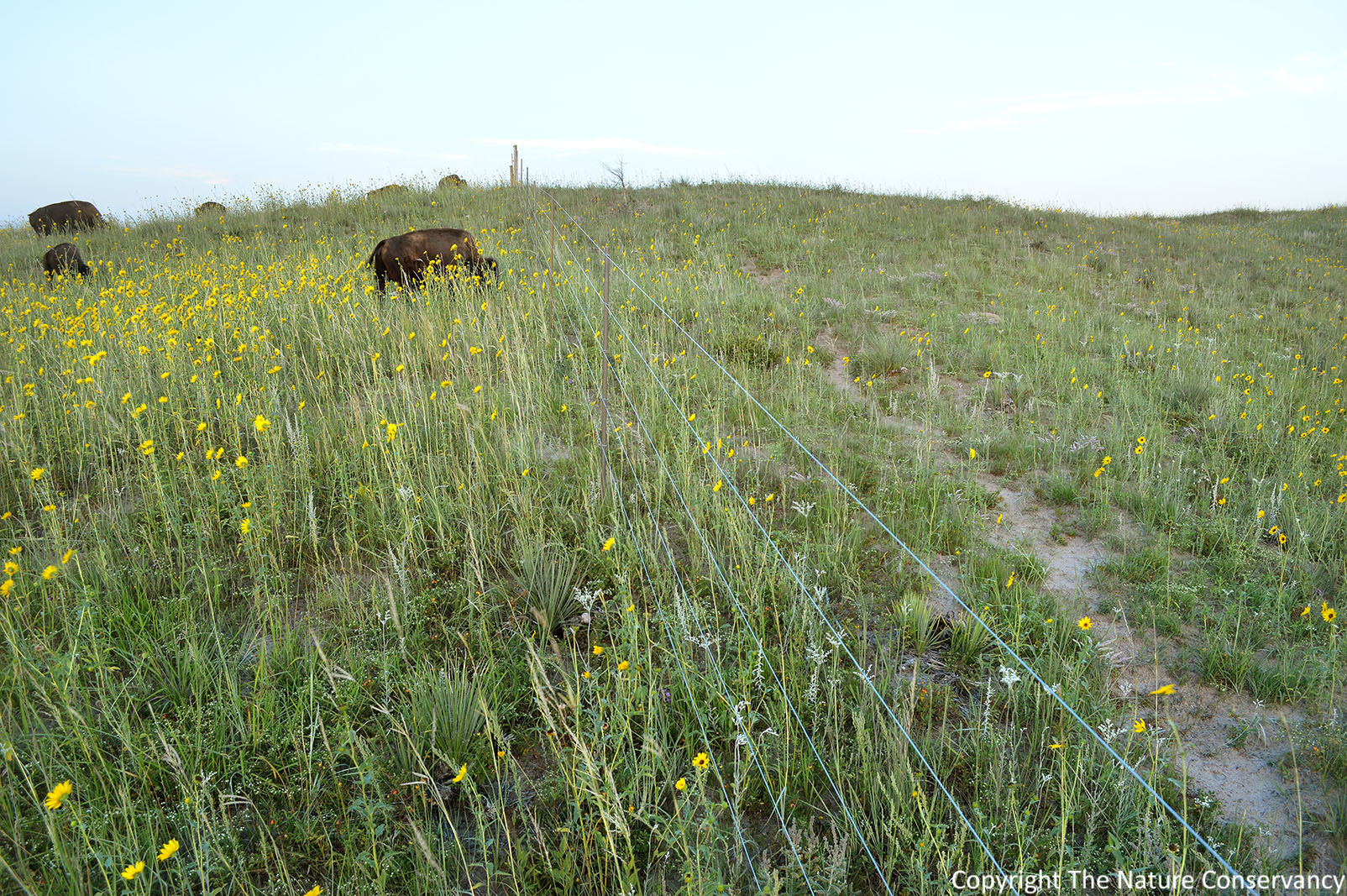
Oh, and in case you doubted me, the photo below proves that there truly were bison on the left side of the fence in 2013, though their numbers and the relative size of their pasture to the cattle pasture on the right created a very different grazing environment.

Bison grazing on the left side of the fence.  August 10, 2013

Bison grazing on the left side of the fence. August 10, 2013

The two sides of the fence looked pretty different from each other by the time cattle were removed, in terms of vegetation height and density.  After my last post, several of you asked about the stocking rates on each side.  There were approximately 225 bison (cows, calves, and bulls) in the 10,000 acre bison pasture to the left of this fence in 2013.  They were grazing year round, but had plenty of room to roam since the Preserve staff had cut back their numbers pretty drastically following the big wildfire in 2012.  At that stocking rate, bison didn’t graze very intensively in most parts of the pasture, including the area shown in this photo.  On the cattle side of the fence, the 110 cow/calf pairs were restricted to only 640 acres of pasture.  Even though they were only in the pasture for about 5 weeks (June 2 – July 12), that’s still a much higher effective stocking rate than that in the bison pasture.  The difference in the height of vegetation between the left and right sides of the fence, then, is due to stocking rate, not grazer species.

I’m already learning an awful lot from looking at the first year of timelapse imagery at the Niobrara Valley Preserve, and much of what I’m learning has been unexpected.  The rapid formation of a cattle trail is a great example.  I’ll be sharing another example within the next week or two, though it’s more of a mystery than a lesson at this point.  For now, I’ll just tease that post by saying it has to do with a stick that moves by itself…  You can have fun thinking about that for a while!