Nature can be incredibly complex and difficult to understand. Every creature is always reacting to the conditions around them, and continually evolving strategies to keep up with an ever-changing world. Because we don’t always understand the full spectrum of challenges facing organisms their behavior sometimes seems illogical. (And, sometimes, it probably is.) Regardless, trying to understand that behavior sure makes ecology fun!
Over the last month, I’ve seen two behaviors that are really interesting but don’t quite make sense to me. Both involve bees.
On several occasions during the last several weeks, I’ve seen bumblebees spread out across the prairie, sitting on prominent high perches. When approached, the bees fly a short distance and then either return to the same perch or land on a nearby one. The second time I saw this, Anne Stine (Hubbard Fellow) and I were out collecting data for a research project. There were dozens of bees on perches, and I just had to know what was going on. Fortunately, I was able to catch Mike Arduser by cell phone and ask him.

A male bumblebee (Bombus griseocollis) sits above the prairie on an unopened stiff goldenrod flower. Platte River Prairies, Nebraska.
I didn’t even finish my description of what we were seeing before Mike was able to tell me the species and gender of the bumblebees, as well as the reason for their perching behavior. He said we were seeing males of the species Bombus griseocollis, and they were on the lookout for new queens making their first foray from of the nests they were raised in. Sure enough, a few minutes later, we saw a gigantic female bumblebee being swarmed by eight or ten smaller males trying to mate with her. Apparently, the perching behavior is successful.
So I guess sitting on perches makes sense. However, wouldn’t it be more effective for the bees to wait right outside the nest exit instead of at apparently random locations across the prairie? Surely these bees – or at least some of them – hatched from the same nest as the queens, so they should know where that nest is. I’d think the males would want to be as close to that exit as possible so they could be the first one to “welcome” the female to the outside world. Maybe there’s a good reason not to do that, but I don’t know what it would be. As I said earlier, this kind of thing is what makes ecology fun!
(Another thing that’s fun is tossing small flower heads or other bumblebee-sized objects near the perched bees and watching them dart out after them…)
.
The second bee observation came from the little prairie across town from my house. I was out on a dewy morning, taking a few photographs before heading to the office. It was cool and wet enough that most insects I saw were sitting very still, encased in droplets of water – a very nice situation for a photographer.
Many of those insects had found relatively sheltered and hidden locations in which to spend the night. A few, though, were right out in the open – something that seemed foolish to me, but certainly made it easier to photograph them. One such insect that caught my eye was a medium-sized bee hanging upside down on a grass stem. As I approached it, the bee spread its legs out (defense mechanism?) and by the time I set up my tripod to photograph it, the bee looked like a circus acrobat – hanging upside down and holding on only with its teeth (mandibles).

A female bee (Anthophora walshii) clings upside down to a grass stem with her mandibles. Lincoln Creek Prairie – Aurora, Nebraska.
I don’t even know where to start as I question this behavior. First, why would the bee spend the night out in the open, rather than in a more sheltered location? One explanation, I guess, is that it fears predators that hang out in sheltered locations than those that hunt in the open. More confusing, however, is that this bee is a female ground-nesting bee. She should have nearby a nest tunnel with eggs in it – why doesn’t she stay in that and protect her babies? I asked Mike about this (of course) and he suggested it was possible that she had just become an adult and hadn’t yet had time to build her own nest. I saw two or three other females of the same species nearby – had they also just emerged as new adults from the same nest? I guess it’s possible.
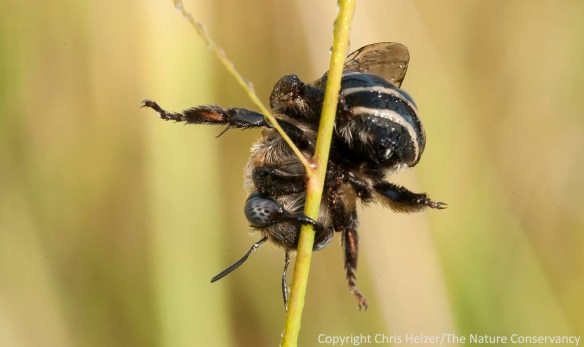
Another view of the same bee.
So, maybe the bee was a young female, still in the process of trying to find a good spot to dig her own nest tunnel. I can buy that, and I wish her good luck if that’s the case. However, that still doesn’t explain why she was hanging upside down by her mandibles… I’m sure there’s a good explanation for that too, but I’m not sure I’ll ever figure it out.
Fortunately, my lack of understanding doesn’t make it less interesting to watch bees – and all the other organisms in the prairie. In fact, quite the opposite is true. If I knew what I was going to see – and why it was happening – there’d be no reason to go to the prairie at all!
Thanks (again) to Mike Arduser for confirming the identifications of these bees and for explaining at least some of their behavior!