
Ants in the Sun

A couple weeks ago, I was broadcasting seeds across a prairie we’d recently burned.  The sun had just popped out after several days of cool rainy weather, and its warmth felt pretty good.  As I crisscrossed the burned area, I noticed several large ant mounds.  When I looked closely at those mounds, I was surprised at the large number of ants massed on top.
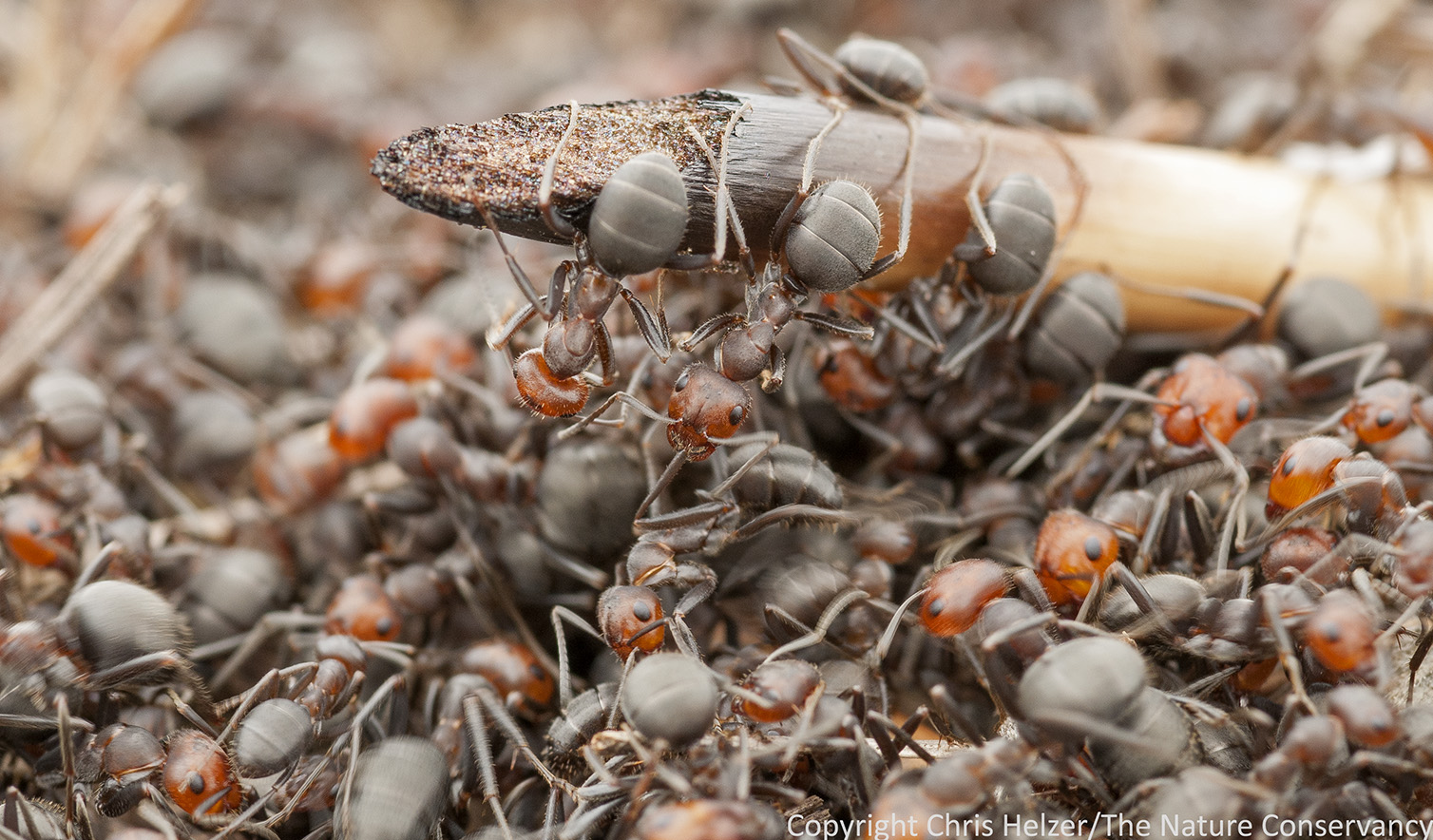
Formica obscuriventris  TNC Platte River Prairies, Nebraska.

A few ants found a perch above the mob of ants beneath them on top of a large ant mound.  Formica obscuriventris.   TNC Platte River Prairies, Nebraska.

Because it didn’t appear most of the ants were doing anything other than milling about, I surmised they were probably just enjoying the heat of the sun as I was.  James Trager, who graciously identified the ants for me, supported my guess.  He added that this kind of thermoregulatory behavior is common, and not only warms the individual ants, but also the inside of the mound as those warmer ants go back into the tunnels.
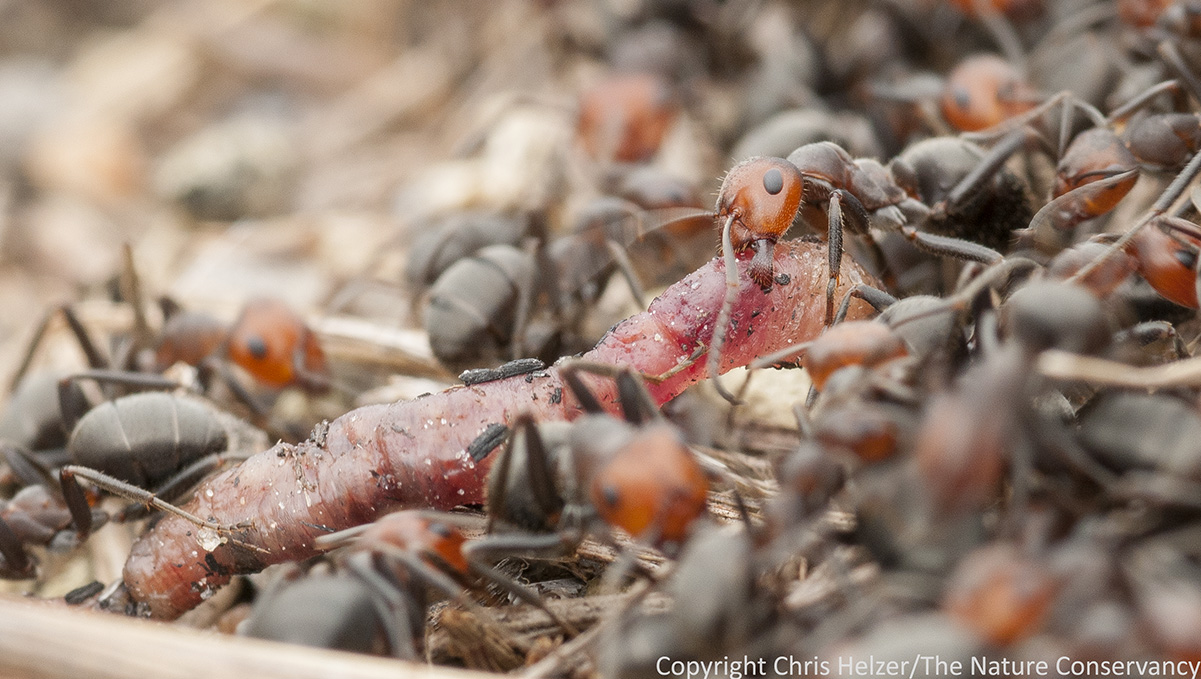
Mound building ants trying to drag a piece of earthworm into the mound.

Mound building ants trying to drag a piece of earthworm into the mound.

Not all the ants were just enjoying the sunshine, however.  At least a few were returning from hunting trips with food for the colony.  The foragers were dragging the food items up the mound and toward multiple tunnel entrances.  Unfortunately, it looked like it was going to be very difficult to get the food past the mob of ants.  In particular, I watched as several ants pulling a piece of earthworm toward the tunnels gave up after trying for several minutes to drag it into the mob.  Other ants periodically tried to pick it up and move it as well, but they also gave up.  I assume the piece of worm made it inside at some point, but I can’t confirm that…

Spider

A spider being carried toward the mound.


More food.

More food.

I enjoyed watching the ants, but eventually had to get back to work.  I was trying to help increase the plant diversity of the degraded prairie the ants are living in.  That broader range of plant species should help the ants in several ways, including by attracting a wider selection of insects for the ants to feed on.  I hope so.

Beaver Crossings

Karen Hamburger, a longtime volunteer with us, recently passed along another batch of trail camera video clips from our Derr Wetland Restoration.  You might remember seeing some of her video in an earlier post.

This time, much of her footage was centered around beaver dams.  There were quite a few video clips of beavers repairing dams or swimming past, along with otters, muskrats, ducks, and other wetland creatures.  However, Karen also captured some more terrestrial species using the beaver dams.

I often use beaver dams as a convenient bridge to cross a stream, and I know I’m not alone in that.  It makes sense that those same dams are important crossing locations for many wildlife species as well.  Karen’s trail cameras documented some of those crossings, including species such as bobcat, raccoon, coyote, and white-tailed deer.  See below.

In addition to wildlife, Karen’s camera also caught another creature crossing a beaver dam at our wetland.  Not once, but twice, she documented photographer Michael Forsberg working his way across the stream with camera in hand.

Mike has been photographing the wetland for many years, and has his own set of camera traps (trail cameras) at the site.  He has also been helping us capture timelapse imagery from the site through both the Platte Basin Timelapse Project and Moonshell Media.  This time, Mike got caught on the other end of the camera.

Beavers play important engineering roles in landscapes. Their dam construction activities change water flow patterns, flood low-lying areas, and create important habitat for many plant and animal species.  Karen’s videos are a good reminder that beaver activity not only affects wetland species, it also affects movement patterns of terrestrial species by providing stream crossings.  As beaver dam locations change, wildlife have to adjust their travel accordingly, and it’s fun to think about how those movement changes could ripple through ecosystems.  The location of a stream crossing for both predators and herbivores affects where those animals choose to forage, for example.  The fate of a plant or small mammal could well be decided by where a deer or coyote can cross a stream – which may be determined by where a beaver family decides to place a dam.  Fascinating!