
Hubbard Fellowship Blog – Conferences

A guest post by Eliza Perry, one of our Hubbard Fellows.  All photos are by Eliza.

Last week, most of the Platte River Prairies cohort hopped in a van together and drove to South Dakota for the annual Patch-Burn Grazing conference, one of many conferences I’ve attended in the last four months.

Before I started with The Nature Conservancy, I had never been to a professional conference and the concept was very mysterious to me. Who goes to conferences? What do all of these people do for days at a time together? Why are conferences necessary? I found answers to these questions quickly, and continue to be blown away by each one that I attend. To be honest, I didn’t have a clear concept of patch-burn grazing systems prior to last week. Conferences like these aptly serve as a classroom for the newbies like myself and also as a forum for the seasoned to offer feedback, discuss strategies, and reflect on successes and disappointments. But perhaps above all they serve as a reminder to experiment!
caption

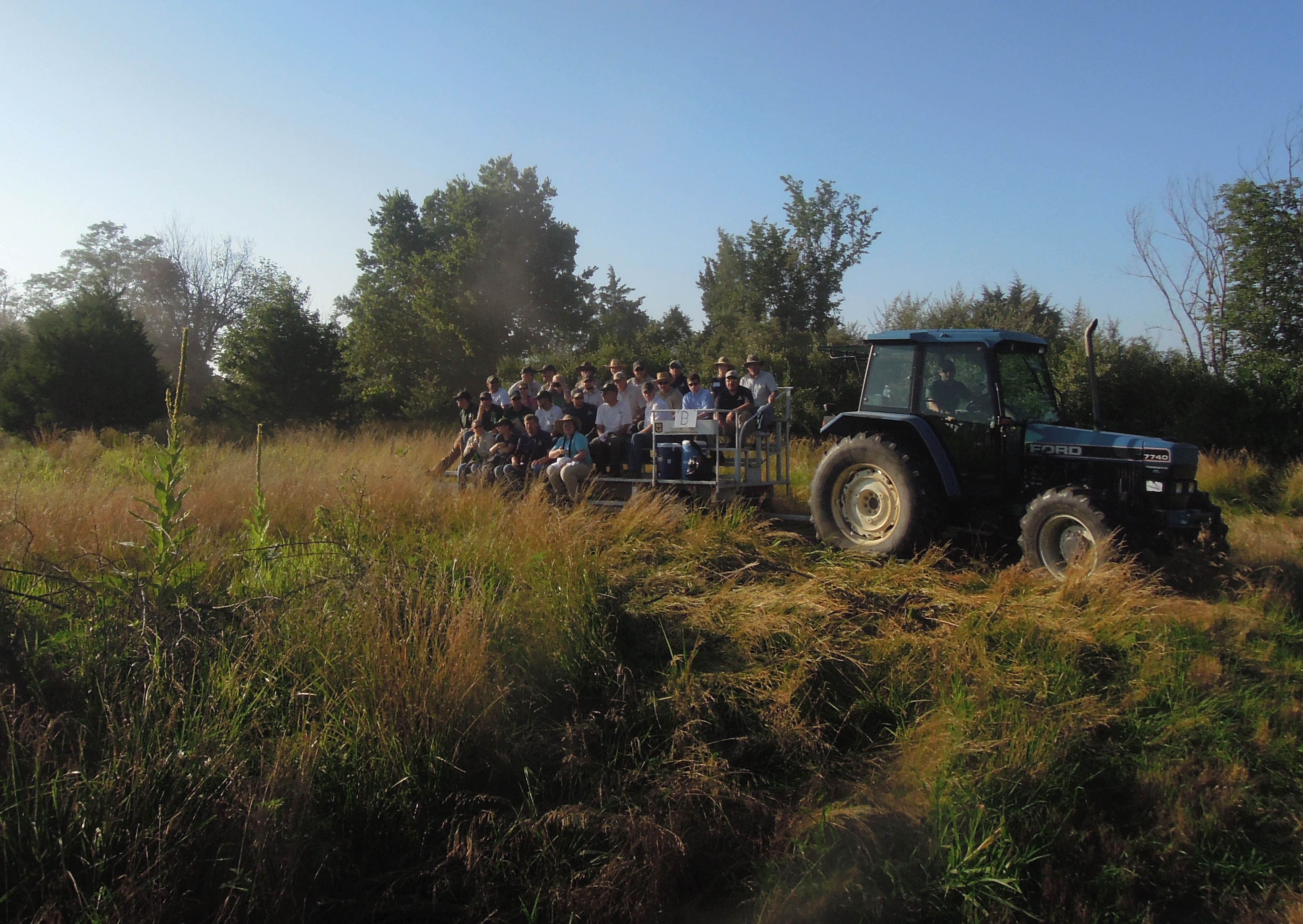
Tractors towing loads of “prairie people” from site to site at the Grassland Restoration Network workshop in July (Missouri).  I thought it was a creative way to transport so many people, but it was also a pretty goofy sight.

On one hand, prairies have varied responses to climatic, seasonal and environmental conditions, keeping us on our toes. But on the other hand, there is some discernible rhythm to land management, despite what Chris and Anne discussed in a recent post, and it is our job to constantly review and reevaluate our methods and maintain self-criticism, though it can be difficult to think beyond our own situations. The Patch-Burn Grazing conference was not just an opportunity to see what works elsewhere, but to open ourselves up to possibilities that hadn’t occurred to us or that we had previously discounted.

It’s been fascinating to see that what works at one site or in one particular year is not necessarily the end-all-be-all solution to our ever-present invasive problems, maintenance backlogs or lack of manpower. But hearing about others’ strategies prompts some useful reflection. For example, the fact that haying has been a prairie management tool for more than a hundred years does not mean definitively that we ought to continue doing it, partly because no one yet understands its comprehensive effects on things like soil composition, and also because there may be a more efficient or effective alternative management tool.  Likewise, as Chris argued at the patch-burn grazing conference, assumptions that seem to be common sense, such as the idea that promoting plant diversity and habitat heterogeneity allows most prairie species to thrive, still need to be tested by anyone whose management objectives are influenced by them. I was also interested to learn that the often-held “more is better” presumption that a high seeding rate is necessary to achieve high plant diversity was found not to be true at one of the restoration project sites that presented at the Grassland Restoration Network workshop this summer.
caption

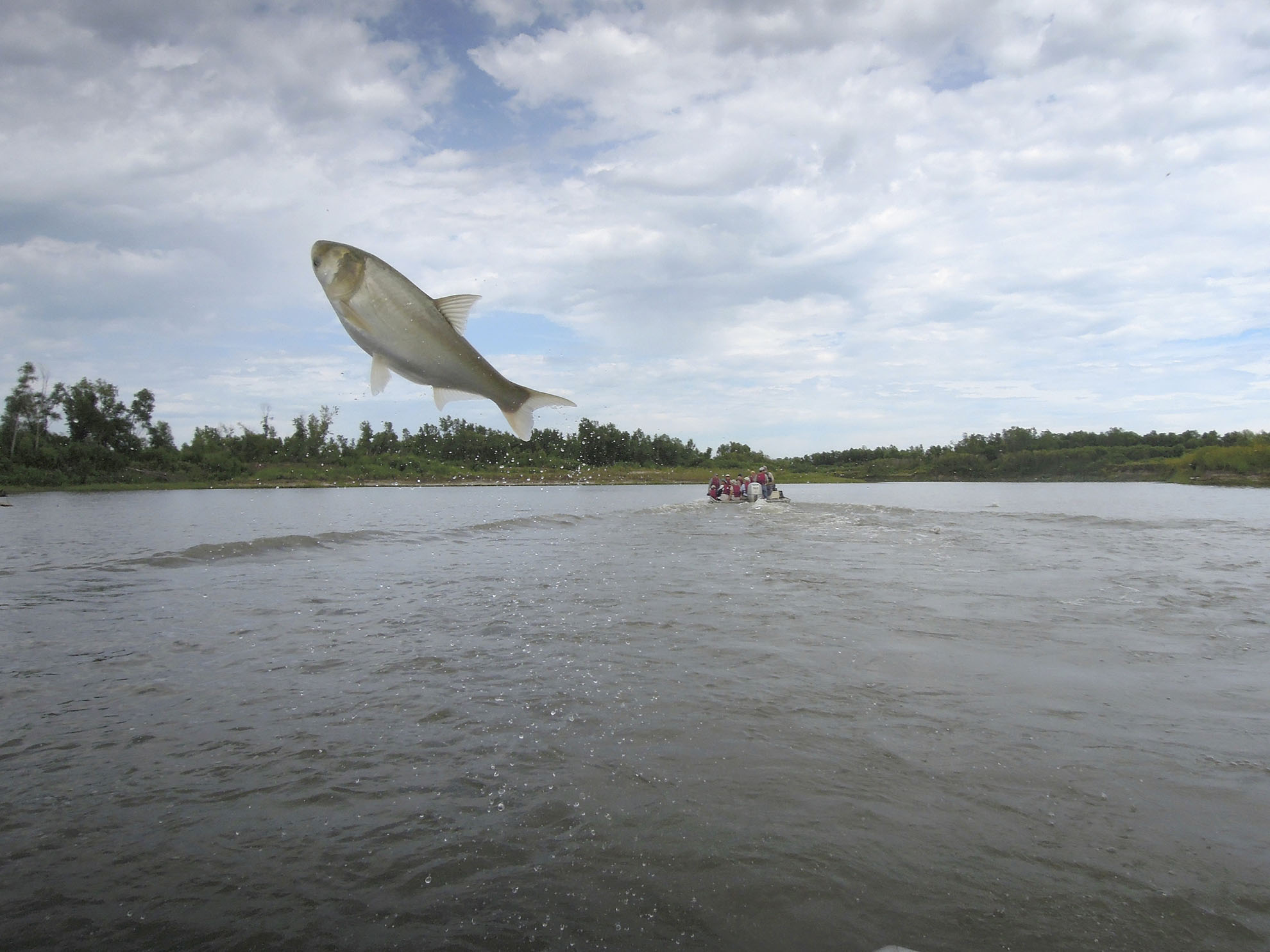
A silver carp dances in front of my camera for a moment during a Missouri River field trip at the Nebraska Natural Legacy Conference.  Up ahead is a boat full of Nebraska’s conservationists.

The cherry on top of all this perspective-gaining for me is that I meet loads of interesting, energetic people from all corners of the Great Plains who are willing to answer my questions, reassure me it’s taken them a long time to understand all that they understand, and let me listen in on their conversations with others. All in all, I think conferences are an awesome way to share knowledge, build relationships, and provoke thought.

Editor’s note:  Eliza and Anne have been able to attend some really good workshops and conferences during the first four months of their Fellowship with us.  Most of those conferences have been relatively small and narrowly focused – and most of included great field trips and lots of time for discussion.  Unfortunately, for those of us who attend a fair number of them, not all conferences, conservation or otherwise, are like that.  More on that topic in the near future…

Prairie Response to Grazing and Drought

Fire, grazing, and drought are the three dominant forces that shape(d) our prairies over time.  Because of the drought we experienced last year, many of our prairies experienced all three of those forces in the same season.  We manage most of our sites with variations of patch-burn grazing.  After we burn a portion (patch) of prairie, cattle concentrate their time within that burned patch, grazing it much more intensively than other portions of the same prairie until a new patch is burned.  As a result, the dominant grasses are much weakened by the end of the season, temporarily opening space for opportunistic plants of many species.

Showy evening primrose is prominent among a number of profusely blooming plants in this restored prairie that was burned and intensively grazed during last year's drought.  The Nature Conservancy's Platte River Prairies, Nebraska.

Showy evening primrose is prominent among a number of profusely blooming plants in this restored prairie that was burned and intensively grazed during last year’s drought. The Nature Conservancy’s Platte River Prairies, Nebraska.

The patch of prairie in the above photo is not being grazed this year, which will allow the dominant grasses – still present, but much reduced in size and vigor – to recover.  In the meantime, butterflies, bees, and other pollinators are enjoying an abundance of “weedy” flowers such as hoary vervain (Verbena stricta), showy evening primrose (Oenothera rhombipetala), yarrow (Achillea millefolium), upright prairie coneflower (Ratibida columnifera), black-eyed susan (Rudbeckia hirta), and many others.  At the same time those pollinators can still find their regular fare of more “conservative” long-lived perennial forbs (prairie clovers and other legumes, perennial sunflowers and silphiums, etc.) – they are just visually obscured by the species responding positively to last year’s grazing and drought.  If you’re interested, you can see some plant data from this site from a couple years ago that shows some trends in species frequency and floristic quality over time.

Here’s another photo of the same patch prairie, showing the diversity and abundance of opportunistic wildflower species and a thin, weakened (temporarily) stand of grass.

Another shot from the same prairie as above.

Another photo from the same prairie.

One of the aspects of fire/grazing management I enjoy most – and one that can make some people uncomfortable – is the variability in prairie response between years and between sites.  Every time we burn/graze a prairie, we see somewhat different responses from the plant community, even if we’re using very similar timing and stocking rates each time.  I think that’s great, and that it adds to the kind of messy, dynamic diversity I think is important in natural systems.  That messiness helps prevent any species or group of species from becoming too dominant, but also helps ensure that each species has the opportunity to thrive and reproduce now and then.

Griffith Prairie (owned and managed by Prairie Plains Resource Institute of Aurora, Nebraska).  The area shown in this photo was burned and grazed during the drought of 2012 in a way very similar to the prairies shown earlier.  However, the plant community response at Griffith was very different - including a big flush of deer vetch (Lotus unifoliatus) and abundant reproduction of leadplant (Amorpha canescens).

Griffith Prairie (owned and managed by Prairie Plains Resource Institute of Aurora, Nebraska). The area shown in this photo was burned and grazed during the drought of 2012 in a way very similar to the Platte River Prairie shown earlier. However, the plant community response at Griffith was very different – including a big flush of deer vetch (Lotus unifoliolatus) and abundant reproduction of leadplant (Amorpha canescens), among other things.  Visually, the prairie is very flowery this year because the vigor of the dominant grasses is suppressed from last year’s drought/grazing.

These days, I spend quite a bit of time thinking about the scale and arrangement of our management treatments across the landscape.  For example, I’m not sure how big each of our within-prairie habitat patches should be.  I don’t think it matters much to plants, but habitat patches have to be large enough for animals to live in, yet small enough that wildlife and insects don’t have to travel unreasonable distances to find appropriate habitat when conditions change from year to year.  For example, voles living in a thatchy patch of unburned prairie will have to relocate when that patch gets burned.  How far can they travel to find another patch of unburned prairie?  What kinds of habitat do they need as they make that trip?

For now, we’re just doing what seems reasonable, but I’ll feel better if we can get some data to help us better evaluate the travel abilities of insects, snakes, small mammals, and others.  Anybody looking for a career’s worth of research projects?