Continuing Wildfire Recovery at the Niobrara Valley Preserve

When I was at the Niobrara Valley Preserve a couple weeks ago, I spent some time exploring the area north of the river where the 2012 wildfire ripped through oak savanna and ponderosa pine woodland.  As discussed in earlier posts, the density of trees, especially eastern redcedar, fueled a fire that killed nearly every pine and cedar in the 3000 acres of Preserve land on the north side of the river.  Most oaks and other decidous trees were topkilled, but many resprouted within a few weeks of the fire.  I have been following the regrowth and recovery of this part of the Preserve with great interest, and trying to help the Preserve staff as they think about how to manage the area in the future.

Here is a series of photos from an uphill hike I took on September 18.  The photos are roughly in order of elevation, starting at the river road (just above the floodplain) and proceeding upslope to the ridgetop at the north edge of the valley.

Hemp and marestail

On the first slopes above the river road, hemp (Cannabis) and marestail (Conyza) dominate the understory of a woodland that now consists mainly of skeletons of eastern redcedar and oak trees.  Most of the oaks have resprouts from their bases, however, and a few still have live branches up high.

.

Marestail and cedar skeletons

The abundance of marestail (a native pioneering species) is especially interesting to me because it’s the same species that usually dominates two-year-old prairie plantings.  This is the role it plays in ecosystems, and it plays it well.  It’s difficult to see very much below the marestail, but when I looked closely, I found scattered grasses, sedges, and wildflowers – a good sign of future recovery.

.
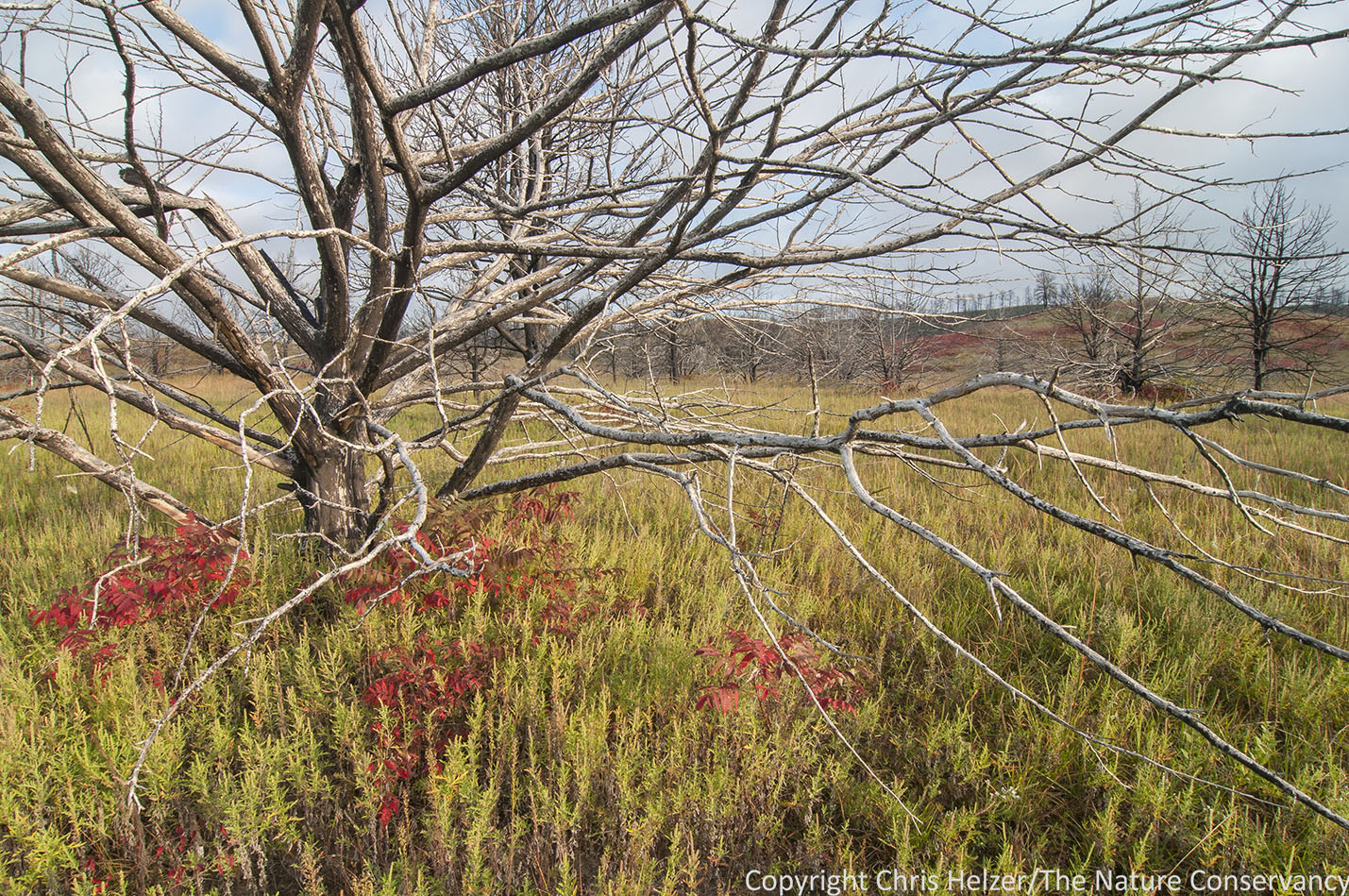
ragweed

As I walked higher and got into the prairie-covered slopes, ragweed (Ambrosia) replaced marestail as the visually dominant plant in the formerly shaded areas beneath cedar trees.  The ragweed is playing the same role as the marestail – quickly filling in the open space until a more permanent plant community establishes.  That community should move in pretty quickly in cases like that shown in this photo, in which a cedar tree is surrounded by prairie.

.
prairie

Higher up the slope, large areas of prairie had not been encroached upon by cedars, and recovery after the fire was just as predicted – quick and easy.  The vegetation was still a little thin, but that was more of an aftereffect of the 2012 drought than of the fire.  In this image you can see the scattered cedars further downslope (such as the one featured in the previous photo).

.

Oaks

Almost every bur oak tree I saw was vigorously resprouting from the base.  Those numerous stems should thin themselves down to three or four major trunks over the next decade or so.  Some of the branches were already 6-8 feet high, so recovery is proceeding quickly.  These oaks were growing along the edge of one of many steep draws scattered along the north side of the river.  As I was wading through 3-4 foot tall marestail, I couldn’t help but wonder if that dense growth and the presence of mountain lions in the area explained the near absence of deer browsing on the oak sprouts (Ecology of Fear).   I don’t know if the deer felt it, but I sure had moments of discomfort, knowing that if a lion was hiding in the weeds nearby, the steep slopes and thick vegetation would make escape nearly impossible.  It made my hike a little more exciting, but I didn’t stay down in those draws very long…

.

Sedges

I was surprised and pleased to see numerous examples of large sedge patches growing under the marestail forest, especially on the steeper portions of draws.  I don’t remember seeing many sedges last year, so either I missed them or they are expanding rapidly.  Either way, they will sure help stabilize those slopes as other plants move in to join them, and they’ll also help carry fire when we restart fire management of the area.

.

Pine woodland

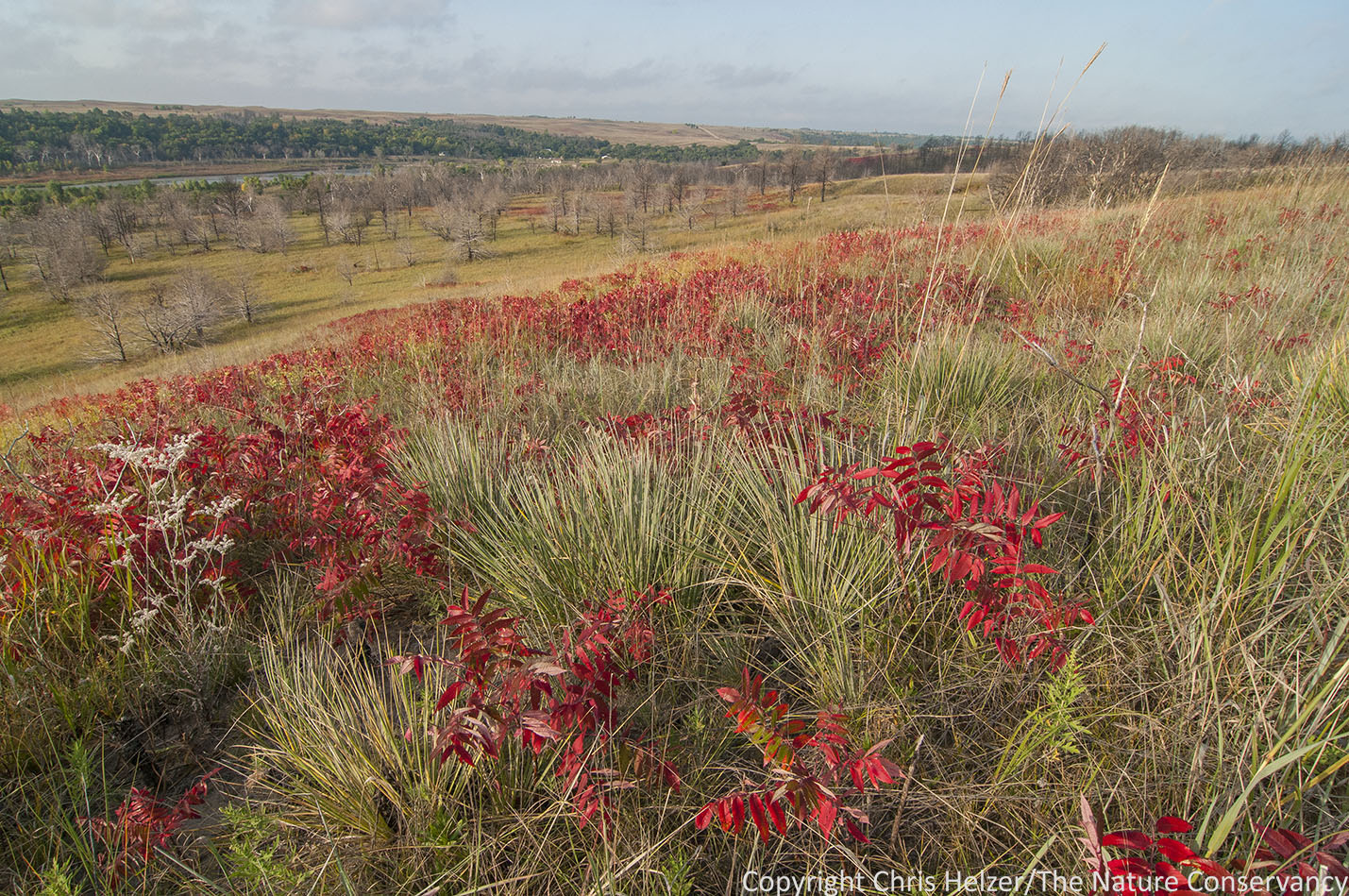
High on the slopes, where ponderosa pine and eastern redcedar had dominated just a few years ago, the scenery was every bit as spectacular as it had been before the fire – just different.  Marestail was abundant here too, but there was quite a bit of grass and wildflower cover as well, and several shrub species were flourishing, including smooth and skunkbush sumac, chokecherry, snowberry and others.  Despite the density of scorched tree trunks, the overall feel of the slopes was not one of death and destruction, but rather of abundant life.

.

Ridge top

Even the very steep erodible slopes at the very edge of the ridge top were full of previously established perennial wildflowers and shrubs, as well as colonizing annuals.

I came down the slope after my walk with a great feeling of optimism.  My greatest worries about this area of the preserve had been that

1) Invasive plants would fill the slopes before the native vegetation could recover, and we’d be faced with the difficult challenge of attacking those invasives in difficult terrain.

2) Numerous eastern redcedar trees would colonize the slopes before there was enough vegetation to carry prescribed fires to knock those cedars back.

3) Soil erosion would be so severe that the seed bank needed to reestablish the native plant community would wash down the slope, along with the topsoil those plants needed to grow.

None of those three have occurred – or at least to the extent I feared they might.  There has been some erosion, but much less than I anticipated, and it doesn’t seem to be affecting vegetation recovery much.  I haven’t seen any truly invasive plants yet – which doesn’t mean they aren’t there, but they sure aren’t roaring in.  Finally, the recovery of the vegetation has been fast enough that we should be able to start running prescribed fires up the slopes within the next few years.  I didn’t see any little cedar trees on my walk, and while I’m sure there are a few around, the abundance is much less than I feared, and our ability to use prescribed fire should make it fairly easy to control them, except on the steepest slopes.

Most of all, the beauty of the Niobrara Valley has survived the wildfire.  The pines are gone from some parts of the valley, but are still doing well in other areas nearby, including other parts of the Niobrara Valley Preserve.  Whether or not (or when) they’ll return to the site of the 2012 fire is still an open question.  Regardless, there is abundant life on the slopes north of the river.  Just because those slopes will be dominated by different species than before doesn’t change the scenic or ecological value of the site.  It’s still one of my favorite places on earth.
Konza Prairie Trip Part 3 – Questions About Frequent Prairie Burning

A few weeks ago, I wrote about our trip to the Konza Prairie Biological Station in eastern Kansas.  On that trip, we learned about research results showing that frequent spring fires (one or two year frequency) can prevent encroachment of tallgrass prairie by trees and shrubs.  Less frequent fire allows shrubs, especially dogwood and sumac, to invade.  Pretty simple – we should be burning tallgrass prairie at least every two years, right?

Hang on just a minute, Sparky.

As you might expect, there is more to the story.  It turns out that the frequent spring fire (with no grazing) regimes at Konza has other impacts.  One example is that frequent fire favors grasses over forbs and decreases plant diversity over time.  Prairies that are burned every year or ever two years develop a grass-dominated plant community in which many forb species are difficult to find.  So, frequent fire is bad for plant communities…  Right?

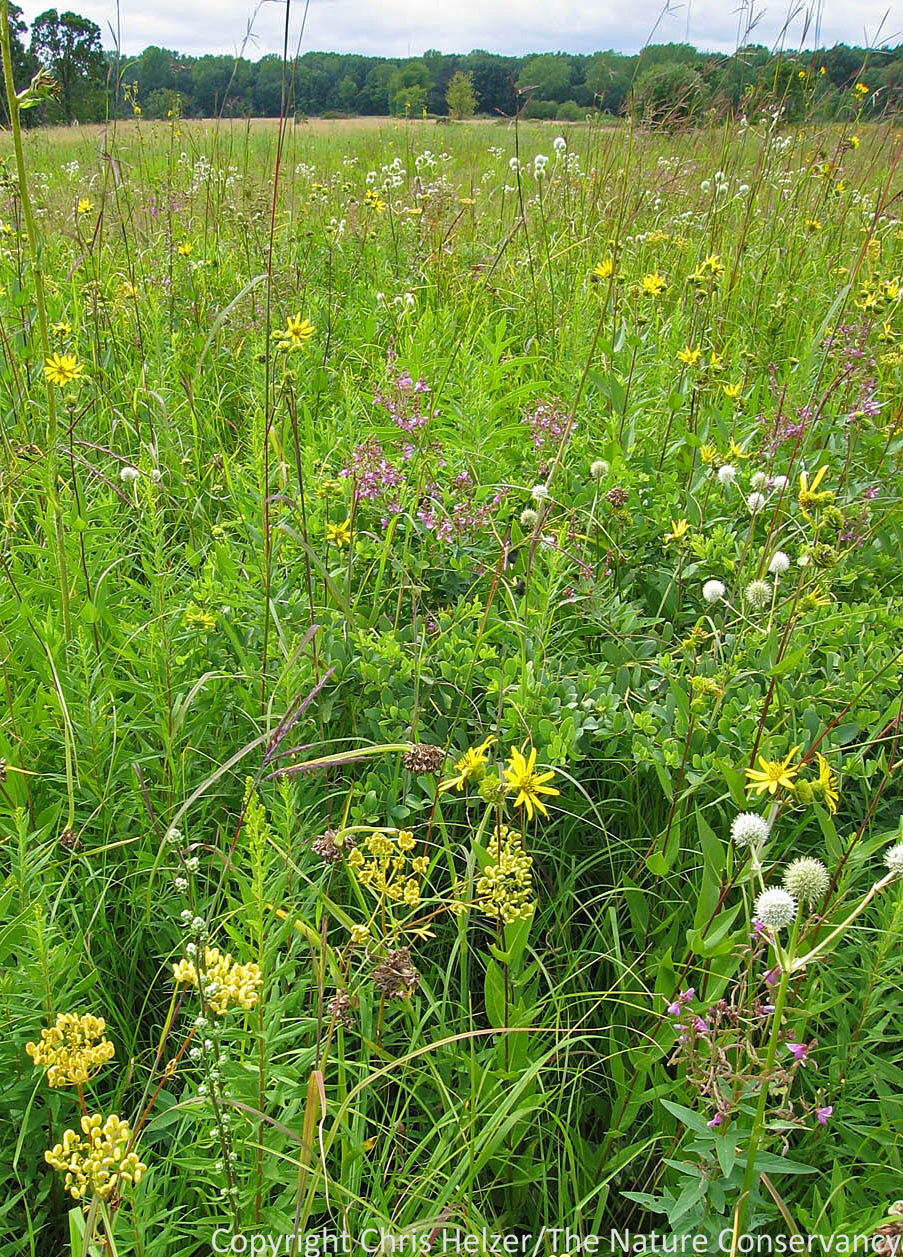
Annually-burned tallgrass prairie at Konza Prairie, in the Flint Hills of eastern Kansas.

Annually-burned tallgrass prairie at Konza Prairie, in the Flint Hills of eastern Kansas.  August 2014.

But in other tallgrass prairies, especially in more eastern prairies such as those in Illinois, researchers are seeing very different impacts of frequent fire.  A paper by Marlin Bowles and Michael Jones, for example, found that frequent fire “stabilizes” plant communities in the Chicago, Illinois area, and that plant diversity was positively correlated with fire frequency.  In fact, their results are almost the exact opposite of what was seen at Konza.  In the Illinois study, frequent fire decreased the dominance of warm-season grasses and increased the diversity of summer wildflowers.

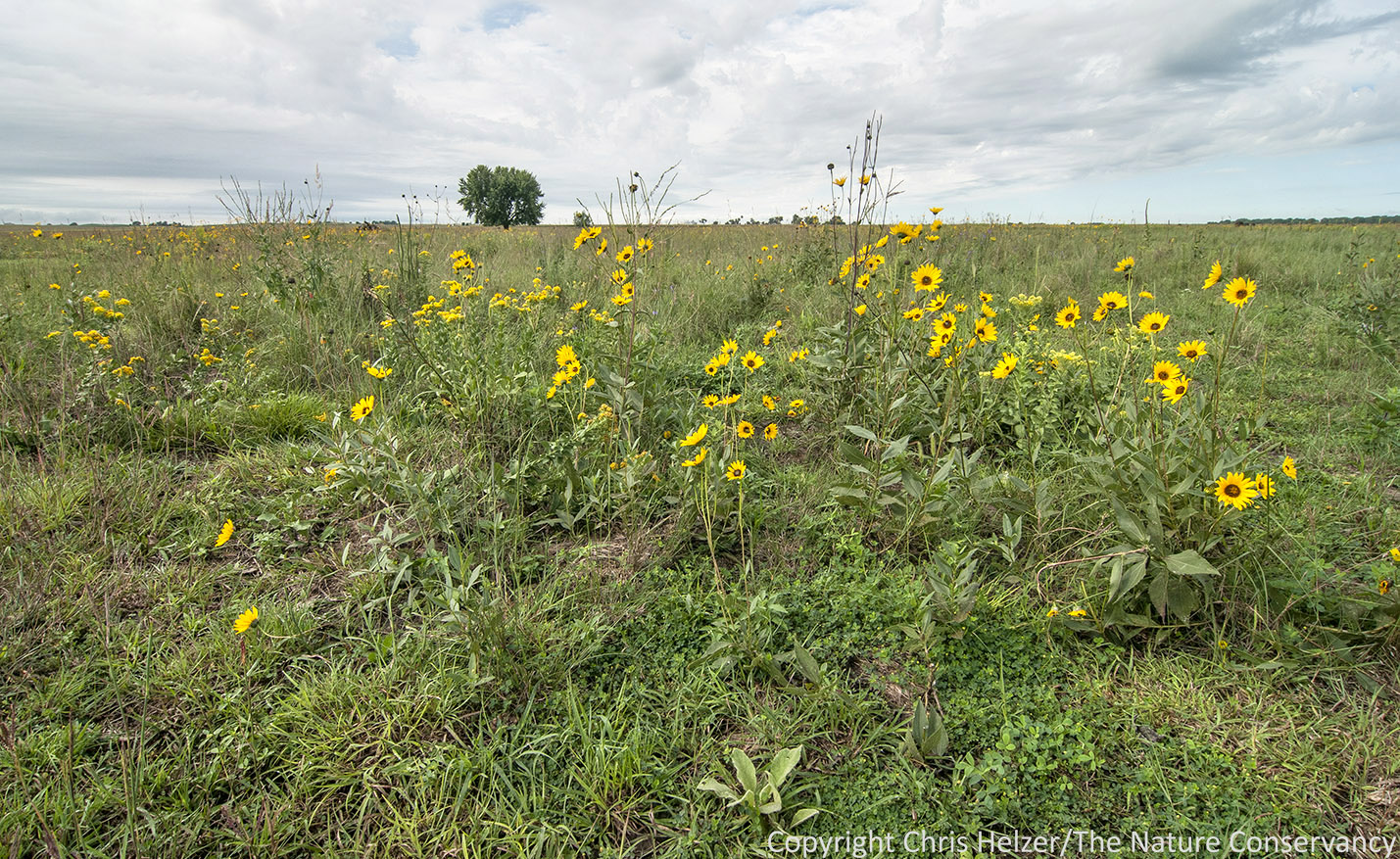
Frequently-burned prairie at the University of Wisconsin-Madison Arboretum.  Clearly, frequent fire is not incompatible with plant diversity...

Frequently-burned prairie at the University of Wisconsin-Madison Arboretum. Clearly, frequent fire is not incompatible with plant diversity…

What the heck is going on??

If we could answer that question, we’d be miles ahead of where we are now in terms of understanding prairie ecology.  I can come up with lots of potential reasons for the difference between frequent fire application in Illinois versus Kansas, but I can’t confirm or deny any of them – we simply don’t know.  As I think about why prairie plant communities might become more dominated by grasses over time, I wonder about factors such as small scale plant diversity, soil productivity, and the soil microbe community – all of which may correlated with each other.

Eastern remnant (unplowed) prairies tend to have a higher density of plant species (e.g., plant species per square meter) than western prairies. High species density could potentially help suppress grass dominance because of the variety of competition strategies each of those plant species employs to take and defend territory.  Those strategies include allelopathy (releasing chemicals that retard growth of nearby plants), rhizomes (underground stems that can connect even fairly distant stems of the same plant together), root density/depth, and many others.  It seems logical that communities with that kind of well-established complex competitive environment would present a major challenge for any species (grasses or otherwise) trying to become dominant.  Maintaining consistent growing conditions by burning or haying annually might facilitate stability within those plant communities because it essentially maintains a stalemate; no plant species is ever given a window of opportunity to gain advantage over its neighbors.  Or this could all be balderdash – I’m just throwing out ideas here.

Does the rich soil organic matter content of eastern tallgrass prairies help suppress grass dominance?  It’s probably the major reason for the higher plant species density in those prairies, so maybe.  On the other hand, research at Konza and elsewhere in more western prairies shows that adding nitrogen to prairies (increasing productivity) increases grass dominance and lowers plant diversity.  Hmm.

Soil microbial communities surely have a very important influence on plant diversity, but (as discussed in a previous post) we don’t know much about them yet.  I’m optimistic that our understanding of soil microbes will grow tremendously during the next few decades, but the complexity of that world might mean that it will take many more decades before we start to get a grasp on it.  In the meantime, we can use it as a convenient scapegoat.  If something you don’t like is happening to your prairie, it’s probably a soil microbe problem…

Those of you who read this blog frequently may be surprised that I haven’t mentioned insects or other animals yet.  Let’s talk about them now, shall we?

It’s very important to remember that even if frequent burning seems to maintain high plant diversity in (some) prairies, a prairie is much more than just plants.  The use of frequent fire tends to create fairly homogenous habitat conditions across a prairie.  Regrowth rates are similar across the whole burned area, so vegetation height and density is relatively uniform.  Dead material, including both litter and standing dead vegetation, is scarce.  Because habitat diversity is limited, so is the diversity of creatures that rely on that habitat.  In taxonomic groups ranging from grasshoppers and spiders to mice and birds, research shows that habitat diversity is positively correlated with species diversity.  Creating habitat heterogeneity – through grazing, patchy mowing, or other means can help facilitate a more diverse animal community.  Burning in a less regimented way can help too, especially if that means splitting a prairie into multiple management units and burning only a subset of those each year.

Habitat

Heterogeneous habitat structure, including tall, short, and mixed-height vegetation – like that shown here – can help maintain diverse invertebrate and wildlife communities.  Grazing is one great way to manipulate vegetation structure, but isn’t feasible at all sites.  Grazed prairie at The Nature Conservancy’s Platte River Prairies, Nebraska.

In small isolated prairies, it’s also critically important not to burn (or mow) the entire prairie at the same time.  With limited opportunities for species to recolonize from other prairies, a fire that kills all of the individuals of a particular species (e.g., an insect that overwinters in the stems of grasses or in the litter along the ground) can mean the end of that species’ existence in that prairie.  Maintaining a floristically diverse prairie without a full complement of invertebrates doesn’t seem like success to me.  On the other hand, I also appreciate the difficulties associated with managing small prairies.

To wrap this up, I think there are two really important points to make about fire frequency in prairie management.  First, there are some big questions about why frequent fire seems to maintain high plant diversity in some prairies but encourages grass dominance in others.  Figuring out the answers to those questions may be one of the more important keys to prairie conservation success.  Second, even if frequent fire maintains high plant diversity and repels invasion by shrubs and trees, it still might not be the best choice for a prairie management strategy.  There is much more to a prairie than its plants, and even if you don’t much care for invertebrates, birds, reptiles, or mammals (and how could you not?) those species – especially the invertebrates – are strongly tied to the long-term viability of the plant community, so it’s probably not good to ignore them.  To be clear, I’m not saying people who use frequent fire are evil destroyers of animals.  I’m just raising a flag of caution and pointing out some potential tradeoffs.

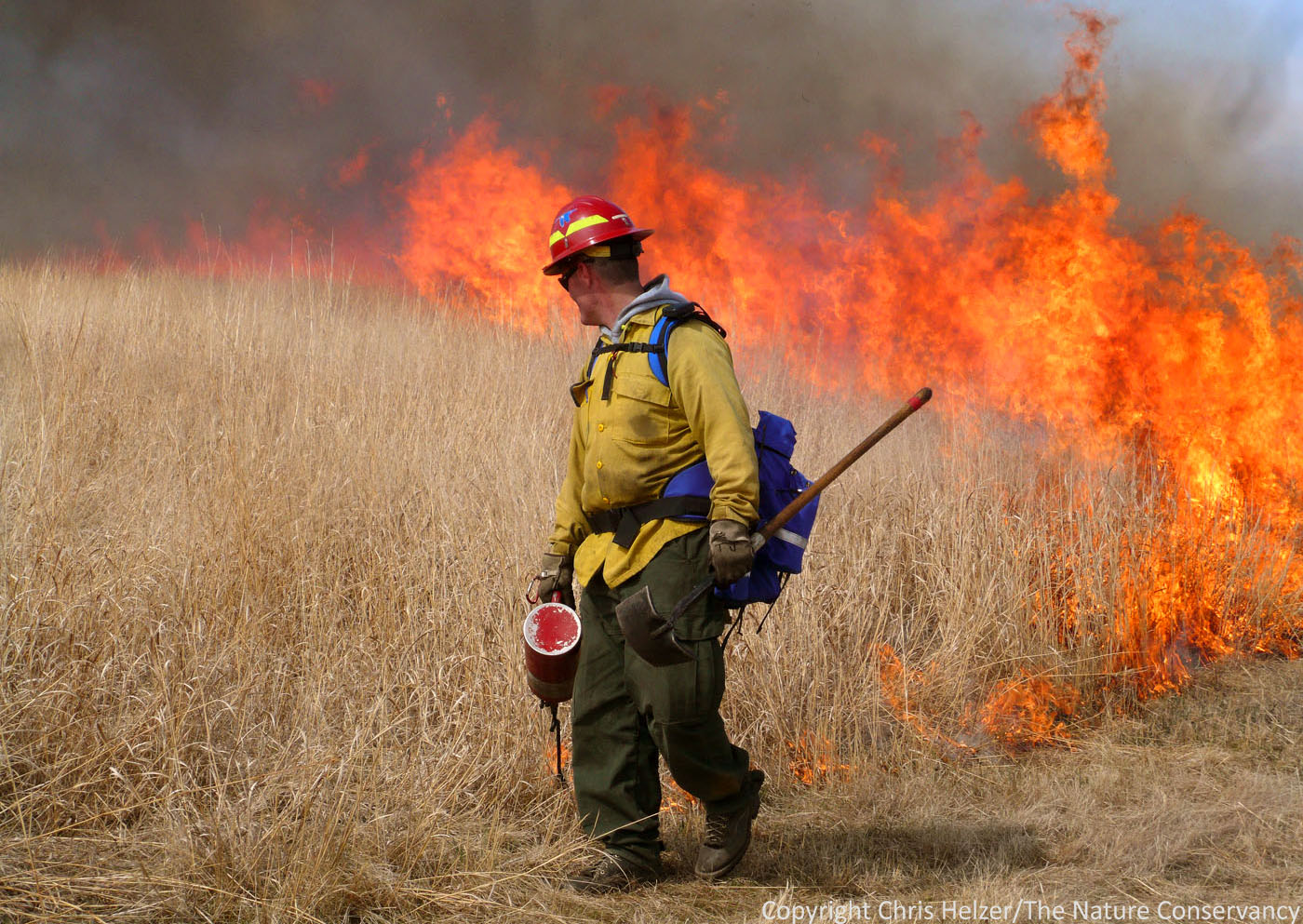
Prescribed burning is an important management tool, but its impacts on prairie communities can be complicated.

Prescribed burning is a valuable management tool, but its impacts on prairie communities can be complicated.  It’s important for prairie managers to recognize and account for both the negative and positive impacts of fire.

Those of us who work with prairies are used to the seemingly overwhelming complexity of grassland communities and the way those communities respond to management.  In fact, for many of us, it’s a big reason we love prairies as much as we do.  While we still have more questions than answers about effective prairie management, we have enough information to go forward with.  Most importantly, prairies are pretty tough, so excepting drastic measures such as broadcast spraying with 2,4-D (and maybe burning an entire tiny prairie), we have the latitude to try out lots of ideas and see what works.  We’ll learn as we go.

In the meantime, it’d be great if all you researchers out there would get cracking on the issue of disparate effects of frequent fire in eastern versus western prairies.  It should only take a few decades to figure it out…  Right?