Just When I Think I’ve Got Something Figured Out…

I pay close attention as I walk through prairies.  I watch for tracks to see what animals are around and I notice which flowers are blooming and which insects are feeding on them.  Often, I notice changes in prairie plant communities and try to attribute them to our management treatments, weather patterns, or other factors.  Observations such as these are an important part of how I learn more about prairies and adjust the way we manage and restore them.

Observations are a critical component of understanding natural systems and how management and restoration actions affect them.

Careful observation helps ecologists and land managers understand how natural systems work and how they are impacted by management actions.  However, observations are tricky because they provide an incomplete picture of what’s happening and are influenced by personal bias.

Unfortunately, observations are inherently biased.  When I start to notice a pattern through observation, I construct a theory to explain it.  That’s good science.  However, once I have a theory in mind, it influences the way I see things – and I tend to interpret my observations based on my theory.  That means it’s pretty easy to start telling myself a story that sounds good, but isn’t actually true.  Sometimes, I figure out that my story is wrong through repeated observations.  More often, however, what causes me to stop and reconsider is cold hard data.  Here’s a recent example of my data showing me that I need to reconsider a theory based on observations.

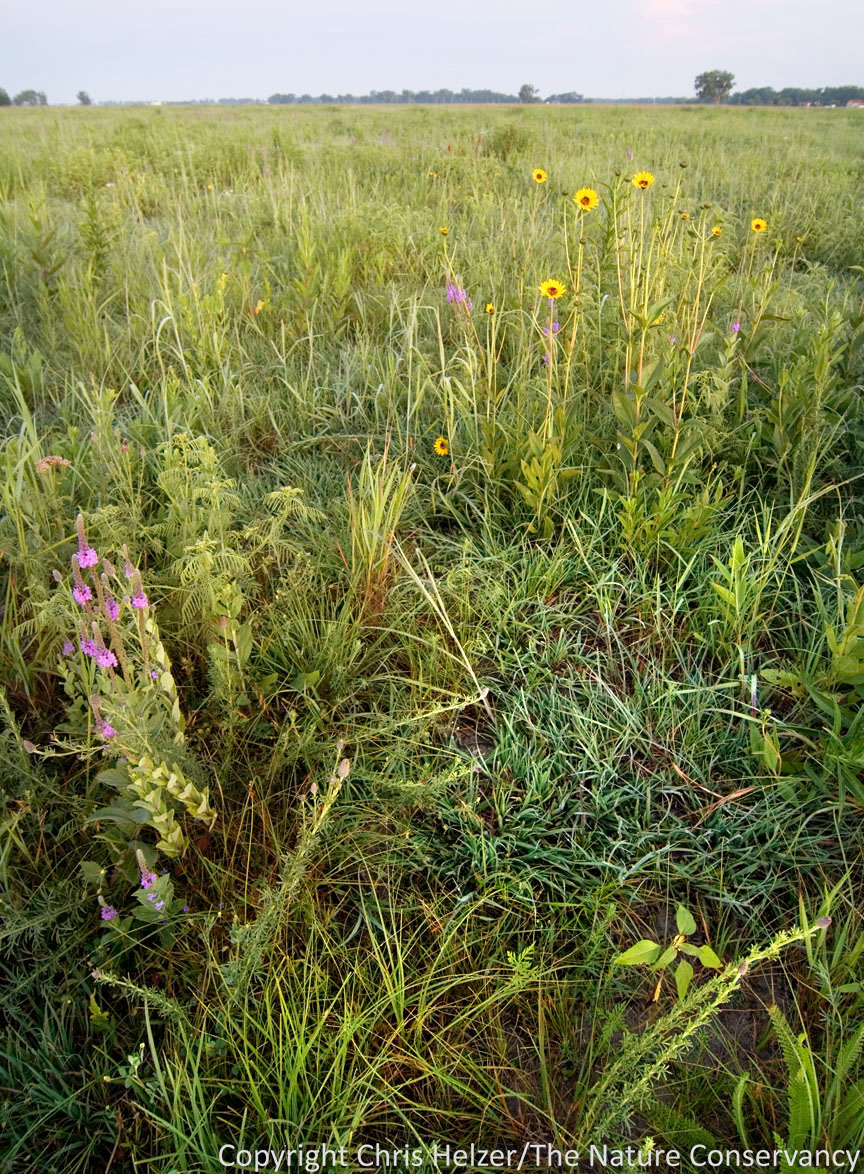
Canada wildrye (Elymus canadensis) is a native cool-season grass that establishes very quickly from seed in our prairie restoration (cropfield conversion) work.  It is often very abundant during the early years of a seeding before settling down into the plant community after a few years as other prairie plants become more dominant.  A common complaint from those working with Conservation Reserve Program (CRP) or similar prairie seeding projects is that wildrye tends to disappear a few years after planting, leading people to question the value of including the species in the seed mixture.  However, in our restored prairies, I’ve observed that while Canada wildrye declines in abundance after the initial establishment phase of a seeding, it seems to persist pretty well at a moderate abundance from then on.  I’ve attributed that to our grazing management, which is partially aimed at periodically decreasing the vigor of dominant grasses.  Weakening dominant grasses should help prevent less dominant species such as Canada wildrye from being pushed out of the community altogether.

Canada wildrye  is a native cool-season grass that is common in our restored prairies.

Canada wildrye is a native cool-season grass that is common in our restored prairies.

So, my theory (which I’ve shared with many people) has been that Canada wildrye is a grass species is tied to disturbance regimes.  If a prairie is managed with a mixture of intensive grazing periods and rest periods, wildrye can sustain a fairly steady population.  It was a good theory, and seemed to fit my observations.  Until last week, I was pretty happy with it.  Then I looked at some recent data.

One

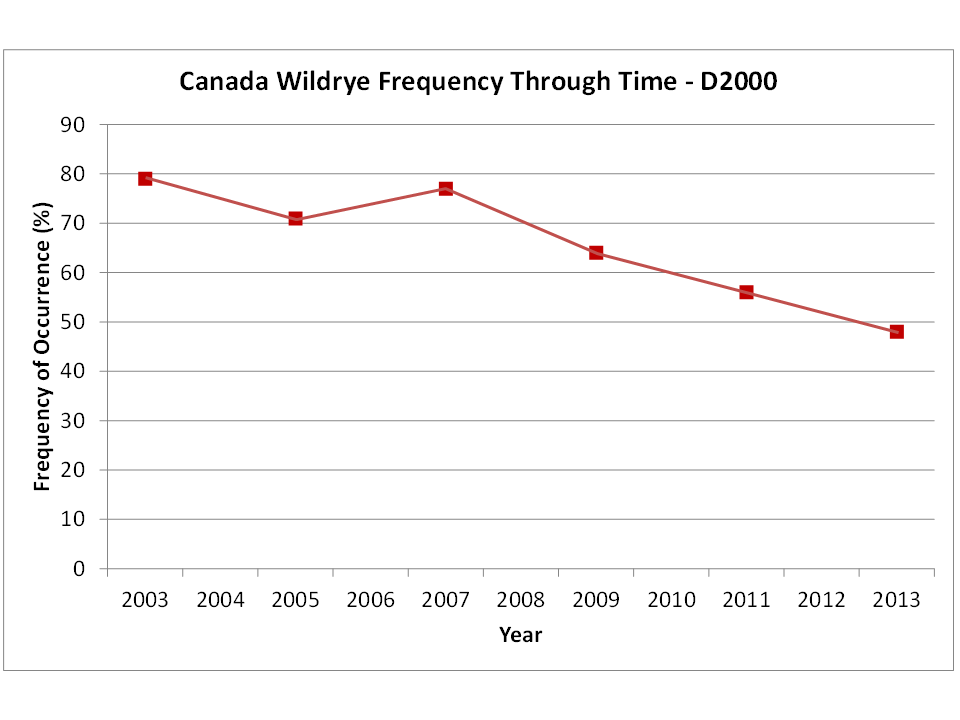
These data were collected from about a hundred 1 meter square plots across a prairie.  Each time I laid down the plot frame, I listed the plant species found within it.  By looking at the data from all of the plots, I can calculate a frequency of occurrence for a plant species (the % of all plots it was found in).   The data in this graph were collected from a restored prairie seeded in 2002.

.
Two

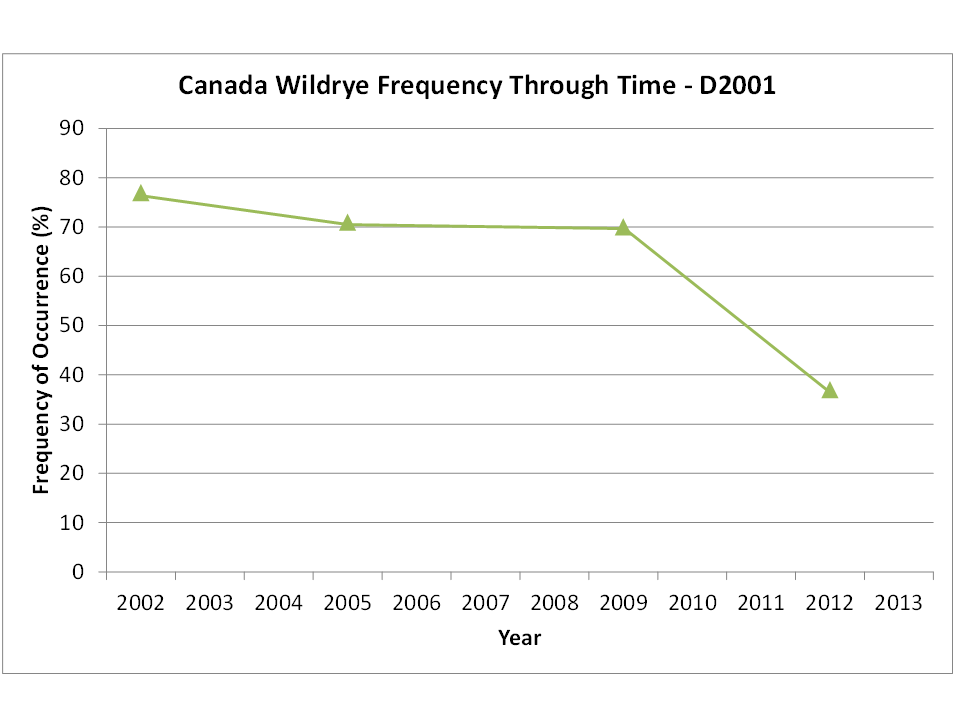
These data were collected from a restored prairie that was seeded in 2000.

.
three

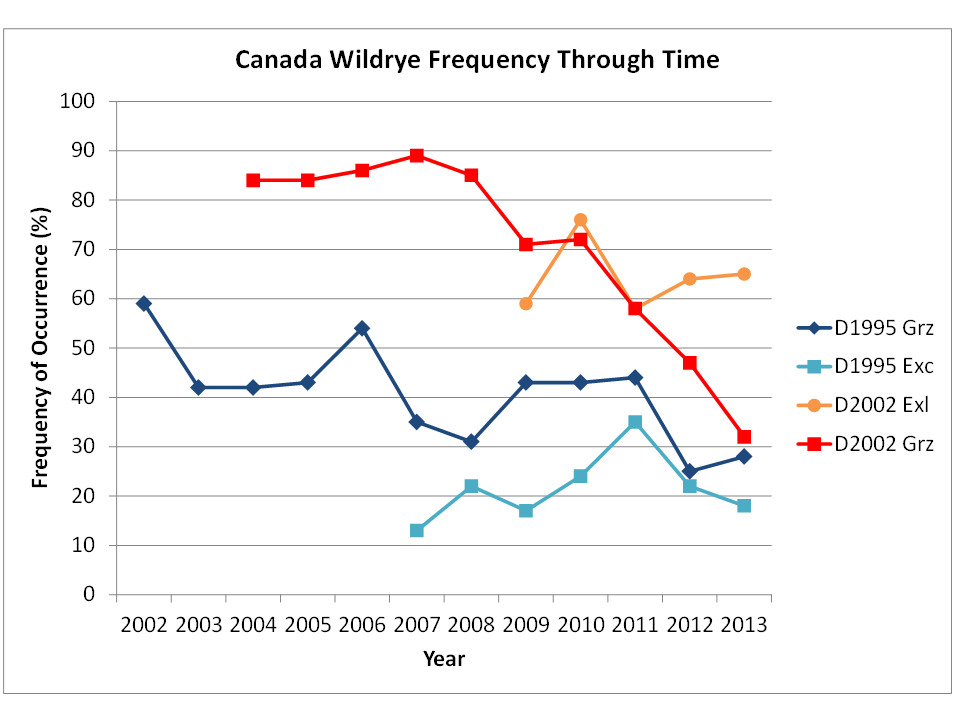
More data – this time from a restored prairie seeded in 2001.

From looking at the above three graphs, you might conclude that Canada wildrye populations stayed high for the first eight or nine years after planting a restored prairie and then started to taper off.  Another interpretation might be that our grazing was able to prop up those wildrye populations for a certain amount of time, but it is now starting to suffer the same fate my colleagues have complained about in CRP plantings.

Now, consider this next graph.
four

This graph shows data from the same 2002 planting as shown in the first graph (red lines in both graphs).  In this graph, however, the orange line is data from a large exclosure at the same site that has been burned but never grazed.  The two blue lines are from a different restored prairie seeded in 1995.  The dark blue has had fire and grazing management since 2002, while the light blue line is from a large exclosure at that site that has never had grazing within it.

By looking at the red and orange lines you might conclude that grazing management had a strong negative impact on Canada wildrye in the 2002 planting between 2011 and 2013.  The lines from the grazed portion of the site (red) and the exclosed portion (orange) are heading strongly in opposite directions.  However, the site was also grazed in 2008 and 2009, and there is less difference between grazed and exclosed in those years.  In addition, the blue lines on this graph show data from populations in a different nearby restored prairie (seeded in 1995) which don’t seem to be strongly affected by whether or not they are grazed.  There is less wildrye in the ungrazed exclosure of that 1995 planting but the changes in frequency seem pretty similar between the grazed and ungrazed areas.  Hmmm…

five

This graph shows data from two of the sites shown earlier (2000 and 2001 plantings) as well as another nearby restored prairie that was seeded in 1999.  Despite very similar management regimes, the 1999 restoration seems to be maintaining a high population of Canada wildrye.

This last graph just muddies the water even more.  While populations in the 2000 and 2001 restoration seem to be declining over time, wildrye frequency in the 1999 restoration has been holding steady for 15 years.  All of these sites are within a mile or two of each other, were planted with the same kinds of seed mixtures and have been managed with very similar mixtures of periodic fire, intensive grazing, and rest (modified patch-burn grazing).

It’s possible that soils play a role in the differences between sites, but all the prairies above are on similar alluvial (river deposited) soils.  None of them seem all that different from each other (I need some data on that!).  Weather could also be a factor, though most of the declines seemed to start around 2008 or 2009 – a few years after a long drought period – and have continued through both wet and dry years since.  I’m not sure what weather factors might have popped up since 2009 that would cause a decline in wildrye abundance (and only at some sites).

Surprise!  Reality is more complicated than a simple cause and effect relationship between a management regime and a plant species…

I take two major lessons from this.  First, I need to be more careful in my assumptions about how our management is impacting prairies.  That’s nothing new – I fall into that trap all the time, and frequently have to remind myself not to overgeneralize.  In this case, I had constructed a logical story explaining why Canada wildrye was abundant in our well-established (old) restored prairies but rare in ungrazed plantings such as CRP fields.  There are, of course, many possible explanations for that phenomenon (differences in soil types, plant diversity, seeding rates – particularly of warm-season grasses, fire management, etc.) but I grabbed one simple explanation without adequately considering all those other factors.

The second lesson is that it’s dangerous to rely solely on observations when trying to figure out natural systems.  This is not a new lesson either, and it’s why I try to collect as much data as I can.  Observations are really important, but are easily biased by what we think is – or should be – happening.  It’s natural to see what you expect to see.

Collecting some unbiased data, even just a little, is well worth the effort – especially if you target the data collection to your objectives.  It’s not useful to just collect data for the sake of data, but if you have a specific question (“are we maintaining diverse plant communities in our restored prairies?”) data can help answer it.  I consider plant community data collection to be a very important part of my job, but it doesn’t actually take that much time.  It takes about a day per year for each site I sample, including data collection, data entry, and analysis.  I strongly encourage every land manager to collect some kind of data from their sites.  It doesn’t have to be complicated or time consuming – just something that can help evaluate how management treatments are working.  Observations are great, but unbiased data is a good way to make sure you’re telling yourself (and others) the right story.

I’m not sure what to think about Canada wildrye now.  It’s a little disappointing to find out that my story was wrong – or at least incomplete.  On the other hand, the complexity of interactions that apparently drives Canada wildrye populations are why I love prairies and prairie management.  If it were simple, it’d be boring.

And no one likes a boring story.

Bison Good, Cattle Bad??

Among some prairie enthusiasts, there seems to be a perception that plains bison are magical creatures that live in complete harmony with the prairie.  They eat grasses but not wildflowers, they float just above the ground to avoid stepping on plants or compacting the soil, and they create tidy little wallows that fill with rainwater for tadpoles and wading birds.  Cattle, on the other hand, are evil creatures that seek and destroy wildflowers, removing them from prairies forever.  They also stomp all over prairies, trampling plants and birds to death and causing cascades of soil erosion and water pollution.

Seriously?

These particular magical animals are at The Nature Conservancy's Broken Kettle Grasslands in northwest Iowa.

These particular magical animals are at The Nature Conservancy’s Broken Kettle Grasslands in northwest Iowa.

Let me be clear: I’m a big fan of bison.  I feel very fortunate to spend time at The Nature Conservancy’s Niobrara Valley Preserve and other big prairies where I can observe and photograph bison up close.  Bison are distinctive, attractive animals that evoke a sense of history and grandeur… but they are also big stompy animals that go wherever they want, poop all over the place, rub on trees, trample plants (and animals), and can cause erosion issues.  None of that is good or bad; it just is.

I’m a fan of cattle too.  They have big beautiful eyes, individual personalities, and can be more playful than their typically stoic faces might hint at.  I enjoy spending time around cattle at our Platte River Prairies and in my own family prairie.  In both places, they are a major part of our prairie management strategy, which is aimed at creating and maintaining diverse plant communities and high quality wildlife habitat.  (And yes, cattle are also big stompy animals that go wherever they want, poop all over, rub on trees, trample plants and animals, and cause erosion issues.)


TREES AND PONDS

While both bison and cattle can be engaging creatures, there are a few real differences between the way bison and cattle utilize and impact prairies.  However, those differences are less stark than you might think.  Based on the best available research and expert knowledge, the biggest distinction between bison and cattle behavior in prairies essentially boils down to this: cattle hang around water and trees more than bison do.

That general pattern is reported in many studies comparing the two, but was most reliably demonstrated in a recent study at The Nature Conservancy’s Tallgrass Prairie Preserve in Oklahoma, where GPS collars tracked animal locations through time.  That study looked at bison and cattle at similar stocking rates and under the same management regime (patch-burn grazing) – though the bison were grazing year-round in a 23,000 acre pasture while cattle were only present for 7 months/year in pastures of around 1000-2000 acres.  The GPS collars showed that cattle were attracted to ponds and trees while bison tended to avoid areas near water and showed no attraction to trees.  Importantly, the same study also showed strong similarities between bison and cattle behavior, namely that both were strongly attracted to the most recently burned areas of pastures and tended to avoid steep slopes.

The conclusion that cattle are attracted to water and shade fits with one of the big objections to cattle grazing by some prairie enthusiasts – that cattle tend to “wreck” areas near ponds and tree groves by repeatedly stomping around and defecating in those places.  While that can be true, those impacts are highest under high stocking rates, and can be avoided by fencing out ponds and trees or greatly reduced by providing long rest periods between grazing bouts.  Those impacts are also less severe in larger pastures, especially when multiple water and shade options are available and cattle are encouraged (or forced) to use each area intermittently.  The attraction of cattle to wet and shaded areas can be a real challenge, but it’s not an insurmountable one.

These cattle almost look ashamed of their tendency to hang around in water.

These cattle almost look ashamed of their tendency to hang around in water.  In this case, however, we were actually encouraging it as a way to help us control invasive cattails.  We pulled the cattle out the next season and this little spot was a great shorebird area, with mud flats with scattered sedges and rushes.

DIET

The other beef prairie enthusiasts have with cattle (sorry) has to do with their diet.  The perception of many is that bison subsist solely on grass, leaving wildflowers untouched, while cattle eat a high percentage of forbs (broad-leaved plants), often leading to the decline of those species over time.  The purported result is that bison-grazed prairies maintain high plant diversity, including an abundance of rare plant species, while cattle-grazed prairies become degraded as numerous forb species are grazed out of existence.  While that’s a big overgeneralization, it’s an understandable one because a number of research projects have reached that conclusion.

Unfortunately, those research projects have largely compared bison and cattle under very different circumstances.  Diet comparisons are usually made between bison in a single huge pasture (often under patch-burn grazing management) and cattle in a rotational grazing system – often at a higher stocking rate.  As a result, it’s not clear whether observed differences between bison and cattle diets are due to biological differences or grazing systems.

Imagine if you were given 30 days’ worth of groceries at the beginning of each month. You’d likely eat many of your favorite foods first and then make do with whatever’s left toward the end of the month. Comparing your diet to that of someone who was allowed to go grocery shopping every day would be completely unfair, wouldn’t it?  Unfortunately, that’s essentially the comparison made by many research projects comparing the diets of cattle and bison.  Cattle in a rotational grazing system can only choose from the available plants in their particular paddock, and don’t get a new set of choices until they are moved into a new paddock.  In contrast, cattle or bison that spend their whole season in a large pasture, especially one in which a portion has been recently burned, can regulate their diet much more freely.  They spend most of their time eating their favorite foods (mostly grasses) in the most recently burned patch, but they can also travel elsewhere if the supply in that patch runs low.  In addition, by regrazing their favorite plants over and over, livestock can keep them in a state of high nutritional value for much of the season.

We did some research back in 2001 in which we evaluated the forage choices of cattle in a patch-burn grazing system under a moderate stocking rate (Helzer and Steuter 2005).  Our data showed that those cattle were very selective toward grasses, and ate very few forbs under those conditions.  That research, along with observations other scientists and cattle managers at patch-burn grazed sites, has led to an altered perception of the forage selection differences between cattle and bison – namely, that many of the differences are driven more by grazing system than by biology.

This photo shows the kind of selective grazing cattle can do in a patch-burn grazing system with a moderate stocking rate.  Ungrazed forbs in this photo include purple prairie clover and stiff sunflower, among many others.

This photo shows the kind of selective grazing cattle can do in a patch-burn grazing system with a moderate stocking rate. Ungrazed forbs in this photo include purple prairie clover, Illinois bundleflower and stiff sunflower – among many others.  We like the impacts of this kind of grazing on both plant diversity and insect/wildlife habitat.

CHOICES

Prairie managers have to make difficult decisions about how to create and maintain diverse plant and animal communities at their sites.  One big choice is whether to graze or not to graze a particular prairie.  Regardless of whether it is grazed by bison or cattle, a grazed prairie is going to look and act very differently than an ungrazed prairie.  Many plants will be stepped on and eaten.  Some portions of the prairie will be more heavily visited than others and will get trampled down.  Short-lived opportunistic plants will become more abundant, due to the weakening of dominant grasses through repeated grazing.  Some managers will see those effects as positive, but others will not – depending upon the management needs of a particular prairie.  Regardless, deciding whether or not to graze has far greater consequences than the subsequent decision about whether to graze with bison or cattle.

If the decision to graze has been made, it’s important to recognize the appropriate criteria for deciding between bison and cattle.  Bison do act somewhat differently than cattle, especially around water and trees.  However, those differences depend heavily on scale.  Both cattle and bison create areas of bare soil around drinking water sources, and both create trails as they move from one favorite place to another.  In small pastures, those impacts are multiplied because both bison and cattle are forced to visit the same places repeatedly, which can lead to repeated trampling of plants, soil compaction, and other issues.  The differences between a small bison-grazed pasture and a small cattle-grazed pasture are pretty minimal.

In larger pastures (thousands of acres in size), grazing animals have room to spread out.  At that scale, bison-grazed pastures tend to have fewer heavily grazed and trampled areas near trees and standing water than cattle pastures do.  While that can certainly be a perk of using bison, it’s also important to remember that even in large cattle-grazed pastures, the proportion of the overall pasture that receives that kind of heavy impact is very small.  In addition, there are management options that can be used to minimize the size and severity of those impacts by cattle.  Those include fenced exclosures around sensitive areas and tactics that shift the locations where cattle spend most of their time (such as creating new burned patches, turning on/off drinking water facilities, and moving mineral feeders around).  The upshot is that there can be some prairie conservation benefits of using bison.  However, those benefits accrue most strongly in very large pastures, and even at that scale, there are cattle management strategies that can close that gap considerably.  On the flip side, bison come with their own set of complications and costs.

These bison are grazing in a 10,000 acre pasture at The Nature Conservancy's Niobrara Valley Preserve in Nebraska.

Bison at The Nature Conservancy’s Niobrara Valley Preserve in Nebraska.  These animals are in a 10,000 acre pasture where they have plenty of room to roam.

I spend most of my time working at our Platte River Prairies, and I’m often asked why we don’t have bison at those sites.  There are several good reasons for that, starting with management flexibility.  The cattle that graze our Platte River Prairies belong to our neighbors, and our lease arrangements allow us to dictate how many, where, and for how long cattle graze each year.  Between years, or even within years, we can pretty easily change those plans if we get unexpected weather patterns or just don’t like the way things look.  That kind of adaptive management is much more difficult with bison, especially because if we had bison, we’d have to own the herd and keep them on our prairies year round.

A second reason we use cattle is financial.  It takes a much lower investment in infrastructure and personnel to lease cattle than to own bison.  We have to provide a good perimeter fence (usually a four-wire barbed wire fence) to hold cattle in our pasture, and provide water for them to drink.  Beyond that, the owner of the cattle trucks them in when we ask for them, and then gathers and trucks them away again when we’re done.  If we owned a bison herd, we would need a much stouter, and more expensive fence, and a very expensive corral system to use for an annual roundup, sorting, and inoculation process.  In addition, we would be responsible for conducting that roundup, doctoring animals when if needed, and for dealing with buying/selling animals to maintain our desired herd size.  All of that takes time and people, and that’s expensive.  At our Niobrara Valley Preserve, the 22,000 acres of bison pasture can hold enough bison that income from selling excess animals covers many of those costs. That wouldn’t pencil out in our much smaller prairies down on the Platte River.

Conservancy employee Doug Kuhre runs the hydraulic-operated gates at a bison sorting corral at the Niobrara Valley Preserve.

Conservancy employee Doug Kuhre runs the hydraulic-operated gates at a bison sorting corral during an annual roundup at the Niobrara Valley Preserve.

The last reason we run cattle instead of bison is that in our relatively small prairies (200-600 acres), the behavior of bison would not be very different than that of cattle.  We might see less stomping around in standing water and under trees, but we can already manage those impacts by controlling whether/how often cattle have access to those areas.  Most importantly, through our use of patch-burn grazing, electric fence enclosures and exclosures, and our ability to set and change grazing intensity, timing, and frequency, we are getting the prairie management impacts we want by using cattle.  We can get cattle to graze very selectively in order to suppress grasses and give wildflowers a chance to flourish, and to create the kind of patchy habitat structure many wildlife and insect species need to thrive.  In other cases, we can get them to graze much less selectively in order to create a particular habitat structure or other impact.  As a result, we are maintaining resilient and diverse prairies – and that is our ultimate goal.

Cattle aren't so bad when you get to know them...  More importantly, they can serve as very effective tools for prairie conservation... even if they don't look exactly like bison.

Cattle aren’t so bad when you get to know them… More importantly, they can serve as very effective tools for prairie conservation… even if they don’t look exactly like bison.

CONCLUSION

Plains bison nearly disappeared completely from the grasslands of North America as European settlement spread across the continent.  The ongoing recovery of bison is an important indicator of prairie conservation success, and I hope that upward trend continues.  At the same time, I worry about the tendency of some to heap accolades upon bison while dismissing cattle as inherently destructive.  The differences between them simply don’t warrant that kind of broad categorization.  If grassland conservation is our goal, we should be sure we’re open to using whatever strategies (or animals) can help achieve that.  In very large prairies, bison may be the best fit – assuming the logistics and costs of owning bison make sense.  In other situations, however, deciding whether bison or cattle are most appropriate is not a simple matter.  It’s a decision that should be based on facts and management objectives – not on aesthetics or mythology.