Photo of the Week – December 7, 2017

A couple quick comments before I share this week’s photos…

First, a brief celebration.  This little prairie blog surpassed 1,000,000 hits a few months ago, which is both shocking and humbling.  In addition, more than 3,500 people now subscribe to the blog via email and/or Twitter.  Most gratifying to me, however, is that as of today, there have been 10,000 comments in response to posts and photos on this blog.  I can’t tell you how much I appreciate the discourse that occurs here.  Out of those 10,000 comments, there have been only a handful that weren’t respectful, constructive, and/or informative.  While I don’t reply to all comments, please be assured that I read every single one, and aside from that aforementioned handful, I appreciate them all very much.  Whether you’re expressing your appreciation for a photo or thought, asking questions about topics we’re exploring, or sharing additional information, the comments are my favorite thing about writing this blog.  Please keep sending them!

Second, thanks to Brandon Timm, biology teacher at Aurora High School (Nebraska), I can now say I’ve appeared on a podcast!  Mr. Timm has a podcast, called My Science Story, in which he interviews a variety of scientists, discussing both their work and the path they followed to get where they are.  His main objective is to inspire students to see themselves as potential scientists, but the podcast is also a great way to catch up on what some fascinating scientists are up to these days.  If you’re interested, you can listen to the episode I appear on HERE, but please also check out his other episodes.  I think you’ll be impressed.

Ok, now the photos:

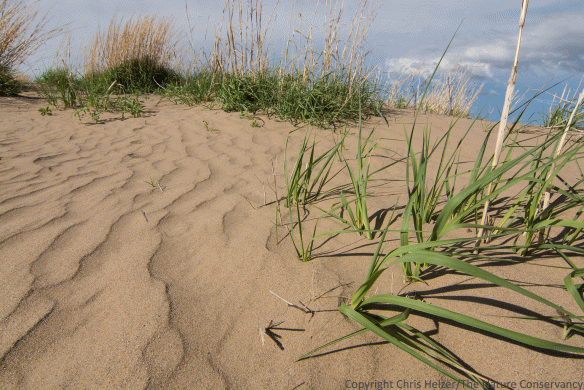
A hybrid of sandsage and sandhills prairie in Garden County, Nebraska.

While I tend to turn my camera toward small insects and flowers, I often find myself in some pretty extraordinary landscapes, especially the Nebraska Sandhills, where I am surrounded by nothing but open grassland as far as I can see in every direction.  Using photography to capture the sense of immensity and pleasant isolation I feel in those landscapes has turned out to be a big challenge for me.  Even with a wide angle lens, it’s really hard to portray the expanse of grassland and sky around me.  In the above photo, for example, there is nothing but grassland between me and the horizon at the top of the photo (several miles away), but while it’s a nice image, it doesn’t do justice to what I was seeing.

Wetland, dunes, and sky. Cherry County, Nebraska.

In this second photo, I wanted to show both the foreground vegetation as context for the wetland and vegetated sand dunes behind it, and the clouds gave me a great sky to work with as well.  However, the photo seems about three times too narrow to portray what I saw as I stood near the edge of the clear water.  Sure, I could have stitched multiple images together in a panorama, but when I try that, I’m usually disappointed by the result.  I can show more of the landscape, but the scene seems to become somehow smaller rather than larger.  I’m not sure I can verbalize why that is.

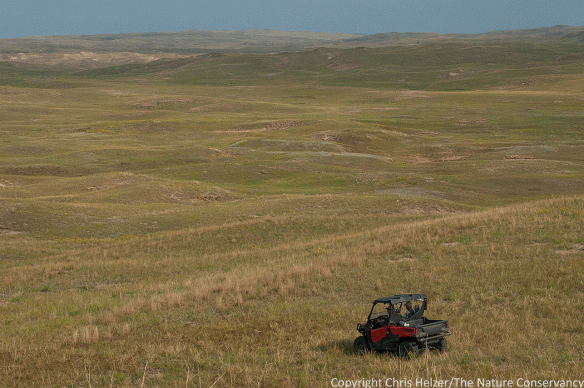
Sandhills prairie. Cherry County, Nebraska.

This last photo comes about as close as I’ve gotten to showing off the expansiveness of the Sandhills.  Ironically, it was shot with a zoom lens set at about 54 mm, which is far from a wide angle.  However, I was able to get up high, include a vehicle in the foreground for some context, and include an awful lot of landscape between me and the distant horizon.  It’s the depth of the image, rather than the width, that makes it work for me.  But even this image is a poor representation of reality.

I guess you’ll just have to go look for yourself.

Photo of the Week – September 22, 2017

The Chinese mantis (Tenodera sinensis) is an impressive creature.  Introduced to North America, it has certainly made itself at home here.  Entomologists I’ve talked to express varying levels of concern about the presence of the Chinese mantis – as well as the narrow-winged mantis (Tenodera angustipennis) and European mantis (Mantis religiosa).  Most would rather those non-native mantises not be here, but say it’s hard to find strong evidence that they are doing measurable harm to the ecosystems they’ve moved into.  If anyone knows of research that has defined the impacts of these non-native mantises I’d love to hear about it.

The Chinese mantis comes in either grayish-brown, green, or a combination of green and brown.

Regardless of impact, Chinese mantises are fascinating animals, as are our native mantises like the Carolina mantis (Stagmomantis carolina).   While I was out taking pictures last weekend, I ran across three different Chinese mantises and captured the images in this post.  I think they show some of the various attributes of these amazing (and possibly harmful) creatures.

A Chinese mantis feeds on a captured hover fly.  Lincoln Creek Prairie, Aurora, Nebraska.

Seen from underneath, the mouth of the mantis is really otherworldly.  Praying mantises can turn their head 180 degrees – a unique attribute among insects.  That ability helps them scan for both prey and predators.

“Do you mind? I’m eating here…”

This mantis was finishing off a skipper butterfly (a Sachem?) while hanging beneath the flowers of pitcher sage (Salvia azurea).

The “pupils” in the big compound eyes of mantids are actually pseudopupils, and are a trick of the light rather than an actual structure.  Look at the location of the pseudopupil in the earlier photo showing the underside of a mantis’ head…

The mantis in this photo is not looking in a different direction than in the above photo, but the angle of light hitting the eyes makes it look that way.

One additional attribute of praying mantises, especially the big ones, is that they are noticed by the general public, including kids.  I spent last Friday helping with a prairie-based field day for 5th graders, and my job was to get the students interested in invertebrates.  We used sweep nets to catch inverts, and the kids got to catch and hold grasshoppers, katydids, and spiders.  Moving kids from “Spiders are icky!” to “Ha ha – this spider tickles when it walks on my hand!” is a really important process.  If we want people to understand the value of invertebrates, they first have to see them as something other than icky.  In that regard, the absolute star of the day was a big Chinese mantis one of the kids found early in the day.  I kept it and showed it to each group of students I visited with during the day, and it never failed to get oohs and aahs from them.  Everyone got to touch it, and it was big enough that we could easily talk about it’s various body parts, how it hunts, etc.  As an ambassador for invertebrate kind, it was very effective.  An important gateway bug, if you will.