Frozen Bugs (and Beetles)

My family and I spent some time exploring the frozen pond/wetland at our prairie during the holiday break.  We even got a couple days of great ice skating weather.

My three kids had a great time ice skating on the pond over the holidays.

My kids had a great time ice skating on the pond over the holidays.

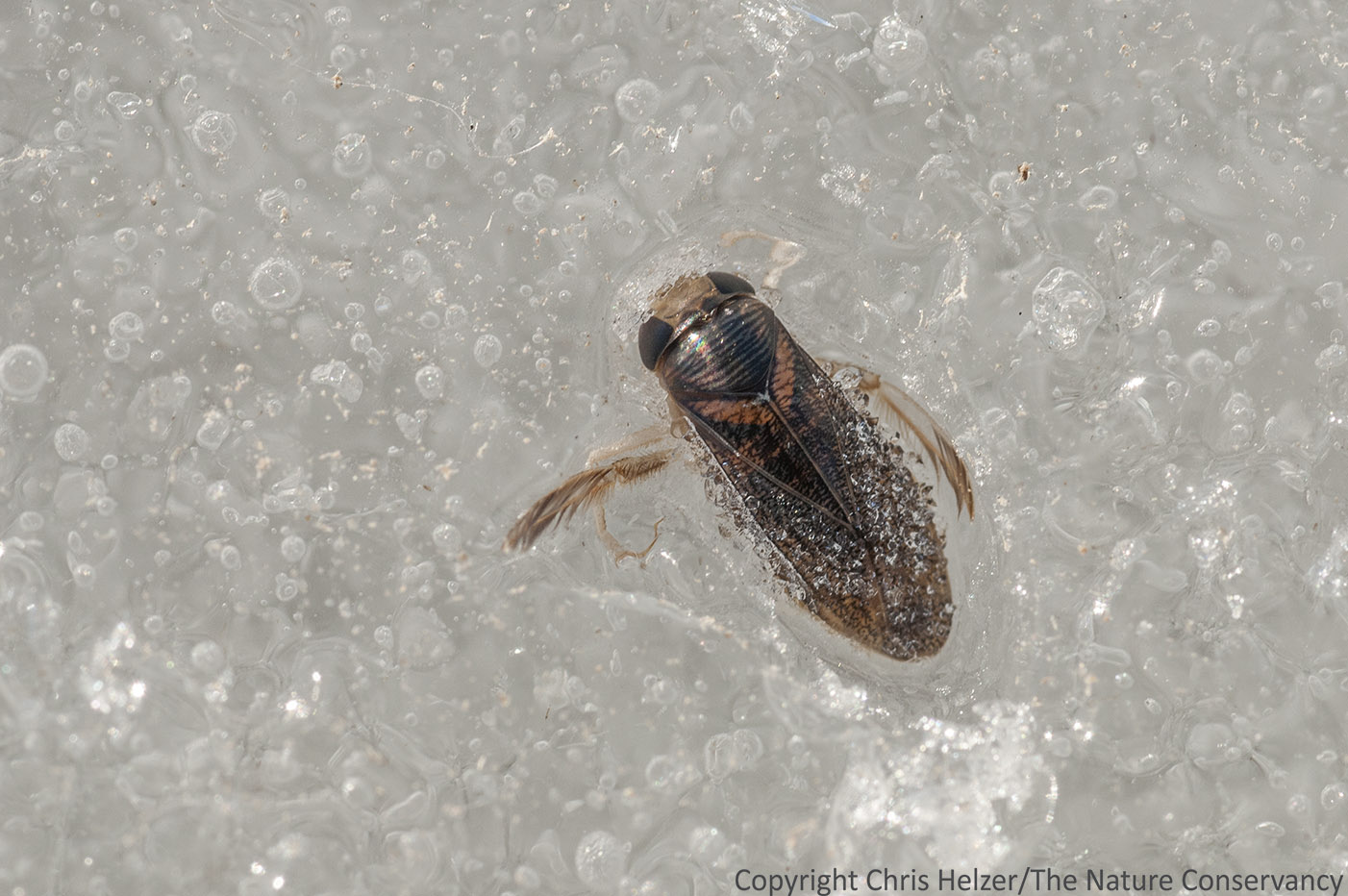
While we were on the ice, we found some great patterns (see earlier post), but we also found quite a few frozen insects.  In particular, there seemed to be two species of insects – one bug and one beetle – encased in ice.  The bug was a species of Corixidae, or water boatman.  Its name comes from the fact that two of its legs are extra long and sport hairs that make the legs look and function like the oars on a boat.  Water boatmen suck the juices from algae and plants through their long straw-like beak and are common inhabitants of just about any freshwater body around here.  They are also frequently seen in the ice when those water bodies freeze up in the winter.  Apparently, water boatmen can survive freezing and just start swimming again when the ice thaws.  A pretty neat trick for an aquatic bug that lives in a temperate climate.

A frozen water boatman

A frozen water boatman

.

Another one

Another one

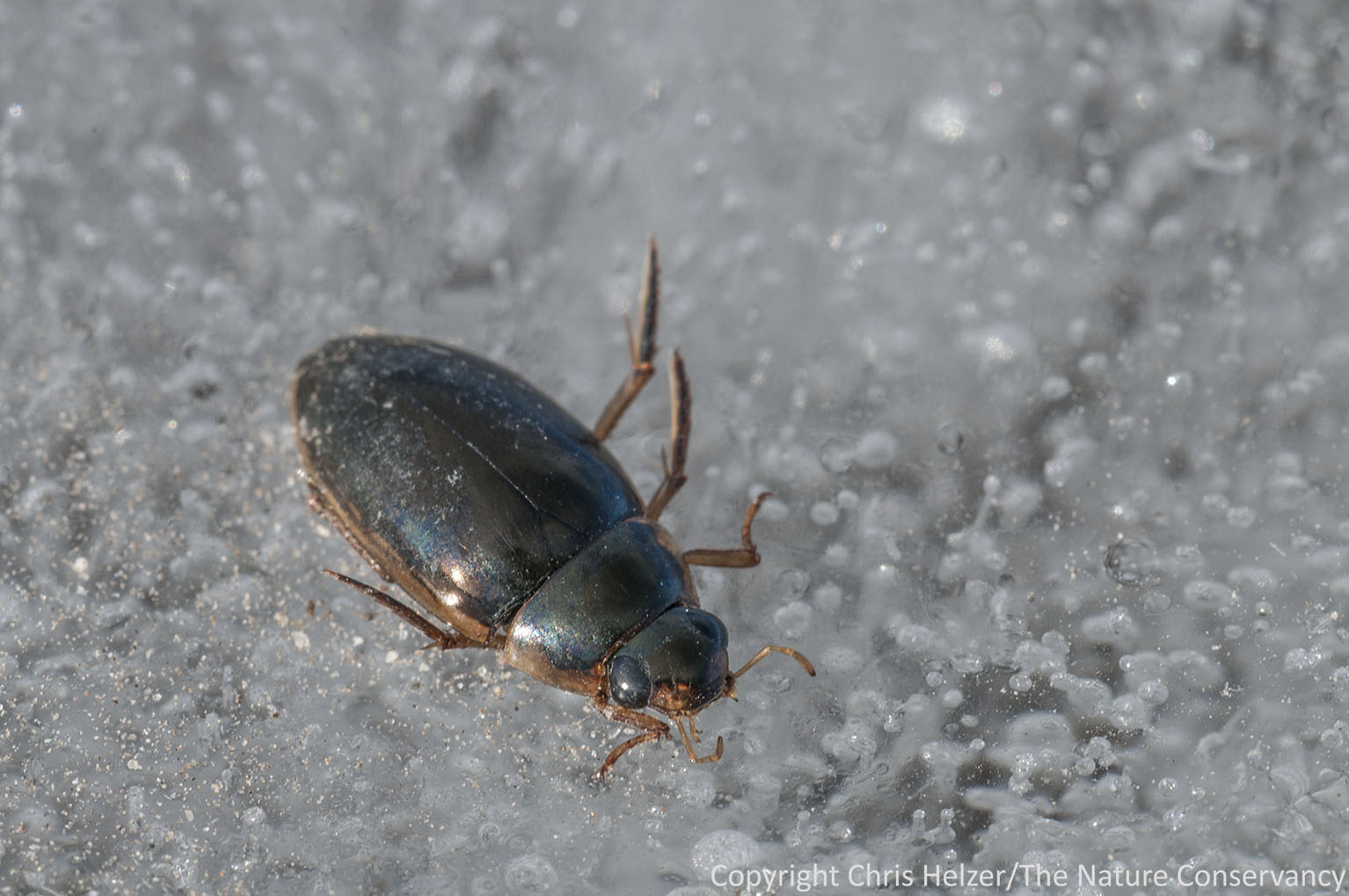
We had a two day period over the holidays during which the temperature briefly climbed up to about 60 degrees (Fahrenheit).  The warmth didn’t last long enough to spell an end to our ice skating, but did melt some of ice along the edges of the pond.  Apparently, the warm temperatures also encouraged a number of individuals of one particular beetle species to go exploring.  Unfortunately, it appears quite a few of those beetles wandered out onto the ice and didn’t make it back.  We didn’t see any of them on the ice before the warm spell, but found lots of them afterward.

Here's one of the beetles that froze after (apparently) getting caught out on the ice after a warm day.  I'm hoping one of my entomologically-inclined friends can help me out with identification and/or natural history info?

Here’s one of the beetles that froze after (apparently) getting caught out on the ice after a warm day. I’m hoping one of my entomologically-inclined friends can help me out with identification and/or natural history info?

.

This beetle apparently got flipped over before freezing.

This beetle apparently got flipped over before freezing.

I was curious to know whether those frozen beetles could do the same thaw-out-and-re-energize trick as the water boatmen, so I broke off a chunk of ice containing a frozen beetle and brought it home to thaw it.  The beetle has been thawed out for more than a week now, and hasn’t moved, so I’m pretty sure it’s dead…  The next question is: where were those beetles staying during the very cold weather earlier this winter, and how did they prevent themselves from freezing to death then?

Always more questions…

For more information on how water boatmen and other creatures weather the winter, see this earlier post from 2011.

Timelapse Snapshots

One of the great features of timelapse photography is the ability to compress time and see patterns or changes in the landscape we’d otherwise miss (such as daily groundwater fluctuations due to evapotranspiration).  However, another benefit of timelapse photography is simply the regular documentation of what’s happening in front of the camera.  For example, as I’ve been going through the thousands of images from the timelapse cameras on our Derr Wetland restoration project, I’ve been pleased to see a variety of wildlife species captured in those photographs.  Since we spent a lot of time and money converting this sandpit lake to shallow wetland habitat, it’s nice to see it being used.  The cameras have also captured more than just wildlife…

I thought I’d share some of the more interesting individual photographs I’ve found from the timelapse images.  These have been variously cropped to narrow in on the portion of the scene that’s most pertinent.  There are actually two cameras (set up so they can be combined into panoramic images – more on that in a later post) so don’t be confused if the scene appears to be different between photographs.

12:06pm.  February 25, 2013.  Canada geese and mallards are among the many migratory water birds that visited the wetland.  The heaviest use seems to be during the northward migration in late winter/early spring.

February 25, 2013.  12:06 pm.
Canada geese and mallards are among the many migratory water birds that visited the wetland. The heaviest use comes during the northward migration in late winter/early spring.

.

9am.  March 3, 2013.  Three white-tailed deer pass through the wetland with a group of mallards in the background.

March 3, 2013.  9am.
Three white-tailed deer pass through the wetland with a group of mallards in the background.

.

June 9, 2013.  11:36 am. Two bald eagles, one mature and one immature, sit on the edge of the water.  This may be part of the family raised in a nest about a mile to the north of this wetland.

June 9, 2013. 11:36 am.
Two bald eagles, one mature and one immature, stand on the edge of the water. This may be part of the family that nested about a mile to the north of this wetland.

.

June 5, 2013.  9:50pm. Great blue herons are very frequent visitors to the wetland.  This one was taking advantage of the last light of the day.

June 5, 2013. 9:50pm.
Great blue herons are very frequent visitors to the wetland. This one was taking advantage of the last light of the day.

.

June 4, 2013.  8:46 pm.   There are a number of nice sunset photos, especially in June, when the sun was actually setting in front of the camera (which is facing north/northwest).

June 4, 2013. 8:46 pm.
There have been a number of nice sunset photos, especially in June, when the sun is actually setting in front of this camera (which faces north/northwest).

.

June 15, 2013.  6:33 am. Break out!  These calves found their way out of our pasture to the south and went for an early morning exploration.  They were eventually rounded up and returned.

June 15, 2013. 6:33 am.
Break out! These calves found their way out of our pasture to the south and went for an early morning exploration. They were eventually rounded up and returned.

.

June 13, 2013.  9:54 am.  Our land steward, Nelson Winkel, is releasing beetles to help us control the invasive purple loosestrife plants that have gained a foothold on the site.

June 13, 2013. 9:54 am.
The camera documented our land steward, Nelson Winkel, releasing Galerucella beetles to help us control the invasive purple loosestrife plants that have gained a foothold on the site.

.

(Top) March 26, 2013.  4:45 pm.   (Bottom) March 26, 2013.  5:15 pm. These two photos, taken a half hour apart, show two of us preparing to burn off the small island in the restored wetland and then the completed burn.  (It doesn't take very long when the island is surrounded by water and sand).

(Top) March 26, 2013. 4:45 pm.
(Bottom) March 26, 2013. 5:15 pm.
These two photos, taken a half hour apart, show Nelson and I preparing to burn off the small island in the restored wetland (top), and then the completed burn (bottom).  It doesn’t take very long when the island is surrounded by water and sand.

.

September 23, 2013.  8:27 am.  Anne Stine, one of our Hubbard Fellows was working in the wetland this day.  She was either pulling loosestrife plants or harvesting seeds, I'm not sure which.

September 23, 2013. 8:27 am. Anne Stine, one of our Hubbard Fellows was working in the wetland this day. She was pulling purple loosestrife plants as we tried to remove new plants before they bloomed and set seed.

.

October 4, 2013.  11:16 am. Even I got caught by the camera.  Here I am, taking a mid-day break to take photographs.

October 4, 2013. 11:16 am.
Hey look!  A prairie ecologist taking a mid-day photography break.

.

May 26, 2013.  8:36 pm. This is my favorite image, so far, from the timelapse cameras.

May 26, 2013. 8:36 pm.
So far, I think this is my favorite from the timelapse cameras.

.

Thanks to Michael Forsberg and Jeff Dale for helping set up and maintain the twin timelapse cameras on this site, and to Steven Speicher for helping with data storage and advice.  Photos shown here were taken with Canon EOS Rebel T2i cameras with 18mm lenses.  They are inside weatherproof housings, charged by solar panels, and operated by electronic controllers designed by Jeff.  Since these cameras were installed, Mike, Jeff and others formed Moonshell Media to design and install cameras like these for others.  They are also key players in the Platte Basin Timelapse project.