The emotional response you have to this photo will say a lot about your background, experience, and cultural influences.

A profusion of annual sunflowers (Helianthus petiolaris) in sandhill prairie at The Nature Conservancy’s Niobrara Valley Preserve in north central Nebraska.
The sandhills of Nebraska consist of nearly 20,000 square miles of prairie. The scale can be hard to comprehend until you have driven through it for hour after hour, gaping at the beauty spreading out all around you. When I drove through a good portion of the eastern sandhills this week, a lot of it looked like this photo – covered with blooming yellow sunflowers.
Many readers of this post will be thinking, “Wow! What a beautiful year in the sandhills!” But I know others of you are thinking, “Ugh, what do we have to do to get rid of these invasive weeds?”
I’m going to get to that discrepancy, but let’s first back up and look at why the sunflowers are so abundant this year. First, the sunflower species we’re talking about here is an annual called plains sunflower (Helianthus petiolaris). It germinates from seed in the spring, flowers in the summer, and dies at the end of the same year.
During the drought of 2012, annual sunflowers were among the few plant species able to continue growing and flowering during the hot dry summer. Because of that, sunflowers were able to produce copious amounts of seed, many of which ended up on the ground at the end of the year. Few other grassland plants produced anything comparable to the seed crop of those sunflowers.
The spring of 2013 brought abundant rain to the dry sandhills. In addition, the plant litter from last year’s dry growing season was thin and sparse, allowing a lot of light to hit the soil. That combination of abundant light and moisture was exactly what all those plains sunflower seeds needed, and they germinated.
Of course, germination doesn’t ensure survival, and many annual plants germinate each year, only to be quickly overshadowed and outcompeted by strong perennial plants. Perennials have the advantage of a pre-existing root system that can monopolize moisture and nutrients from the soil while annuals are still struggling to get started. In years when perennial grasses and wildflowers are strong, there is very little space for annuals to grow, except in places where the soil and plant community were disturbed by digging animals or intensive grazing/trampling.
However, in the spring of 2013, not only were conditions perfect for plains sunflower germination, competing perennial plants were also weak from drought and grazing in 2012, leaving lots of open space belowground for sunflower roots to take advantage of. In short, you couldn’t have designed a better situation for the sunflower. It was one of the few plant species to produce seed in 2012, and then it got light, moisture, and weak competition in 2013. It’s no wonder the hills are yellow!
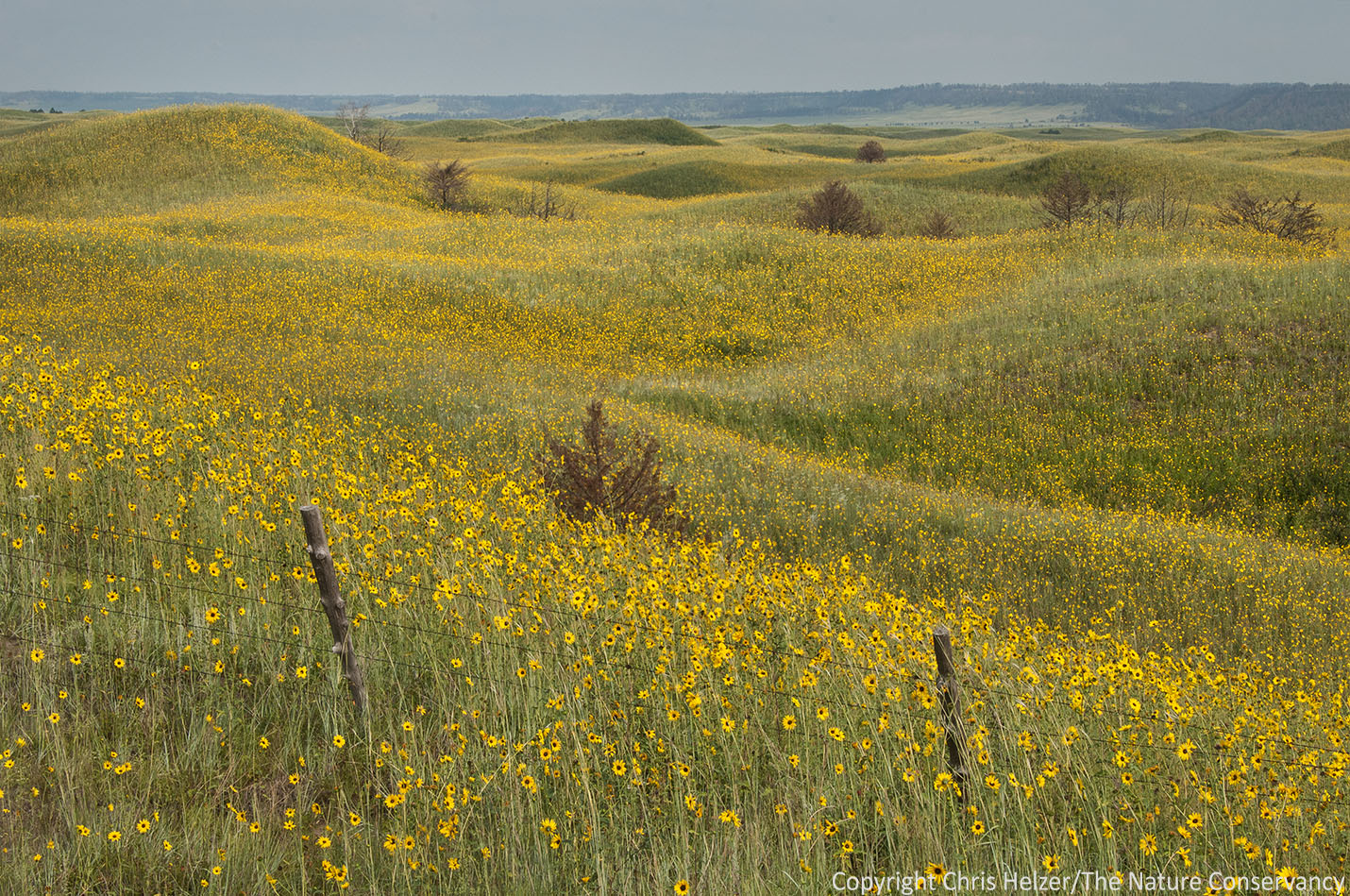
Some people will look at this photo and see an amazing abundance of pretty wildflowers. Others will see weeds running amuck. At the Niobrara Valley Preserve, last year’s wildfire increased the favorable conditions for plains sunflower by creating massive amounts of bare ground for germination. While it looks like a monoculture from a distance, hidden among the sunflowers are lots of grasses and other plants that are slowly regaining their vigor. By next season, this will be a very different looking prairie.
Ok, back to the perception issue. Sunflowers are one of the most popular and well-known flowers in the world. They are big, attractive, and easy to recognize. On the other hand, many farmers and ranchers have grown up learning that sunflowers (of any kind) are weeds. The presence of sunflowers in a field or pasture – especially an abundance of them – can be seen as a badge of shame for the landowner who is clearly not managing his/her weed problems adequately.
The important thing to remember if you’re a rancher, however, is that the sunflowers are not outcompeting perennial grasses. Instead, the sunflowers are opportunists, taking advantage of the fact that grasses are weak. As perennial grasses recover from last year’s drought and/or grazing, they will reclaim the root space they lost in 2012 and sunflowers will have much less room to grow next year. Plains sunflower is a native prairie plant, and it’s role is to fill the space left when other plants are weakened (similar to ragweeds and other opportunistic species). If sunflower wasn’t filling that space, another “weedy” species would, and the alternative could be much worse.
Some ranchers will be tempted to spray their pastures to kill off the “invading” sunflowers, but that’s actually a counterproductive strategy. First, the annual sunflowers are going to die at the end of the season anyway, so if you want fewer sunflowers next year, the best strategy is to focus on limiting the germination and growth of next year’s crop by allowing perennial grasses and wildflowers to regain their dominance. Second, herbicide spraying will kill a number of other plant species that are both valuable as forage and competitors with sunflowers and other annuals. Why spend money to weaken the long-term viability of your grassland?
It’s also important to remember that cattle do eat sunflowers – they particularly like them early in the season when the leaves and stems are tender, but will also seek out the nutritious buds and flowers later in the season. The evidence of that can be seen right now; pastures grazed at certain times this year have many fewer blooming sunflowers than those that haven’t yet been grazed this season. In addition, of course, sunflowers are among the most valuable grassland plants in a prairie for wildlife and pollinators. They produce large nutritious seeds for birds and other wildlife, and have abundant and accessible supplies of nectar and pollen that attract numerous pollinator species. In short, sunflowers may not be everyone’s favorite plant, but they’re far from a useless weed or invasive threat.
For those of you who started out reading this post as fans of sunflowers, good for you! If you get the chance, you should take a drive through Nebraska’s sandhills this summer and enjoy the scenery – it’s not likely that we’ll see another year like this for a while. For those who are appalled by the abundance of sunflowers this year, maybe you can take some comfort from the fact that it’s a temporary phenomenon, and one tied to a particular combination of weather factors more than anything you or others did as land managers. Things will be different next year.
Regardless of whether or not you like sunflowers, I guess there’s one thing we can all agree on. The year 2013 will be one to remember!
Note: Nebraska has nine species of native sunflowers, seven of which are perennials. All of them are valuable for wildlife and pollinators, and important components of a healthy grassland community.