
The Value of a Good Field Notebook

One of the most powerful tools of a prairie manager is a field notebook.  There’s no substitute for recording observations and ideas as they happen.  Memories can fade, but notes don’t (as long as you don’t drop them in a stream).

There are multiple roles for a field notebook.  First, just writing a paragraph or two a year about each management unit, combined with a couple of photos, can form the backbone of a very nice basic monitoring system.  Additional data are nice too, of course, but it’s really helpful  just to note the general appearance of a site and the apparent impacts of management treatments and weather.  I try to visit every site I manage late in the season to make these observations, and then use those thoughts and ideas to help guide my management planning for the next year.

Sometimes photos can be important companions to field notes as a way to better describe the appearance of a site. This photo of a second-year prairie planting does a much better job than I could have done with text to capture the abundance of annual sunflowers. The photo is especially interesting to look at now, when the planting has matured (it's now 7 years old and has a well-established and diverse prairie plant community.)

Second, it’s important to record any interesting sightings of species or species behavior.  Sometimes those observations are important by themselves because they can indicate changing conditions in your prairie.  For example, seeing your first Henslow’s sparrow might indicate that a management strategy to provide more thatchy habitat is paying off.  Other times, the observations might be mildly interesting at the time, but become even more valuable later, when you look back and realize that they were part of a larger pattern of change.  After multiple seasons, for instance, you might notice that a particular species was present or especially abundant in years with a management treatment or weather pattern.

Third, tracking the impacts of specific management actions is critically important, especially when you’re trying something new.  When I conduct formal experiments, I collect data on separate datasheets and store them as part of a larger file on that research project.  However, most of my experimentation is much less structured, and my field notebooks are full of observations and thoughts about the impacts of various little trials. Looking back at those observations has helped me hone our techniques over time.  For example, I’ve tried multiple variations on our standard prairie seeding rates in little corners of most of our restoration sites.  Recording the results of those, and then looking over those cumulative records has helped me adjust our strategies over time.

Finally, if you’re like me, many of your best management and restoration ideas come while walking around the prairie.  Capturing those on the spot can ensure you don’t lose them, and can also help record whatever observation or circumstance led you to come up with the idea in the first place.  Of course, writing down those ideas is only helpful if you look at your notes later…
Continue reading

Save The Date! July 13, 2012

It’s going to be a big day.  I’m not sure what to call it yet, but it’ll be big.  Mark July 13 on your calendar, and make plans to travel to the Platte River Prairies in Nebraska!

Prairie Ecologist readers may remember previous posts about how to measure success in prairie restoration (reconstruction) and some early attempts to evaluate how insects are reacting to our prairie restorations.  Next July, I’m taking the next big step, and you’re invited to join in the fun.

With the help of entomologists James Trager (Shaw Nature Reserve, Missouri) and Mike Arduser (Missouri Department of Conservation) – and hopefully some others – I’m going to try to do three things.

1) Ramp up efforts to establish an inventory of the insect and animal species in our prairies – including both our remnant prairies and those we restored from cropland.  I have a pretty good handle on the plant communities, but we’ve just scratched the surface on the insect and animal communities.

2) Build a list of species that can help indicate whether or not our restored prairies are functioning correctly (e.g. expanding and re-connecting our fragmented prairies).   That list will include habitat specialists with specific needs our restored prairies will have to meet if we are to be successful.

3) Establish sampling protocols that we can follow, using staff and volunteers, to track those species over time to see if they are moving into and through our restored prairies.

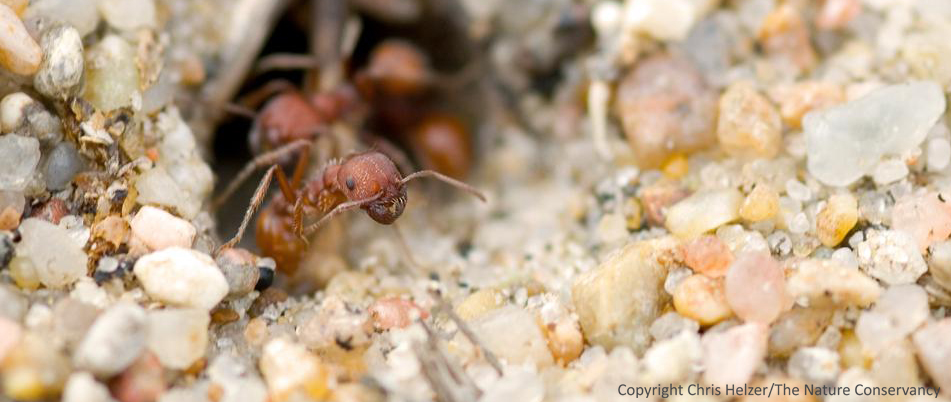
Do you know what kind of ant this is? Me neither!! That's why I'm excited to have James Trager - who DOES know - coming to our prairies to help me figure out what we've got, and why.

James and Mike have already committed to come to the Platte and help me do some initial sampling and think about how to set all of this up for the future.  We’ll spend a good part of the week of July 9th collecting critters, analyzing what we find, and thinking about what makes the most sense for future evaluation work.

Then, the big day is Friday (yes, Friday the 13th) and you’re all invited to join in the conversation.  The agenda is still under development, but at this point, the plan is to have a public field day/open house revolving around prairie ecology, management, and restoration – with a particular emphasis on insects and other prairie animals.  We’ll have tours and demonstrations of prairie management and restoration work and research projects, displays of plant and animal species from our sites, and presentations by various prairie ecologists.  Besides James and Mike, I hope to have several other experts on insects and other prairie animals on hand to talk about those species and their ecology, and hopefully give you a close-up look at them (the animals, not the experts).  It should a great time of year to see wildflowers, birds, and lots of insects – including regal fritillaries, which should be near their peak abundance at that time of year.

Overall, the day should be a great opportunity to learn more about the natural history and identification of prairie species, trade ideas about prairie management, restoration and research, and network with other people who are just as interested in prairies as you are.  In addition, it will allow us to build upon some of the conversations we’ve had through this blog – but to do it in person.  We can walk through the same prairies, look at the same fire, grazing, and seeding results, and compare observations.  I hope that a number of the regular readers of this blog will be able to come – especially those of you from outside Nebraska – because I think it can only increase the value of our future blog conversations to have you see our prairies in person.

We work hard to maximize native plant diversity in our prairie restoration work, then use fire and grazing to maintain that diversity - and hopefully also ecological resilience. Does it work? Come judge for yourself. Most importantly, we need to know how insects and other animals are responding, and I hope to learn more about that.

So – if you’re interested, please put the day on your calendar, start thinking about your travel plans, and we’ll hope to see you next July!

(Stay tuned for more details)