The Myth of Self-Sustaining Prairies

Here’s a question I get asked occasionally:  “At what point will my prairie become self-sustaining?”

There are lots of ways “self-sustaining” can be defined, of course, but usually the person is hoping that at some point they can just step back and let the prairie do its thing with very little or no human input.  In other words, they hope the prairie will function like a machine.  Once you have it tuned up correctly, it’ll hum along just fine with only occasional inputs of fuel or maintenance.

Ah, that it would be so easy.  Unfortunately, there is a short answer to the question, and it’s a disappointing one.  The answer is, “It just doesn’t work that way.”

Here’s the short explanation of that short answer:

A prairie with no management at all accumulates thatch from each successive year of plant growth, and if not removed, that thatch eventually builds up to the point at which only a small number of plant species can survive.  Unfortunately, the most dominant of those surviving species tend to be either trees/shrubs or invasive plants.  In the eastern half of Nebraska, smooth brome tends to be a primary winner, along with tree species such as Siberian elm and eastern red cedar.

Besides the issue of thatch build-up, there are just too many threats, particularly from invasive species and trees, for prairies to maintain their species compositions and ecological functions without human management.  This is particularly true with tallgrass prairies in an agricultural matrix.  The degree of vulnerability to invasion depends upon soil type and the surrounding landscape.  Some soil types seem favor invasives more than others – oftentimes, high soil nitrogen levels can favor exotic grasses, for example.  The degree of invasive species pressure on a prairie is also influenced by the abundance and proximity of those invaders in the neighborhood around the prairie . However, all prairies (that I’m aware of) have some degree of vulnerability to invasive species.
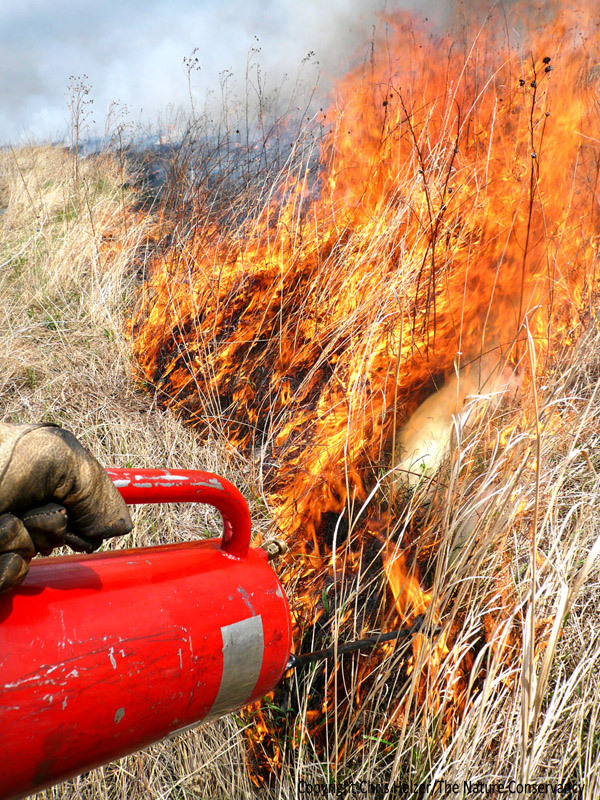
Active management, such as the application of prescribed fire, is needed to prevent excessive thatch buildup and to help suppress invasive species.

That’s the short answer.  A longer and better answer is that tallgrass and mixed-grass prairies are not “climax communities” in the classic sense.  In my early ecology classes, I learned that terrestrial plant communities move through a process called succession from bare ground to some final stable state – usually a forest.   Bare ground is colonized by opportunistic species, which are eventually pushed out by longer-lived grasses and wildflowers.  Those grassland species are then replaced by various generations of tree species, each topping out the other until a final set of tall long-lived trees becomes dominant and creates a stable community.  Disturbances such as fire or severe weather events might set back succession temporarily, but the process keeps moving toward that climax community.

Prairies don’t fit that successional model very well.  Prairies are maintained (and defined?) by disturbances such as fire, grazing, and drought.  Without some combination of those ecological processes, prairies turn into woodlands.  Because of that, some might argue that prairies are simply an ephemeral stage of the longer successional process, and not really a stable ecosystem.  Others might argue that the whole idea of ecological succession is overly simplistic and not representative of the way all ecosystems function.

Without getting into that larger argument, the real point is that if we agree prairies are important, and we want to maintain them, active management is necessary.  Some people point to expansive prairies in Great Plains landscapes and wonder if those prairies could maintain themselves without humans if given the chance.  After all, lightning-caused fires and roaming herds of bison should be able to take care of things without interference from people, right?  In reality, we don’t have any historical precedent to back that up.  Today’s prairies have only been around since the last ice age –  about 10,000 years (less in the east, more in the west.)  During that entire time, people have been active managers of those prairies.  Fires set by Native Americans were much more abundant and extensive than lightning-caused fires.  Bison herds, and many other herbivores, responded to those fires by focusing grazing in those recently burned areas.  That intensive fire/grazing disturbance interacted with and compounded the impacts of long droughts, floods, and other weather-related events.  Cumulatively, those major disturbances maintained the integrity of prairies.

Along with climate and fire, bison (and other grazers/herbivores) were a major force that shaped prairies. However, people and their activities were also an important component of the process.

There’s really no way (and no reason) to separate people from prairie.  Regardless of the intent or motivation of the people who manage prairies – historically or now – their actions have tremendous impacts.  Similarly, inaction by people who control prairies has tremendous impacts as well.  In the natural resource management world, the phrase “No management is still management” is well-worn but nevertheless true.

Of course, defining the need for continual human management – even in the absence of today’s new challenges such as invasive species – doesn’t solve the problem.  What kind of management is needed?  How do we know when to do what?  The answers to those questions are complex, still being debated, and the primary subject of this blog, my book on prairie management, and myriad discussions among prairie managers around the world.

Some people who agree that prairies require some level of active management still search for a relatively simple management recipe to follow.  Annual haying or burning or two to three-year rotations of fire or grazing are examples of management regimes that are commonly used and advocated for.  This is really just a small step up from the idea that prairies should maintain themselves.  In this case, the argument is that prairies should be able to maintain themselves if we just provide them the right basic disturbance framework.

I’ve given my opinion on simple, repetitive management regimes often within this blog (see my Calendar Prairies post as an example).  I think repetitive management threatens plant diversity because there are always some plant species that are favored in a particular management regime and others who are not.  Over time, those species not favored will inevitably fade out of the community if the same regime is applied over and over.  Perhaps more importantly, animal species – including insects – with fairly specific habitat structure requirements are similarly affected.  Some species thrive under repetitive management if that management consistently favors them.  However, those animals that don’t find what they need in that management system can’t normally survive for many years in suboptimal habitat like many perennial plants can.   Animals without appropriate habitat either move or die – and in fragmented landscapes, or in landscapes where the same management is in place across the entire landscape, moving may not be a viable option.

Annual haying provides good growing conditions for many plants - especially those the bloom and produce seed prior to the haying date. On the other hand, some of the plant species favored by annual haying (including smooth brome) can become invasive. In addition, some desireable native plant species do poorly under annual hay management and eventually disappear from those prairies.

All of this adds up to one conclusion.  Diverse, functioning prairies require active, constant, and thoughtful management by humans.  There’s no getting out of that responsibility.  If we choose not to be active thoughtful managers, we are choosing to let prairies degrade, and we’ll have to live with the consequences (“No management is still management”).  Hopefully, though, most people with influence over the management of prairies will embrace their role, and be active managers – as well as active participants in ongoing discussions about the impacts of various management techniques and systems.

Though active prairie management is time-consuming, and often expensive, it’s also extremely rewarding.  Whether it’s a small backyard prairie garden, a 20,000 acre grassland, or something in-between, every year is a chance to try new things, see what happens, and learn from the experience.  More importantly, the diversity of plant, insect, and invertebrate species in well-managed prairies – large and small – is its own reward.  Who could ask for more than that?

Aiding and Abetting Invasive Species

HAPPY (?) NATIONAL INVASIVE SPECIES AWARENESS WEEK

It’s bad enough that invasive species are taking over our prairies and other natural areas.  Why do we insist on helping them do it?

When my dad was in high school in the 1960’s, he planted trees and shrubs behind the pond in my grandpa’s pasture as part of a 4H conservation project.  The species he planted – Russian olive, eastern red cedar, honeysuckle, and multiflora rose – were all promoted as conservation trees at the time but considered to be invasive species today.  The honeysuckle and multiflora rose didn’t make it, but we’ve still got a strong population of Russian olive and cedar trees today, and now that I’m taking over the management of the pasture, I’m making plans to eradicate them.  I give my dad a break on this one because it was a long time ago.  Unfortunately, less has changed in the last 50 years than you might hope for.  (See my earlier post on invasive trees in prairies)

Eastern red cedar trees are native to Nebraska, and so should probably be labeled as “aggressive” rather than “invasive” – though they can certainly take over grasslands, they’re only a problem where fire has been removed from the ecosystem.  Russian olives, on the other hand, are clearly invasive species.  Many thousands of dollars are being spent trying to remove them from riparian areas around Nebraska and many other states.  Why, then, are we still planting Russian olives??  They are still listed and sold as conservation trees in Nebraska, and several agencies have long been providing cost-share dollars and promoting both the planting AND eradication of Russian olive trees (a situation that is just starting to change).

A Russian olive tree resprouting after a late-spring prescribed fire. Russian olives and most other deciduous trees are particularly difficult because of their capacity to re-sprout.

Siberian elm is another species that is being both promoted and controlled.  The species was first introduced to the United States in 1860.  When Dutch elm disease started wiping out American elms in the 1930’s, Siberian elm gained popularity because it was much less susceptible.  It was also promoted as a substitute for privet (another introduced invasive species) in hedge plantings.  Today, Siberian elm is widely recognized across the country as an invasive species (it is an official noxious weed in New Mexico) and is one of the most aggressive trees invading prairies in Nebraska and other states.  Its abundant wind-dispersed seeds allows it to quickly overwhelm grasslands (and grassland managers) with numerous small saplings.  They are common urban trees – but largely reviled because of their brittle branches and unattractive crown shape.   Notwithstanding its record, however, this ugly aggressive non-native tree is still being promoted as a conservation tree in Nebraska and elsewhere, and the U.S. Department of Agriculture’s Plant Materials Center in Kansas is actually developing an “improved” cultivar for use in the western Great Plains (see page 82 of this report for details).

Unfortunately, Russian Olive and Siberian elm are only two of many examples of introduced species that are simultaneously viewed as useful and invasive by different constituencies.  Nebraska’s newest official noxious weed is Japanese Knotweed, which has numerous hybrids (most of which are invasive) that can still be purchased through garden catalogs.  Sericea lespedeza, a horrible invasive plant in the southern prairies (and a noxious weed in Kansas and Colorado) is still promoted as a forage and wildlife plant by Auburn University.  In fact, sericea’s status as a “crop” is preventing the development of biocontrol agents that may be the only hope of controlling its spread.

Invasive grasses such as smooth brome, tall fescue, and reed canarygrass are being promoted as forage crops for livestock at the same time that huge amounts of money and effort are being spent to keep them from overrunning prairies.  Perhaps most frightening, Monsanto and Scotts have developed strains of Kentucky bluegrass and creeping bentgrass (both invasive grasses in prairies) that are resistant to glyphosate herbicide (aka Roundup) for use in turfgrass applications.  The possibility (probability) that those Roundup Ready species will either escape from planted areas or hybridize with naturalized populations is apparently being ignored – in spite of the fact that the bentgrass has already escaped from test plots in Oregon.  There are plenty of other examples of introduced ornamental or agricultural plants that we’re assisting with their invasion of natural areas, but the list is too long and depressing to present here.

Why do we have such trouble agreeing whether species are helpful or harmful?  A big part of the problem is the diversity of organizations and entities that work to introduce, promote, evaluate, and/or control plant species.  There is no single clear controlling entity that can designate species as being invasive or not.  Because of that, an internet search is not usually an effective way for a member of the general public to find out whether or not a species is invasive.  While there are excellent sites like the USDA’s PLANTS database that list whether the species is considered to be invasive or a noxious weed in any states, a general search for species like sericea lespedeza brings up some websites that promote it as a wonder plant and others that denounce it as a nasty weed.  What’s a person to believe?  (In this case, it’s a nasty weed…)

To further confuse things, those who continue to promote the use of invasive species often claim that the species aren’t invasive in the habitat type or geographic area they’re promoting them for.  I often hear that Russian olive trees are safe to plant as long as you only put them in uplands, and not in lowlands where they become invasive.  This argument appears to rely on the assumption that the wildlife species eating the Russian olive’s “wildlife friendly” fruits don’t move between upland and lowland habitats.  Considering a species safe in one state when it’s demonstrated to be invasive in a nearby state is equally illogical.  True, it can be difficult to predict whether a species will be able to thrive in one area or another without actually testing it, but given the cost of controlling invasive species, why take a chance?

Siberian elms and smooth brome - a pretty nasty one-two punch of invasive species.

How Do we Fix the Problems?

One part of the solution to these issues is to make the general public more aware of which species are considered to be invasive in their area.  Nebraska is currently building a set of lists that will identify known and candidate invasive species, and will rank them by severity and the appropriate response needed (e.g. – prevent their introduction, eradicate current populations, or contain the spread of current populations).  It’s surprising that lists such as this are not more widely available across the country, but they’re actually difficult to find.  Of course, while lists of invasives are helpful, they only work when they’re used.  It’s difficult to imagine many homeowners taking the time to cross check their annual garden catalog wish list against an invasive species list before ordering.  Most consumers assume that if they can buy it, it must be safe – something that is far from true – and the conflicting information found on the internet and in other sources only serves to further confuse and frustrate people.

Educating the general public about the value of using native species for both urban and rural plantings – thus avoiding the risk of introducing species that may become invasive- is another important approach.   I’m a big fan of using native plants, but I’m also realistic about both the difficulty of marketing natives and some of the complications associated with “native” plants.  One of those complications is that it’s very difficult for the public to know which plants are actually native.  For example, mixtures of wildflower or wildlife habitat seeds that are commonly sold in Nebraska and other prairie states include both native wildflower species (though often with genetic origins from far away states) and non-native species, some of which are invasive.  Invasive species that are often included in wildflower mixes include oxe-eye (shasta) daisy, damesrocket, baby’s breath, bouncing-bet, birdsfoot trefoil, red clover, chicory, common St. Johnswort, Queen Anne’s-lace, sweet clover and many others.   It’s not reasonable to expect consumers to be able to determine which species are safe and which aren’t.  (What could be dangerous about wildflowers?)

The demand side of the equation (consumers) is an important place for us to focus attention, but the only way we’re really going to solve the problem is by also working on the supply side.  Somehow, we have to build consensus and understanding between those who are fighting invasive species (e.g. conservation and agriculture groups and landowners) and those who are introducing and promoting new plants (e.g. some agencies, universities, and nurseries).  It’s certainly not going to be a quick or easy process, and it’s not going to solve the problem completely – but the only other option is to continue fighting an ever-growing list of invasive species.

Rather than sniping at each other across fences, we need to build partnerships that bring together nursery organizations and noxious weed control agencies, tree advocates and prairie biologists, and forage specialists and native plant enthusiasts.  The initial partnerships don’t have to be (can’t be?) built around the sources of greatest disagreement.  For example, nursery owners and noxious weed agents might come together because they both see the need for improved influence over nurseries that purposefully (or neglectfully) sell plants that are clearly illegal to sell – nursery owners might be concerned about reputational risk of the nursery industry as a whole, and noxious weed agents would want to prevent introductions of dangerous plants.  More difficult discussions about how to handle the sale of plants that are potentially, but not definitively, invasive can wait.  Once a rapport has been established, it’s much easier for both sides to see and appreciate the point of view of the other – and both have a stake in maintaining the relationship by finding ways to compromise.  In some cases, it might not be possible to build partnerships right away, but important first steps toward building relationships can include things as simple as inviting each other to attend meetings, join field trips, or give presentations on current and future projects.  Anything that gets people into the same space so they can see each other as people rather than adversaries is likely to be productive.

Invasive species are one of the biggest threats to prairies (maybe the biggest) and the issue is much bigger than simply attacking species as they appear.  If we can work to prevent the next leafy spurge or sericea lespedeza from being introduced or released in the first place, just about any level of effort would be worthwhile.  It’s up to all of us to raise awareness about the risks of introduced species and the benefits of native species.  Even more importantly, it’s up to us to work with those who see things differently than we do to establish relationships and common understanding.  While it’s tempting to go around with a rolled-up newspaper and whack those who appear to be acting irresponsibly, that’s not likely to be very productive.  Maybe we should start by sending them (carefully vetted) flowers instead!