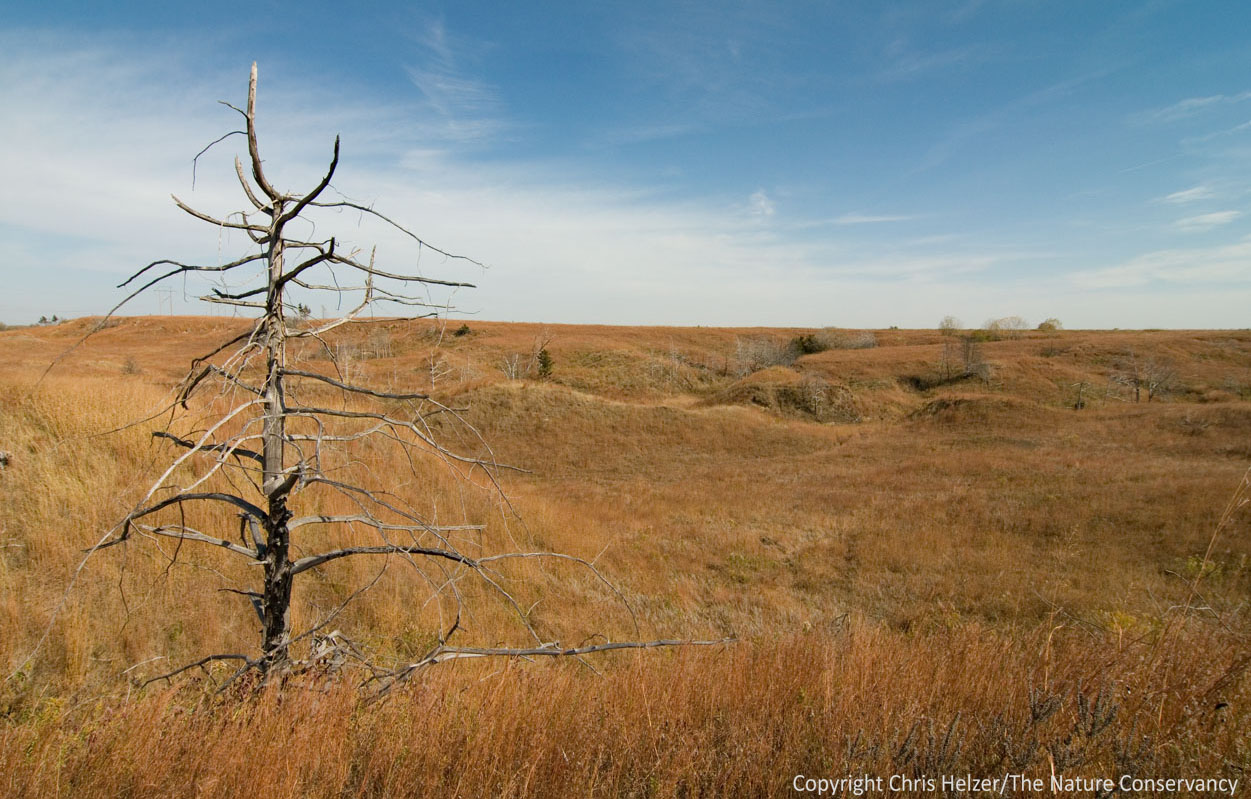
Today is National Arbor Day – a holiday initiated by J. Sterling Morton right here in my home state of Nebraska. The idea of Arbor Day is to encourage the planting of trees. However, as a prairie ecologist, I spend considerable effort trying to keep trees from taking over the prairies I manage and/or care about.
As a result, I have some mixed feelings about Arbor Day.
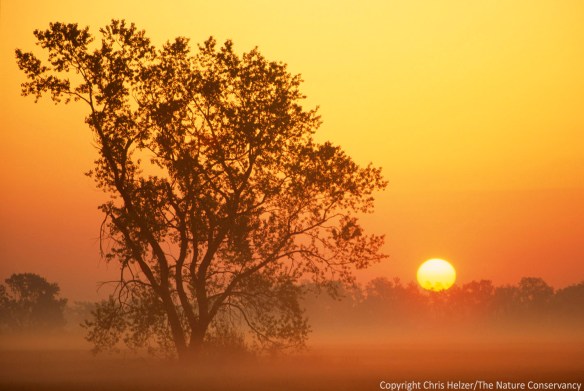
A cottonwood tree in a Platte River prairie at sunrise. Beautiful, but not without some impacts on prairie ecology.
I don’t harbor any particular enmity toward trees themselves. In fact, some of my favorite places in Nebraska have fantastic woodlands, including The Nature Conservancy’s Rulo Bluffs Preserve and Niobrara Valley Preserve. I also really like the trees in my yard – especially the one that produces a big crop of pie cherries each year!
On the other hand, I don’t hesitate to use all necessary force to remove trees from grasslands. Why? There are numerous reasons. Here are a few examples:
– The shade from trees changes the microclimate underneath them, suppressing the growth of many prairie plants and favoring others, including some nasty invasive species that can then spread into prairies.
– Trees completely change the habitat structure of a prairie, making it unsuitable for many wildlife species that rely on wide open habitats. As trees and shrubs increase in density, prairie animals are forced out.
– Many grassland birds avoid nesting near woodlands, or even lone trees. There are multiple reasons for this, but a big one is the abundance of predators that hang around in and under trees. A line of trees along the edge of a prairie creates a wide “dead zone” within which very few prairie bird species will nest. In landscapes where most prairies are already small and fragmented, the loss of that additional habitat can have serious consequences.
– Once trees and shrubs become established, they tend to promote the establishment of more. Some spread by rhizomes (underground stems) and all of them are good perch sites for birds, which drop seeds out both ends onto the ground beneath the trees. Once on the ground, shade from the trees reduces the vigor of prairie plants and helps woody seedlings thrive. Dense tree and shrub patches can also become fire proof because their shade prevents grass growth beneath them – and it’s grass that carries fire.

Burning prairie can suppress the encroachment of trees, including eastern red cedars.
Woody plants, including both trees and shrubs, have always been good at invading prairies but, historically, fires and dry climate helped keep them from becoming established across most of the grasslands of the Great Plains. Today, fire suppression, landscape fragmentation, and even changing levels of carbon and nitrogen in the atmosphere are giving trees the upper hand. As a result, my staff and I (ok, mostly my staff nowadays) spend an inordinate amount of time cutting trees down, burning grasslands to kill trees, and treating trees with herbicides.
Can you see why a holiday that promotes tree planting – especially in a grassland state like Nebraska – might make me a little nervous? There’s absolutely nothing wrong with planting trees, but the kind of trees being planted and the location they’re planted in makes all the difference in the world.
If you live near a prairie, here are two important tips to consider as you prepare to celebrate National Arbor Day by planting a tree (or lots of trees).
1. Do some research on the tree species you plant. Some species, such as Siberian elm, Russian olive, Autumn olive, and other non-native trees and shrubs can be very invasive in grasslands, quickly spreading by seed far from the parent tree. A quick internet search using the name of the tree and the word “invasive” will tell you whether or not the tree species you’re considering is one that could cause problems. However, even many native trees can spread into grasslands, so that leads us to…
2. Carefully consider the location of your proposed tree planting. As mentioned earlier, even a single tree, let alone a row along the edge or (heaven forbid!) through the middle of a prairie can wreak havoc on grassland birds and other species. Prairies and their plant and animal inhabitants thrive in wide open habitats; adding trees to those habitats can really mess things up.
By all means, plant trees in your yard, around your farmstead, or in a local park or school. Trees provide shade, habitat, food, and aesthetic beauty to cities, towns, and acreages, and you should feel good about contributing toward those things. However, as you celebrate Arbor Day, please don’t forget about prairies, the plants and wildlife that rely on them, and the hard-working prairie ecologists and land managers trying to conserve them.
So,
Happy Arbor Day!
(please celebrate wisely)