Prairie Word of the Day – Disturbance

It’s been too long since the initial installment of what was intended to be a regular feature of this blog – the Prairie Word of the Day.  Since one blog post does not make a series, I figured I’d better at least write one more.  I will try to add more to the series relatively soon. 

If you read this blog or any other source of information about prairie ecology or management, you’re likely to have seen the term “disturbance” used in some context (e.g., “ecological disturbance,” “disturbance regime,” “disturbance in the force”).  Ok, that last one is from a different context, but nevertheless.

Outside of prairie ecology or other ecological conversations, a disturbance is often something that requires contacting the police.  However, in almost every case, prairie managers would appreciate you not calling the police in response to disturbances in a prairie.  So what does the word “disturbance” mean in an ecological context?

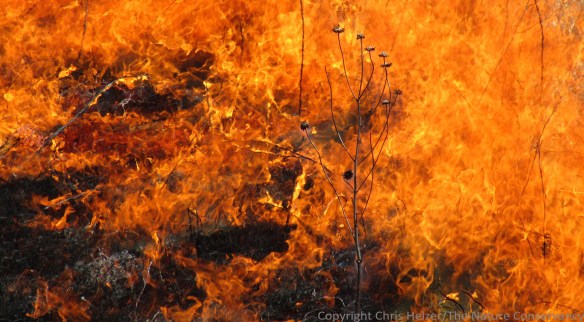
Fire is one of the big three historical disturbances to which prairies are adapted to and rely on.

Fire is one of the big three historical disturbances to which prairies are adapted to and rely on.

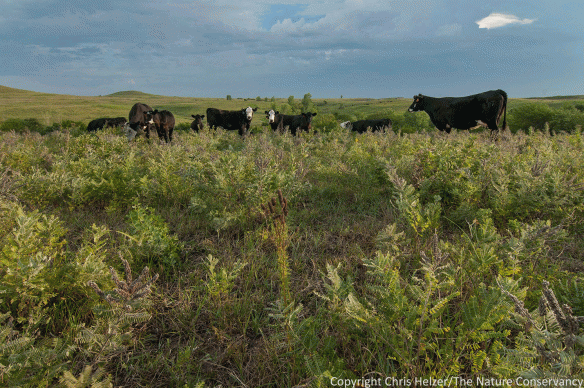
It’s probably easiest to think about a disturbance in a prairie as something that disrupts the lives and processes of prairie organisms and creates a shift in the competitive balance among those species.  Historically, the big three disturbances in grasslands were fire, grazing, and drought.  Fire and grazing are still used as management strategies today, along with mowing/haying and, sometimes, herbicide treatments.  Drought (and other significant weather events such as a flood) is not something managers prescribe or apply to a prairie, but it certainly has significant impacts.

Both “natural” disturbances and those prescribed by prairie managers are critically important to the health of prairies, despite the fact that they have significant impacts on species.  In fact, many animals, plants, and other organisms often die as a result of disturbances.  Prairies, however, more than most other ecosystems, are not only well suited to survive disturbances, they are defined by and rely on those disturbances.  Without fire and drought, for example, prairies wouldn’t even exist – they would be woodlands instead (and who wants that??).

Every time a fire burns through a prairie, grazers chomp off much of the vegetation, or an extended drought turns a prairie brown in mid-summer, the competitive balance in a prairie is altered.  Depending upon the timing and intensity of a fire, for example, it’s likely to kill some trees and “top-kill” others, forcing them to restart from buds at or below the surface of the ground.  Fires can also kill or suppress the growth of other plant species, especially those most actively growing at the time of the fire.  At the same time, fires create opportunities for other plants – especially those in direct competition with the ones suppressed or killed.  Plants that thrive best in full sunlight and don’t do well under layers of thatch or beneath tall plants also respond very favorably after a fire.

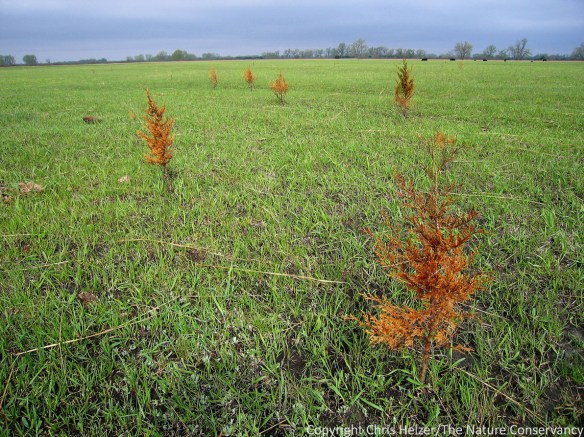
These cedar trees died in a recent fire, but the vegetation around them is regrowing strongly. In fact, the cattle (in the distance to the top right) in this prairie will be attracted to that growth and graze this part of the prairie much harder than unburned parts.

These cedar trees died in a recent fire, but the vegetation around them is regrowing strongly. In fact, the cattle (in the distance to the top right) in this prairie will be attracted to that growth and graze this part of the prairie much harder than unburned parts – adding a second disturbance to the first.

Of course, fires can also kill or injure wildlife or insect species (not to mention microorganisms and other life forms) that are aboveground at the time of the fire and can’t evade the heat and/or smoke.  The season in which a fire burns plays a big role in which organisms are affected.  Dormant season fires can kill insects and other species that overwinter in vegetation or along the surface of the ground, but growing season fires cause even more fatalities because so many more species are active during that time of year.  Even animals that survive the fire itself may have to travel to unburned areas in order to find suitable habitat, and those trips can be hazardous as well.

Despite the immediate negative impacts of fire on individual insects, wildlife, and other species, however, periodic fire usually has longer-term benefits – even for those species that suffer fatalities.  Without fire – or some other disturbance that removes vegetation – prairies can become so overgrown that most species can’t survive there.  Suffocating layers of thatch, encroachment by trees and shrubs, and the potential for diseases and predator populations to build up over time are all conditions that can be found in prairies that go undisturbed for long periods of time.  In addition, if the same habitat and growing conditions prevail year after year in a particular patch of prairie, some species will thrive but others will not – leading to a loss of species diversity and overall prairie health.

Without going into details here, the impacts of drought and grazing on prairie species are similar to those of fire – each event will favor some species over others.  Prairie plants are well adapted to periodic burning, grazing, or drought.  Perennial plants have numerous buds at their base, from which they can grow new shoots after they’ve been burned or cropped off, and most can enter dormancy during a severe drought in order to conserve resources for better days.  Shorter-lived plants often rely on disturbances to create opportunities for them to grow with less competition from nearby perennials.  Those annual and biennial plants produce copious amounts of seed that fall to the ground and wait until the next time conditions favor their germination and growth.

Every vertebrate and invertebrate animal species relies on a particular set of habitat conditions.  Some thrive when vegetation is short and sparse, and others prefer tall dense vegetation.  The highest diversity of animals and insects is usually found where perennial plants have been recently weakened by fire, grazing, and/or drought, and short-lived plants are thriving while those perennials recover.  In any case, habitat conditions are tied to disturbances – some conditions are created during or in response to a disturbance, and others (tall dense vegetation) are created when a disturbance hasn’t occurred for a while.

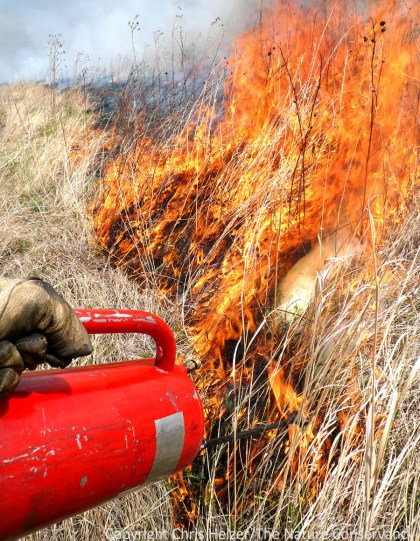
Prescribed fire, along the grazing and mowing, are important ways for prairie managers to introduce disturbances into grasslands in order to maintain prairie health and biological diversity.

Prescribed fire, along the grazing and mowing, are important ways for prairie managers to introduce disturbances into grasslands in order to maintain prairie health and biological diversity.

As prairie managers, our job is to provide habitat and growing conditions for as many prairie species as possible.  We burn, graze, and mow prairies at prescribed intervals (and usually in patches, rather than across an entire prairie) in order to maintain a competitive environment in which all those prairie species can survive.  Whenever we burn a prairie or introduce large grazers to it, we know that some species will be harmed by that action, but that others will flourish because of it.  As long as we allow a patch of prairie to recover between disturbances and create a patchwork of habitats (some recently disturbed and others not), the prairie community will remain diverse and resilient.

Prairie management is complicated, and it can be difficult to make decisions and take actions that you know are going to negatively impact some species.  On the other hand, the other choice is to do nothing.

And that would be disturbing.

How did everything work this year?

This is one of my favorite times of year.  It’s not the cool temperatures, the fall colors, or even the fall migrations of birds and insects coming through.  Instead, I like this time of year because it’s time to figure out how this year’s prairie management worked and start planning for next year.  Closing that adaptive management loop (gleaning lessons from one field season and applying them to the next) is really fulfilling for me.  I get to learn something and then put it right to use.  The only downside is waiting another year to see how things turn out again!

Northern bobwhite on fence post. Helzer family prairie near Stockham, Nebraska.

This northern bobwhite was calling from a fence post along the edge of our prairie earlier this summer.  Bobwhite are abundant in our prairie, probably because of the wide variety of habitat types available.

Earlier this week, I walked through our family prairie and tried to capture the results of 2015.  I wasn’t collecting data.  Instead, I took a few photos, wrote a few notes, and looked back at some photos and notes from earlier in the season.  I mainly tried to measure what I saw against the basic habitat objectives we have for our prairie.

Helzer Prairie Habitat Objectives

1) HABITAT HETEROGENEITY.  Provide patches of habitat that cover the spectrum from short/sparse to tall/dense vegetation, with areas of mixed-height structure in between.

2) PLANT DIVERSITY.  Increase plant diversity over time by allowing all plant species a chance to bloom and reproduce every few years, and periodically suppressing grass dominance to allow wildflowers a chance to maintain or expand their “territories”.

In general, I was pretty happy with what I saw this week.  There was definitely a wide range of habitat structure across the prairie.  We began the season by grazing most of the prairie pretty hard to knock back the vigor of smooth brome.  After that, we put the cattle into about 1/4 of the prairie for the month of June and then gradually gave them access to more of the prairie as the season progressed until they were grazing about 3/4 of the site by September.

Helzer prairie grazing. Pasture #2 se of water tank

This photo from earlier this week shows the contrast between the area in the foreground that hasn’t been grazed since May and the background where cattle have been grazing since late July.

Helzer prairie grazing. Pasture #1 nw of water tank

Some of the areas opened up to grazing late in the season weren’t grazed very hard because the grass was pretty mature by the time cattle came in.  However, the cattle did graze in patches, and also knocked down the vegetation as they walked around – altering the habitat and making it easier for both wildlife and people to walk through.

The grasses in the 1/4 of the prairie we grazed in June stayed short all season, and many of the wildflowers were also cropped off.  However, some of those wildflowers had a chance to grow back as we spread the cattle out across a larger area and they became more selective about what they ate.  Other plants went ungrazed, or only lightly grazed, all season.  As a result, the habitat structure was a mixture of short grasses and medium to tall forbs.  In July, I found a family of upland sandpipers feeding in that part of the prairie – their still-flightless chick searched for insects in the short grass while staying near the protective cover of the taller forbs.

Young upland sandpiper. Helzer family prairie. Stockham, Nebraska. USA

This young upland sandpiper and its parents were enjoying a part of the prairie where cattle had been grazing most of the season, keeping grasses short but allowing some forbs to grow tall.  The chick could feed in the open but remain close to protective cover.

Elsewhere in the prairie, the height and density of the vegetation varied by how much grazing pressure it received.  Areas that were rested much of the year were dominated by tall warm-season grasses, while areas grazed from July through September had much shorter vegetation.  Despite the fact that we’re still trying to boost plant diversity across the site (which consists of small prairie remnants surrounded by former cropland planted to grasses by my grandfather in the early 1960’s) there were good numbers of wildflowers blooming through the whole season.  In the more intensively-grazed portions, only a few species such as hoary vervain (Verbena stricta), ironweed (Vernonia baldwinii), goldenrods (Solidago sp.), native thistles (Cirsium sp.), and other species panned by cattle were flowering.  However, there were many other wildflowers blooming across the rest of the site, including purple prairie clover (Dalea purpurea), leadplant (Amorpha canescens), stiff sunflower (Helianthus pauciflorus), several milkweed species (Asclepias sp.), and many others.  The most abundant wildflowers were found in the portions of the prairie the cattle had grazed intensively in 2014 – grass vigor was still suppressed in those areas, allowing both “weedy” and “non-weedy” forbs to flourish.

Regal fritillary butterfly on milkweed at Helzer prairie, south of Aurora, Nebraska.

Regal fritillaries and other butterflies are common in our prairie. I photographed this one a few years ago as it was feeding on common milkweed in part of the prairie was only lightly grazed that year.

During 2015, just about any animal species should have been able to find what they needed in our 100 acre prairie.  Regal fritillaries had violets for their caterpillars and monarch butterflies had milkweed for theirs – and both found abundant nectar plants, including in the most intensively-grazed areas.  The varied vegetation structure supported a wide range of grassland nesting birds, including grasshopper sparrows, upland sandpipers, western meadowlarks, northern bobwhites, dickcissels, sedge wrens, and others.  Small mammal trails were abundant, as were burrows of the badgers and coyotes that hunt those mice, voles, and ground squirrels.  Best of all, there were myriad bees, grasshoppers, katydids, prairie cicadas, spiders, and countless other invertebrates doing their jobs to support and nourish the plant and wildlife communities.

I haven’t yet worked out all the details of next year’s management plans, but I know a few things.  The portions of the prairie that were grazed hardest this year will be rested for most or all of next season.  We’ll likely bump the cattle stocking rate up a little because of this year’s abundant rainfall and strong grass growth.  I’ll try to make sure cattle have early summer access to the areas where I saw lots of first-year sweet clover plants this year – grazing those areas will greatly reduce flowering and seed production.  Finally, I’m thinking about letting the cattle stomp around for a week or two in one of the wet areas they’re normally excluded from because the vegetation is getting excessively thick there.

I’ll meet with my grazing lessee (the guy who owns the cattle) in late fall or early winter.  Between now and then, I’ll likely change my mind several times about some of my plans and come up with some new ones.  Next season we’ll make adjustments on the fly as we see what happens with rainfall, grazing behavior, invasive species, and all the other factors that influence management decisions.  Then, about this time next year, I’ll be walking around the prairie, trying to interpret the results of all those ideas and adjustments.

…and I’ll be having just as much fun as I am now.