Butterfly Aggression

We started seeing our first regal fritillary butterflies of the season last week, and began our second year of data collection on their habitat use in the Platte River Prairies.  As always, male fritillaries have emerged first and now have to wait a couple more weeks before females arrive on the scene.  In the meantime, they do some nectaring, but mostly seem to just fly around.  They look like a bunch of teenage boys who arrived at the school dance before the girls…

A regal fritillary butterfly seen last week in the Platte River Prairies, Nebraska.

The above regal fritillary was nectaring on a plant that will remain a mystery until my next post (sorry).  I was expecting to see them nectaring on common and showy milkweeds (Asclepias syriaca and A. speciosa) because those plants were just starting to bloom.  In some studies of regal fritillaries, milkweeds are major nectar plants.  Last year we saw regal fritillaries using hoary vervain (Verbena stricta) more than anything else, but I didn’t see a lot of milkweed blooming last year – for some reason.  This year, I figured maybe we’d see something different since milkweeds seem to be having a good year.

As I walked around checking milkweed flowers for butterflies, I saw a number of insect species using them, but none more abundant than the gray copper butterfly.  In fact, I saw one flower that had six coppers on it at the same time.

A gray copper butterfly on showy milkweed. The Nature Conservancy's Platte River Prairies, Nebraska.

I did see a few regal fritillaries nectaring on milkweeds, but surprisingly few, given the high numbers of both fritillaries and milkweeds I was seeing.  Eventually, I decided to just sit for a few minutes in front of one milkweed plant to watch the gray copper butterfly that was nectaring on it.  I figured I’d get to see a parade of other insects come by and nectar there as well.

I saw a fritillary making its way toward the flower and got my camera ready so that I could capture both the fritillary and the copper on the same flower.  However, when the fritillary got within a few feet of the flower, the copper suddenly erupted off the flower and flew straight at the fritillary, chasing it like a small bird chases a hawk.  The fritillary swerved off and sped away.  I saw the same thing happen twice more within the next several minutes.
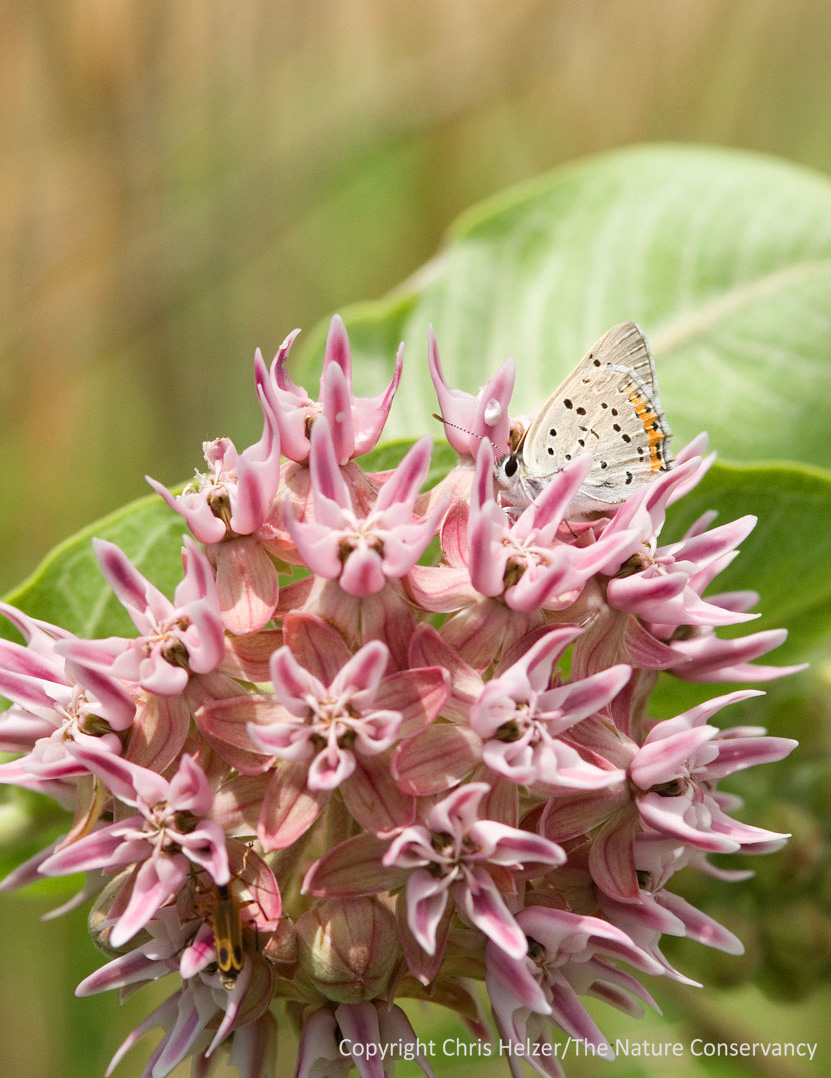
What looks like a peaceful scene with a pretty butterfly nectaring on a flower belies the bottled up aggression waiting to boil over when another butterfly strays too close...

Throughout the day, I saw the same aggressive behavior by coppers on other milkweeds as well.  It’s hard to say, of course, whether the coppers were really protecting their nectar source, but that’s what it looked like to me.  There has been considerable discussion in the scientific literature about whether or not male butterflies (of some species) defend territories like birds do – keeping other males away.  There seems to be consensus that at least a few species do.

What I was seeing, though, was not mating territory defense.  Assuming that coppers can recognize the difference between their own and other butterfly species, they didn’t appear to be chasing away potential competitors for mates.  Instead, they appeared to be monopolizing a valuable food source.  Even when there were multiple milkweed flowers on a plant, or several plants in a clump, coppers successfully chased fritillaries away as they approached.  Interestingly, while coppers wouldn’t tolerate fritillaries, they didnm’t seem to mind sharing flowers with other coppers…  There weren’t many individuals of other butterfly species around, so I didn’t get a good feel for whether coppers chased away all other butterflies or just fritillaries.

I’ve not seen or heard of this kind of behavior before, but I’m sure other people have.  I’d sure appreciate hearing from you if you know anything about it.

Aggressive butterflies… who’d have thought?

Prairie Seed Dispersal

Plants don’t have the ability to walk or fly, but many can send their seeds far out into the world.  Some seeds have the capability to travel very long distances, giving plants the opportunity to colonize new places.

There are few seeds more familiar to prairie hikers than milkweed seeds.

In reality, most seeds don’t travel far from their parent plant.  If you’ve ever come across a milkweed plant with recently-opened pods, you’ve seen that the ground around the plant is often covered with milkweed seeds – even though milkweed seeds have the capability to ride the wind.  While it might seem like failure, dropping a high percentage of its seeds probably makes a lot of sense.  If the plant is able to grow and produce seeds, its current location must be suitable habitat.

Although most apples don’t fall far from the tree, so to speak, some percentage of a plant’s seeds often do travel to new sites – sometimes many miles from their starting place.  Once those seeds land, the challenges are just beginning.  The vast majority of seeds never germinate and become new plants because to do so it must end up somewhere that provides just the right conditions.  The odds are very high against a seed landing in a place where there is bare soil for germination, available root and light space to grow, and suitable habitat for survival.  However, having a few seeds that do manage to establish new populations is so important to the survival of the species, plants invest a lot of resources in this high risk strategy.  Read more about the ecology of seed dispersal in an detailed article by Henry Howe and Judith Smallwood.

Prairie plants have developed an incredible array of seed transport mechanisms.  Seeds can be carried by animals, wind, and water, and each has special physical characteristics that help it travel.

Prairie wild rose fruit in cross-section, showing the hard seeds inside.

Some plants wrap large hard seeds inside fruits that animals like to eat.  When the fruit is eaten, the seeds travel through the animal’s digestive system and out the back end – usually some distance from the parent plant.  Prairie wild rose hips, for example, are a food bonanza for a number of wildlife species.  Besides being tasty and rich in Vitamin C and other nutrients, they are also available during the late fall and winter when it can be difficult for animals to find other food.  Prairie grouse, turkeys, and many other species find them particularly attractive.  While the fruits are nutritious and provide value to the animal, the seeds inside the fruit are hard enough that they pass undigested through the animal and are deposited in a pile of fertilizer – giving potential new seedlings a jump start.

Violets produce seeds in pods that pop open when ripe, ejecting the seeds a short distance from the plant.  However, the seeds of violets are also attractive to ants, which transport them to their tunnels where they are often deposited in trash heaps where conditions are favorable for germination.  (For more on prairie ants, read James Trager’s excellent introduction)

Blue violet seeds.

Sandburs, and many other species, use animals to move their seeds but not because the seeds are particularly edible.  Instead, the plants use specialized spines, hooks, or other structures that get caught on animals as they pass by.  This sometimes allows the seeds to be carried many miles before they fall – or are scraped off.  Historically, bison were major carriers of seeds and often deposited them in wallows, where the bare soil may have helped provide for successful germination.

Sandburs are loaded with spines that help them hitch rides with any animal (or hiker) that happens by.

One of the most common strategies for seed dispersal by prairie plants is to employ the help of the nearly omnipresent wind.  A wide variety of species, including asters, goldenrods, milkweeds, thistles, wild lettuces, and many others, produce long feathery appendages, wings, or other structures that help catch the wind and carry seeds long distances.  Others simply produce seeds so small and light that they can easily be blown around.  While wind dispersal often carries seeds further than animals do, it is also the strategy that gives plants the least control over the final destination.  Animals are fairly likely to carry and drop seeds within the same habitat type, giving seeds at least some hope of finding good places to grow, but casting seeds to the wind is much riskier.

The last seed of a wild lettuce flower hangs on - until the next gust of wind happens by.

Seeds that grow in wetlands or wet prairies often build seeds that float and can be dispersed by moving water (or by wind blowing them across water bodies).  This seems like a logical strategy to help seeds move because it keeps them within the moist habitats they need for establishment.  Some water-dispersed seeds are simply so small that they don’t break through the surface tension of water.  Others have hairs or other structures that help them float.  Still others have hollow spaces that make them buoyant.

Wetland seeds floating on the water's surface.

Regardless of the particular strategy a plant species uses to disperse its seeds, prairie plants can benefit from the ability to transport seeds away from their parent.  Many perennial plants employ rhizomes or runners, in addition to seeds, to help start new plants short distances from the parent, and those reproductive stems help new plants establish because they have an “umbilical cord” of support from their parent.  However, that asexual reproduction doesn’t allow plants to move their progeny very far, and doesn’t involve cross-pollination that can help a species maintain high genetic vigor.

For annual plants, seed production is the only strategy for movement and survival because the parent dies after a single season.  Because annuals only get one shot at flowering, they usually do so prolifically, and spread their seeds far and wide.  This helps them be prepared for any kind of disturbance (burrowing animals, intensive grazing, etc.) that creates bare ground or suppresses surrounding vegetation – the perfect conditions for annuals to grow and flower.

Whether seeds are transported by animals, wind, or water, they are built for the task.  Seed dispersal is one of my favorite discussion topics during prairie hikes because people of all ages can appreciate the amazing strategies plants have developed to move their seeds around the landscape.  In fact, it’s such an interesting subject, it’s easy to get carried away…

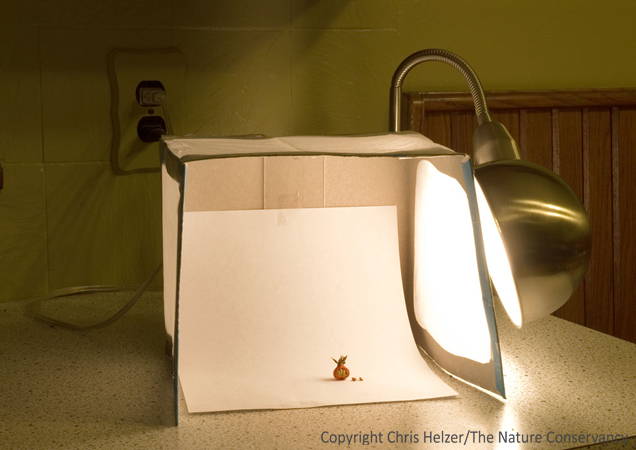
Behind the photos – several of the photos in this post were taken in a simple homemade photo studio made from a cardboard box, tissue paper and a desk lamp.

A homemade photo studio – cardboard box, tissue paper, and a desk lamp.