
Most of you are familiar with the wildfire that affected our Niobrara Valley Preserve this summer. Well, we’re still trying to regain our footing after that event. A great deal of time and money has already been spent on rebuilding and redesigning infrastructure (especially fences), but there’s still much to do. In addition, the staff of the Preserve, along with a few of us from around the state, has taken this opportunity to do some deep thinking about what the Preserve can be in the future. It’s an incredible place, and we want to be sure it lives up to its potential. I’ll share more about that process as the picture becomes more clear.
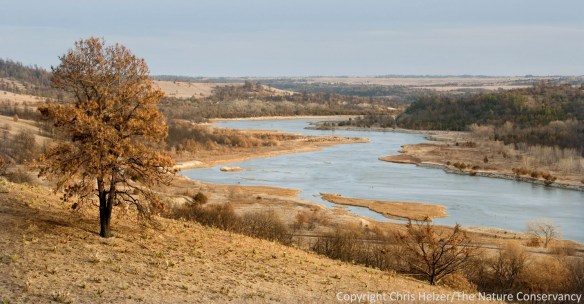
The Niobrara River continues to flow through the Preserve, but much of the landscape looks pretty different since the fire. Open grassy slopes such as this one will recover quickly, but more wooded areas will come back much more slowly.
In the meantime, we’re also trying to learn what we can from the 2012 wildfire so that we and others can be more prepared the next time something like this happens. I’ve been asked to help organize this effort, which is an intriguing task for me since most of our questions are about woodlands – not exactly my area of expertise. Fortunately, I’ve had some great advice from others, particularly Dr. Dave Wedin at the University of Nebraska, who is also generously helping us line up researchers and funding. Other advice has come from a wide spectrum of foresters, ecologists, and others, and I appreciate it all.
I was up at the Preserve last week for another bison roundup (the west herd this time) and had some time to poke around in the hills and think about our current list of research ideas. I think we’re honing in on a few important research directions, but we still have some thinking to do about how to ask and answer the right questions. Since we’re at a good point to get feedback from others, I thought I’d lay out some of what we’re thinking and see if any of you have suggestions for us to consider. If nothing else, those of you who are familiar with the Preserve, and concerned about the impacts of the fire, can get an update on the situation and a feel for where we’re going next.

Yucca are starting to regrow across the burned portions of the Preserve. Many show signs of being browsed by deer and other wildlife – there’s not much else green out there!
.
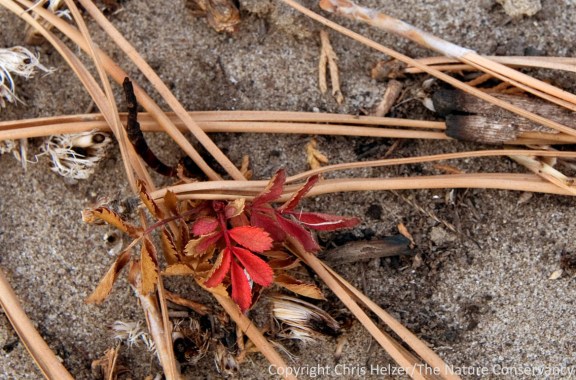
Wild rose is another of the plants regrowing in the burned areas. These and other perennials, including grasses, sedges, and wildflowers, are most abundant in open areas without dense stands of trees.
Our primary research objective is to learn lessons that will help us and others adapt our pre- and post-wildfire management in the future. It would certainly be interesting to simply document the way in which plant and animal communities recover from the fire, but that has been done elsewhere. With very limited resources, we’ll spend a little effort documenting how the Niobrara Valley Preserve recovers from the fire (including the use of time-lapse and other photography) but we want to focus most of our effort on learning things that we and others can actually use down the road.
Impacts of Tree Density
The first thing we want to know is how the density of eastern red cedar and ponderosa pine trees affected the way the fire burned and (more importantly) the way the areas beneath the trees will recover. In addition to the perennial plants that survived the fire, much of the future plant community in our former pine woodland will depend upon the seed bank (the collection of seeds sitting in the soil, ready to germinate when given the chance). Unfortunately, areas under dense tree stands are also the most vulnerable to soil erosion. Especially on steep slopes, wind and water erosion can quickly remove both seed and soil, leaving very little to support plant community recovery. Since there were few herbaceous (non-woody) plants under dense tree stands, there is little to hold the soil (and the precious seeds in it) from washing and blowing away. If seeds and soil go, it’s going to be a very long time before anything grows in those places.
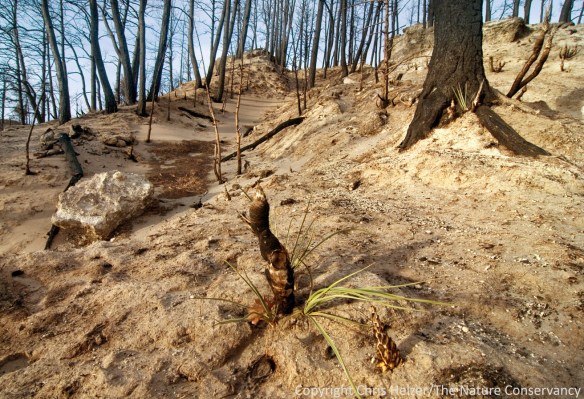
Soil erosion will probably be an issue on steep slopes and under formerly dense stands of trees.
We hope to correlate the amount of soil erosion with tree density and slope, and see how those factors affect plant community recovery. Ideally, we can combine our data with what others have learned elsewhere and develop recommendations for future management. We want to know how densely can we allow trees to grow before the site becomes vulnerable to severe erosion in the aftermath of a potential wildfire. Hopefully, that information can help managers decide how to prioritize tree thinning operations.
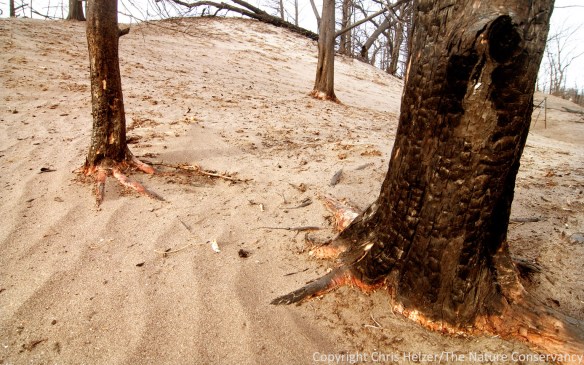
Much of the erosion that’s occurred so far appears to be wind erosion. A 70 mph wind storm really got sand moving in some areas.
On a related topic, we want to see how cedar and pine density affected the survival of bur oak trees. It’s clear that we’re going to have varying degrees of recovery among the oaks growing on the lower slopes of our pine woodlands. Some of the oaks have already re-sprouted from the base, but others haven’t. Those others are either completely dead or waiting to resume growth from the tips of their branches next year. What could we have done as land managers to prevent oak mortality by thinning the cedars and pines near those oaks?
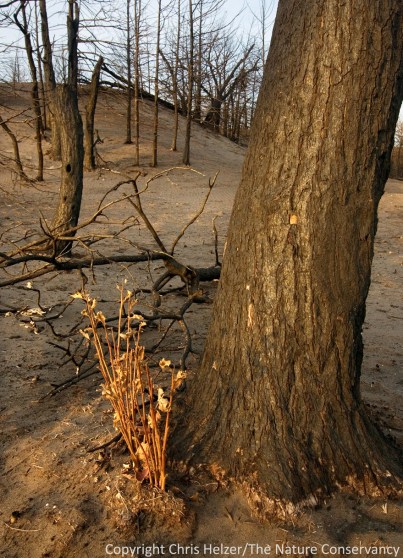
This oak is re-sprouting from the base – it’s still alive, but has to start it’s growth over from the ground.
Aiding Recovery
We also have questions about how best to manage the recovery of burned sites. Some people are advocating seeding burned areas to speed up the establishment of herbaceous and/or woody plants. There are numerous concerns about this, including what kind of seed would be used and whether or not it would actually make any difference. We certainly want to avoid introducing plant species that could cause more problems than they solve, but the bigger question is whether or not seeding will make a difference when the most problematic areas are those where soil erosion rates are high. Putting seed in those erodible areas probably won’t do much good. However, while we and most of our neighbors will probably not be doing large-scale seeding, we might consider a few small-scale trials to test the idea. We could broadcast seeds in a few trial plots and see if the plant community establishes differently within those plots than elsewhere.
Aside from any seeding efforts, the recovery of ponderosa pines in large swaths of burned woodland is likely going to be dependent upon seed coming from unburned areas. Because of the size of burned areas, that could take a very long time. Is it worth trying to speed up that recovery by planting small patches of ponderosa pines in various locations, with the idea that as they mature, those trees would be seed sources for nearby establishment – thus speeding overall woodland recovery?
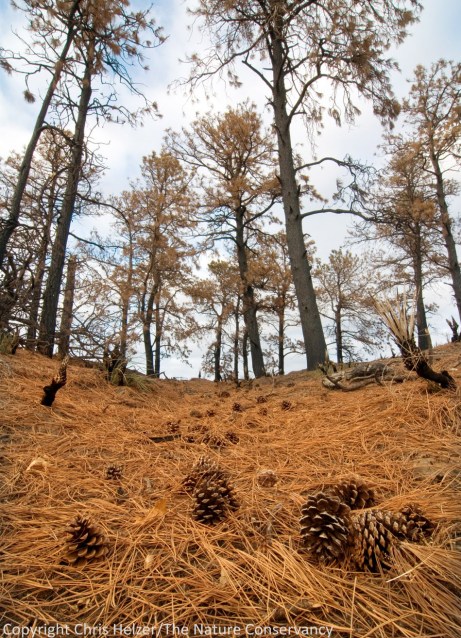
A few mature ponderosa pines may have survived along the very top of the ridge north of the river. If so, new pines may be able to spread from these pockets of survivors.
The answer to that question is related to another big question. How do we manage these burned woodlands over the next couple of decades – especially in terms of prescribed fire? At first glance, it might seem that we’ve had enough fire to last quite a while. On the other hand, prescribed fire might be pretty important to help prevent cedars from coming right back in, and to give us some control over the overall recovery trajectory. If we do employ prescribed fire, that’s going to impact where pines will be able to survive – including any we plant and those that come back on their own.

Not many pine cones can be found away from the very top of the ridge. A few isolated exceptions like this might produce a few trees, but future prescribed fires may not allow many of those to mature.
Grassland recovery from the wildfire comes with questions too. We have choices to make about whether to graze some of those drought and fire-stricken prairies immediately or to rest them for several months or longer first. In our bison pastures, bison are never removed, so grazing resumed immediately after the fire. We could build some exclosures to look at how immediate grazing impacts grassland production and species diversity. In addition, we can manage our cattle pastures in several different ways and measure the results. What we learn could help us and others make informed decisions after future wildfires.
The last big question we’re struggling with has to do with invasive species, especially in burned woodlands. I’m not sure yet how to formulate a research question on this topic because we don’t yet know what kinds of invasives we’ll be dealing with. Some plant species will be much quicker to colonize burned woodlands than others, but whether they will include truly invasive species – and which ones they might be – will be unknown until it happens. We may just have to be ready to react as quickly as possible when we see what happens, and try to learn from our experience as we attempt to contain any invasions that occur.

We don’t yet know what will be growing here in the coming years, but something will – and it will continue to be a beautiful and ecologically important place.
There are plenty of questions we could ask about the impacts of this wildfire. We’re hoping to focus on those that might be the most useful to us and others when dealing with future wildfires. We have our draft list, but would be happy to hear from anyone with suggestions of other questions we should consider or how we should prioritize among the questions we have. Thanks for your help and support!
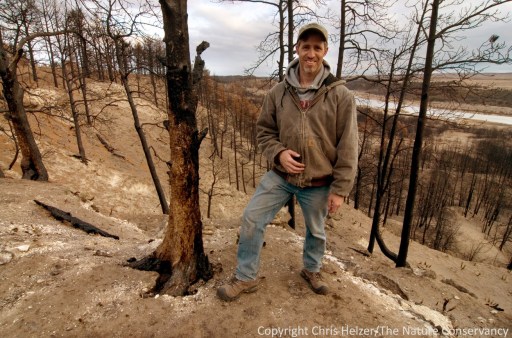
I’m smiling here, but as a prairie ecologist, I’m pretty far out of my element trying to help restore pine woodland.
If you’re interested in contributing toward the recovery of the Niobrara Valley Preserve, please click here.
.

 The Prairie Ecologist