Note: this post was slightly edited after initial publication to make it more accurate.
Migrating painted lady butterflies are stealing some of the attention from the annual monarch butterfly migration, at least here in Nebraska. Thousands upon thousands of painted ladies are fluttering around flowers and trees here in town, as well as out in nearby prairies and roadsides. It’s been a great opportunity for photographers like me, but those big numbers of butterflies also present a great opportunity to remind people that other insects besides monarch butterflies rely on long-distance migrations. Some of you will probably remember posts I wrote several years ago about moth migrations in North America and about longer intercontinental migrations of painted ladies and other species.

This painted lady butterfly was sharing this (native) tall thistle (Cirsium altissimum) blossom with a bee. Lincoln Creek Prairie, Aurora, Nebraska.
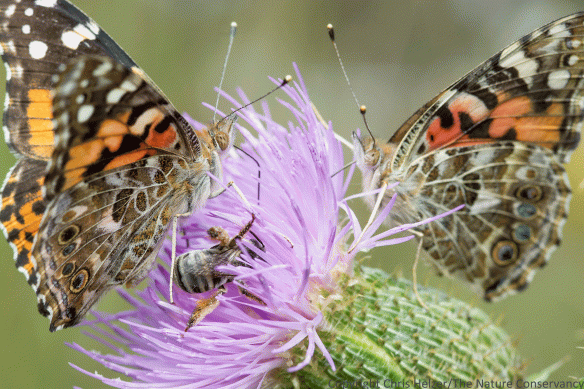
Right after I took the earlier photo, a second painted lady butterfly joined the first. These thistles are extraordinarily popular among pollinators this time of year.
There is still a tremendous amount to learn about insect migration, mostly because it’s difficult to study. Technological advances allow for the use of smaller and smaller transmitters that can be attached to some insects to help track them, but most studies of migration rely upon large coordinated reporting efforts by scientists and members of the public across wide geographic areas. To date, we know that many butterflies, moths, and dragonflies migrate, along with locusts (in Africa and the Middle East) and maybe some ladybird beetles. Many of those migrations are assisted by winds, but the insects use the winds to go where they want rather than just getting blown randomly around. Navigation and orientation strategies are still being explored, but it appears that some species use the sun to help orient themselves, and maybe even the earth’s magnetic field.

Back in September 2013, I photographed this migrating variegated meadowhawk dragonfly as it waited for the morning sun to dry it out enough to continue its southward journey.
Painted lady butterflies have migratory populations around the world (they are on every continent except Australia and Antarctica). In North America, populations are centered in the dry landscapes of the southwestern U.S. and northern Mexico. Migrations to the north and west occur frequently, but not consistently, and are strongest in years of abundant rainfall in those dry landscapes. Strong plant growth in the desert provides lots of food for painted ladies, allowing them to grow big populations that start to outstrip their food availability, and that pushes them to migrate. This year’s painted lady numbers in the Central U.S. appear to be some of the highest in recent years. Reports of very high numbers passing through Albuquerque, New Mexico and Las Vegas, Nevada provide clues about the possible origins of this year’s butterfly “outbreak.” (Thanks to Royce Bitzer for that information).

Painted lady on heath aster (Aster ericoides).
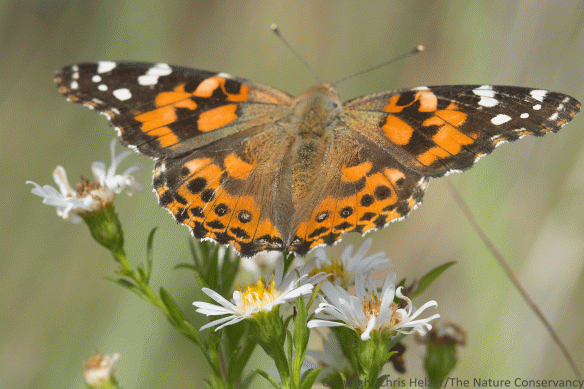
Sunning itself.
It’s fascinating to consider the idea that plant growth conditions (and probably other factors) in the desert southwest led to the hordes of painted lady butterflies we’re seeing right now in Nebraska and around the Central United States. As we learn more about insect migration, we’ll probably see more and more of these kinds of interrelationships between what happens in geographic locations that are very distant from each other.
We already know that many of the grassland nesting birds in Nebraska rely heavily on habitats in Central and South America, as well as on grasslands between here and there. Insect migrations are much less well understood, but monarch butterfly concerns have highlighted the fact that what happens in forests west of Mexico City impacts the butterflies we see in the Central U.S. – and vice versa. Imagine the other interconnections we’ll find as we discover more migratory species and the routes they take from place to place!
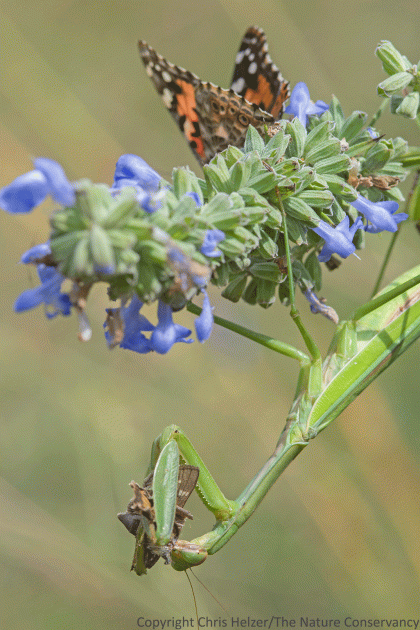
Danger lurks as a painted lady feeds right above a Chinese praying mantis which was finishing off a smaller butterfly (a skipper of some kind) this weekend.
I don’t have any idea what painted lady butterflies need for habitat between their desert southwest origins and Nebraska. Apparently, they’re finding what they need for now, but it’s a little disconcerting not to better understand what factors could lead to a collapse of that migratory process in the future. Painted ladies are really common right now, so understanding those factors might not seem particularly urgent, but how many of us would have predicted the current calamity facing monarch butterflies just a few decades ago? Hopefully, researchers and their citizen scientist partners can start figuring some of this out before we start seeing populations of migratory butterflies, moths, and dragonflies start to decline because of something we just didn’t realize might be important.

As I mentioned earlier, research on insect migration relies on coordination between many people, and across wide geographies. If you want to get involved, there are numerous options. To help collect data on dragonfly migration, check out the Xerces Society’s Migratory Dragonfly Partnership where you can learn how to identify and report sightings of migratory species. If you want to contribute sightings for monarchs, hummingbirds, whooping cranes or even gray whales, check out the Journey North website. Finally, if you want to learn more about the lives and migrations of painted ladies and their cousins the red admirals, visit Royce Bitzer’s excellent website.
In the meantime, if you live in part of the world where painted lady butterfly numbers are extraordinarily high right now, enjoy them while you can. As I write this, I’m following my own advice by gazing happily out my dining room window at the (literally) hundreds of butterflies I can see in my yard right now. I wasn’t able to travel to the desert to see the amazing colors during this spring’s wildflower season, but apparently some of that desert color traveled here instead!



 The Prairie Ecologist